The ongoing argument about the legitimacy of the death penalty recently made its way to the Supreme Court. In March, the high court heard oral arguments for death row inmate David L. Nelson, one of 15 condemned prisoners to challenge the legality of the lethal injection process in the last year.
The debate about whether capital punishment should be used at all has raged continuously since it was reinstituted in the United States in 1976. The latest statistics on the death penalty reveal that 71% of Americans favor it for individuals convicted of murder, while 26% oppose it. But recently, some of the focus has shifted to the question of how painless this mode of carrying out the death penalty really is. Nelson has joined a growing chorus calling execution by lethal injection "cruel and unusual punishment."
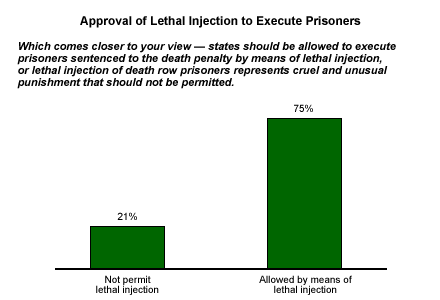
A Gallup Poll conducted at the time of the Nelson hearing* indicates that three-fourths (75%) of Americans agree that "states should be allowed to execute prisoners sentenced to the death penalty by means of lethal injection." Twenty-one percent said it should not be permitted because it is a form of cruel and unusual punishment.
Perhaps in an effort to find a less painful and more humane way to carry out the death sentence, lethal injection was first proposed as a means of execution in New York as early as 1888, but the state instead chose electrocution. Almost 100 years later, in 1977, lethal injection legislation was adopted in Oklahoma, but Texas was the first state to actually carry out an execution by lethal injection in 1982. Since that time, there have been 742 executions by lethal injection in the United States; it is currently the preferred method of putting prisoners to death in 37 of the 38 states that impose the death penalty.
For many years, capital punishment was carried out by firing squad, the gas chamber, the electric chair, hanging, or decapitation. In light of those methods, how can lethal injection be considered "cruel and unusual"? The argument is that human error during the lethal injection process can lead to problems, sometimes causing an extended period of time (up to 45 minutes) before the person dies. Such complaints have led at least one state (New Jersey) to review the entire process, effectively putting the death penalty on hold until the issue can be resolved.
A closer look reveals that there are varying levels of support among certain demographic and political groups:
- Women are less likely than men to support the use of lethal injection (70% vs. 82%).
- Nonwhites are much less likely than whites to support it (58% vs. 80%).
- Liberals are less likely to support it (57%) than conservatives (81%).
But regardless of whether it is possible to implement the death penalty in a completely painless and humane way, feelings about capital punishment -- and the demographic differences -- are probably driven less by the method of execution than by the philosophical issues that surround the death penalty itself. These demographic differences are also similar to what is found for basic support for the death penalty.
*Results are based on telephone interviews with 1,001 national adults, aged 18 and older, conducted March 26-28, 2004. For results based on the total sample of national adults, one can say with 95% confidence that the margin of sampling error is ±3 percentage points.
