Americans smoked 400 billion cigarettes in 2003, nearly 5% fewer than the year before and down 20% from a decade ago. State excise taxes are pushing sticker prices higher and regulation remains relentless. The litigation against Big Tobacco continues, as does the march toward smoke-free workplaces, restaurants, and bars. Recent Gallup polling confirms that the tobacco industry has passed its prime, but the smoking habit in America is far from extinguished.
Not Quite Kicking the Habit
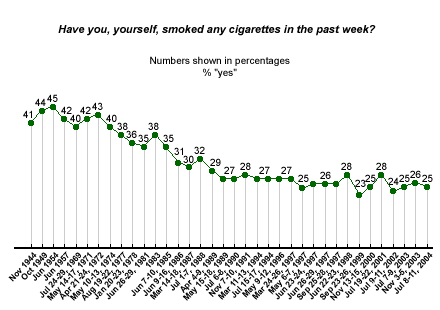
According to data from Gallup's 2004 Consumption Habits poll*, one in every four Americans smoke. In the time Gallup has been asking the question, the number of self-professed smokers peaked in 1954, when 45% of Americans said that they had smoked a cigarette in the last week. The percentage declined sharply over the next few decades and has stabilized at around 25% since the 1990s. Interestingly, the majority of smokers -- in the 80% range since 2000 -- report that they would like to give up smoking.
The Pack-a-Day Crowd
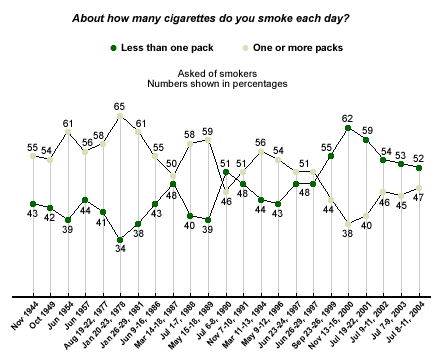
The number of smokers who smoke one pack or more a day was about 6 in 10 before the 1990s, and has consistently remained below 50% since 1999. The percentage of smokers who smoke "less than one pack a day" ranged from 34% to 48% from 1944 to 1989, and from 43% to 62% from 1990 to 2004. This percentage has consistently been above 50% since 1999.
According to Anishka Clarke, an alcohol and tobacco industry analyst at Standard & Poor's, the signing of the 1998 Master Settlement Agreement (in which the five largest U.S. tobacco manufacturers settled with 46 U.S. states and several U.S. territories for $206 billion) "heightened the public's awareness of the health hazards of smoking, as a significant portion of the annual settlement payments went toward public education and media awareness on smoking hazards." Clarke believes that the "effects of the MSA have contributed to the decline in cigarette smoking since 1998."
A More Forgiving Market Environment
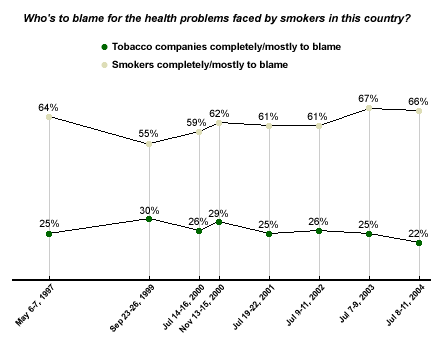
Gallup data reveal that Americans today are slightly more forgiving of Big Tobacco when it comes to assigning blame for the health problems that smokers face than they were about five years ago. In 1999 and 2000, about 30% of Americans believed tobacco companies were mostly or completely to blame for the health problems associated with smoking. By July 2004, that number had fallen to 22%. Dana Bolden, a media affairs representative at Philip Morris USA, believes that the Centers for Disease Control and Prevention's 2004 Report of the Surgeon General might explain this change. Bolden says that the report "includes some data that people are better educated about the health risks associated with smoking," suggesting that Americans might be more likely to believe that smokers know the risks of smoking and are responsible for their own health problems resulting from it.
Demographics of the Smokers' Market
Aggregated Gallup data from 2002 to 2004** reflect that cigarette consumption does not differ significantly by gender. Twenty-six percent of men smoke, as do 23% of women.
A key differentiating characteristic between smokers and nonsmokers is education. Nearly a third (32%) of people with a high school education or less smoke, compared with 20% of Americans with a college education. Income is also a factor -- 27% of those with annual household incomes below $50,000 smoke, compared with a smaller percentage -- 19% -- of those with annual incomes of $50,000 or more.
Bottom Line
Industry analysts predict that per-capita cigarette consumption will continue to decline between 1% to 3% annually. But Gallup data indicate that the number of smokers in the country has remained unchanged for almost a decade and that the decline in cigarette consumption over the past 10 years may result from smokers having cut down on the number of cigarettes they smoke, rather than kicking the habit.
And so it appears that the tobacco industry still has at least one thing going for it -- a stable core customer base. All things considered, the outlook for cigarette manufacturers -- regulation, excise taxes, and other travails aside -- could certainly be a lot worse.
*Results are based on telephone interviews with 1,005 national adults, aged 18 and older, conducted July 8-11, 2004. For results based on the total sample of national adults, one can say with 95% confidence that the margin of sampling error is ±3 percentage points.
For results based on the sample of 224 smokers, the maximum margin of sampling error is ±7 percentage points.
For results based on the sample of 781 nonsmokers, the maximum margin of sampling error is ±4 percentage points.
**Results are based on telephone interviews with 3,016 national adults, aged 18 and older, conducted in July 2002, July 2003, and July 2004.
For results based on the sample of 1,444 men and 1,571 women, the maximum margin of sampling error is ±3 percentage points.
For results based on the sample of 980 adults with a high school education or less, the maximum margin of sampling error is ±3 percentage points. For results based on the sample of 2,022 adults with at least some college education, the maximum margin of sampling error is ±2 percentage points.
For results based on the sample of 1,292 adults with annual household incomes of $50,000 or more, the maximum margin of sampling error is ±3 percentage points. For results based on the sample of 1,535 adults with annual household incomes of less than $50,000, the maximum margin of sampling error is ±3 percentage points.