Health experts advise people seeking to live long, healthy lives not to smoke, to watch their weight, not to drink too much, and to get regular exercise. So, do people who smoke cigarettes, weigh too much, drink alcohol, and rarely work out suffer from poorer health than others do? Gallup's annual survey on health and healthcare asks Americans to rate their physical health, and also asks them about their smoking habits, alcohol consumption, exercise routines, and personal weight descriptions.
To better understand the views of these different groups of people, Gallup looked at combined data from its past two health surveys in November 2003 and November 2004*. The overall results show that 32% of all Americans rate their physical health as excellent, while 49% rate it as good and 19% rate it as only fair or poor. Although most Americans in all groups describe their health as excellent or good, the data show some interesting differences based on the percentage rating their health as excellent.
Weight
Among people who say their weight is "about right," 43% rate their health as excellent; only 15% of people who say they are overweight rate their health as excellent. The overweight people also are more likely than people in the about right category to say their health is only fair or poor -- 25% vs. 15%, respectively.
People who say they are underweight are more likely than overweight people to rate their health as excellent, but roughly the same percentage of underweight and overweight people rate their health as "only fair or poor."
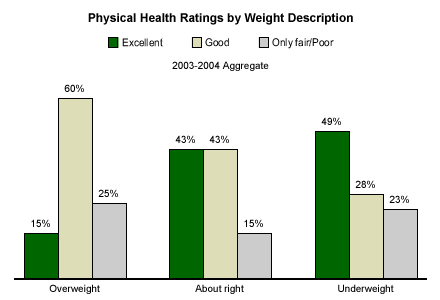
Those who say their weight is about right are more likely than overweight or underweight Americans to say they have experienced days over the past month in which their physical health was "not good." On average, Americans who say their weight is about right experienced 2.9 days of ill health in the past month, compared with 4.6 days of ill health for those who are overweight and 4.7 days for those who are underweight.
Exercise
Gallup's annual health survey asks Americans how many days per week they take part in "vigorous sports or physical activities for at least 20 minutes that cause large increases in breathing or heart rate" or in "moderate sports or recreational activities that cause slight increases in breathing or heart rate, such as walking, gardening, or other similar activities." The results are combined into four different categories in Gallup's exercise index:
- High: Adults who are involved with vigorous activities three to seven days a week
- Medium: Adults participating in vigorous physical activities one or two days a week
- Low: Adults rarely involved in vigorous activities but do partake in moderate activities three to seven days a week
- Sedentary: Adults who rarely participate in any vigorous or moderate activities
Americans who exercise frequently and vigorously are much more likely to rate their health as excellent than those working out less often. Among those who score high on the exercise index, 45% rate their physical health as excellent. This compares with 32% of those with a score of medium, 28% of those with a score of low, and 20% of those who can be considered sedentary.
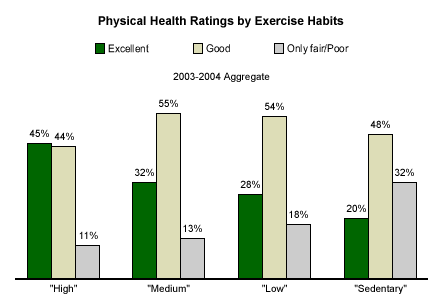
Those who score in the high or medium exercise ranges tend to experience fewer days of poor health in a given month than those who score in the low or sedentary range. Those in the high category report an average of 2.6 days of poor health, compared with 2.9 days in the medium category, 3.5 days in the low category, and 5.4 days in the sedentary category.
Smoking
Smokers are slightly less likely than nonsmokers to rate their physical health as excellent -- 25% vs. 34% respectively.
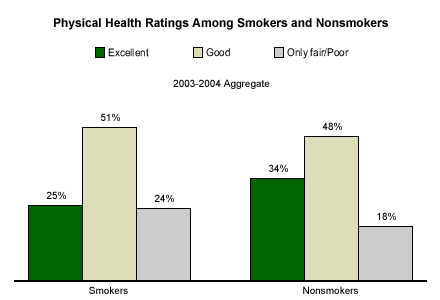
Similarly, smokers report more days of poor physical health over the past month (4.8 days) than nonsmokers (3.4 days).
Alcohol Consumption
Regular drinkers -- who drink at least once a week -- are more likely than infrequent drinkers to rate their health as excellent, and less likely to rate their health as either fair or poor. Forty percent of regular drinkers say their health is excellent, compared with 33% who drink only on special occasions and 21% who never drink.
A review of prior Gallup polling finds few differences in personal health ratings between those who drink in moderation (one to seven drinks per week), and those who drink a higher quantity of alcohol per week (eight or more drinks).
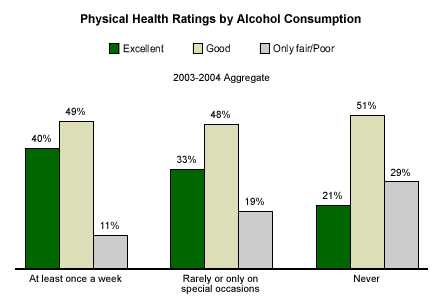
Similarly, regular drinkers report fewer days of ill health during a month than people who drink infrequently or not at all. The average days of poor physical health in a given month among weekly drinkers is 2.1, compared with 3.8 for infrequent drinkers and 5.4 for nondrinkers.
*Results are based on telephone interviews with 2,024 national adults, aged 18 and older, conducted Nov. 3-5, 2003, and Nov. 7-10, 2004. For results based on the total sample of national adults, one can say with 95% confidence that the maximum margin of sampling error is ±2 percentage points.