A recent study published in the Annals of Family Medicine finds that as many as 80% of medical errors chains can be traced back to miscommunication -- often breakdowns in communication between staff members.
One of the items in Gallup's "Q12" employee engagement survey underscores the importance of communication in preventing medical errors and increasing hospital safety. Gallup has found that hospitals whose employees give high scores to the item, "At work, my opinions seem to count," tend to have higher levels of safety and fewer medical errors than do other hospitals.
In consulting with hospital employees on this issue, I have found that if hospitals fail to value their staff members' opinions, then they will not feel empowered to speak up when they observe potential errors.
Do Healthcare Workers Overall Feel That Their Opinions Count?
An analysis of Gallup's Q12 database shows that, on average, healthcare organizations are not as good as organizations in other industries at making employees feel that their opinions count. In all years between 2001 and 2004, the mean scores on this question for healthcare organizations have been below those for all organizations combined, in both the 50th percentile (the level representing average employee engagement scores) and the 75th percentile (the level representing "best-practice" facilities when it comes to engagement) of the database.
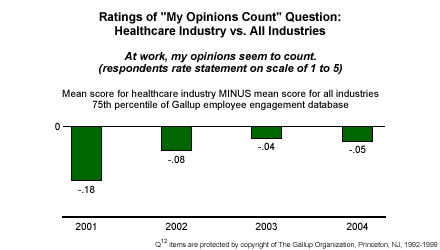
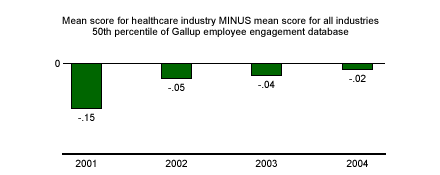
The good news is that healthcare organizations do seem to be closing the gap between themselves and other industries when it comes to valuing staff opinions. Both average and "best-practice" healthcare facilities improved significantly compared to Gallup's cross-industry employee engagement database between 2001 and 2002. However, this improvement is not evenly distributed. Improvement among average healthcare facilities has leveled off in recent years. Best-practice healthcare facilities, on the other hand, have continued to narrow the gap, and are scoring similarly to best-practice organizations in all industries overall in 2004.
Furthermore, it appears that there is also an achievement gap within healthcare facilities themselves. Employees of both 50th and 75th percentile healthcare facilities actually give higher percentages of "strongly agree" responses (5 on a scale of 1 to 5) on the "my opinions count" question than do employees in all industries overall. However, healthcare employees also give higher numbers of "strongly disagree" responses. In other words, the overall average masks the fact that some employees within each facility are very happy, while others are very unhappy, suggesting that improvement in this area is occurring in some parts of healthcare organizations but not others.
Bottom Line
Gallup has found that a key indicator in whether patients will return to a healthcare facility is patient trust that the facility can consistently deliver high-quality care. With large numbers of medical errors, healthcare facilities are falling short of this expectation. If even one staff member observes a medical error and feels comfortable enough to speak up about it, major problems can be avoided. For this reason, all healthcare organizations need to work on ensuring that every one of their employees feels confident that their opinions are valued. The alternative is not worth the risk.