Health authorities in developed nations around the world are making an increasingly determined effort to reduce the burgeoning waistlines among their citizenry. The U.S. Department of Agriculture (USDA) is rethinking its famous food pyramid (as it does every five years), preparing to release new guidelines in 2005. Globally, the World Health Organization (WHO) is focused on reducing worldwide obesity by encouraging countries to enact public policies and clinical guidelines promoting healthy diets and increased exercise.
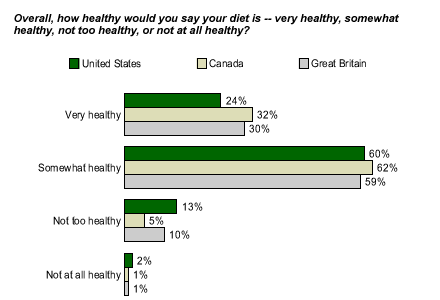
Recent Gallup polling in the United States, Canada, and Great Britain* suggests that adults in these three countries are neither overly enthusiastic nor highly critical about the healthiness of their diets. Only a quarter (24%) of Americans and about a third each of Canadians (32%) and Britons (30%) feel that their diets are "very healthy." Roughly 60% of residents in each country characterize their diets as "somewhat healthy." Fifteen percent of U.S. adults see their diets as either "not too healthy" or "not healthy at all," compared with 11% of Britons and just 6% of Canadians.
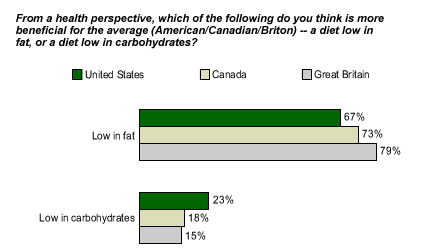
The low-carb dieting theory originated in the United States, when Dr. Robert Atkins introduced his "Diet Revolution" in 1972. But this strategy has gained immense popularity in the last few years, and low-carb products are now offered throughout the world, including Canada and Great Britain. The recent Gallup Polls also asked adults in each of the three countries which diet they think is more beneficial from a health perspective -- a low-carb diet or a low-fat diet. Significant majorities of people in each country feel that low-fat diets are more beneficial, although Americans are slightly more likely than Britons to feel that low-carb diets are the healthier option.
The USDA recommends that adults consume a varied diet that includes plenty of fruits and vegetables, whole grain cereals, lean meats, and low-fat dairy products, while avoiding high-sugar, high-fat, and high-salt foods.
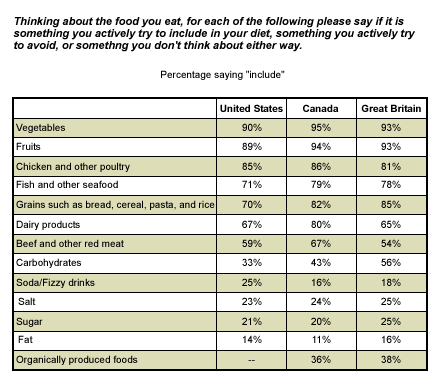
Which foods do American, Canadian, and British adults actively include in their diets? All three nationalities report including many traditionally healthful options -- such as fruits, vegetables, fish, and poultry -- in their diets, but carbohydrates fall relatively low on the list of actively included foods, especially in the United States. Only 33% of Americans, 43% of Canadians, and 56% of Britons say they actively include carbohydrates in their diets. Canadians are substantially more likely than either Britons or Americans to say they actively include dairy products.
Bottom Line
A recent WHO report found that more than 1 billion people worldwide are overweight and more than 300 million are clinically obese. Forty-four percent of Americans, 39% of Canadians, and 36% of Britons see themselves as either somewhat or very overweight.
The WHO has examined the sources of the alarming obesity epidemic and has concluded that several factors -- including declining physical activity in urban societies and increased use of automated travel and technology -- are at work. But another obvious factor is deteriorating diet. In all three countries that Gallup measured, 15% or less of adults classify their diets as unhealthy, but more than a third in each country feel that they are overweight. Adults in these countries, especially those struggling with weight, may need to re-evaluate what they consider "healthy" eating habits.
*Results in the United States are based on telephone interviews with 1,022 national adults, aged 18 and older, conducted Sept. 13-15, 2004; 1,005 national adults, aged 18 and older, conducted July 8-11, 2004; 2,250 national adults, aged 18 and older, conducted June 9-30, 2004; and 1,000 national adults, aged 18 and older, conducted May 2-4, 2004. For results based on the total sample of national adults, one can say with 95% confidence that the maximum margin of sampling error is ±3 percentage points. The survey was conducted by Gallup USA.
Results in Canada are based on telephone interviews with 1,005 national adults, aged 18 and older, conducted Aug. 30-Sept. 6, 2004. For results based on the total sample of national adults, one can say with 95% confidence that the maximum margin of sampling error is ±3 percentage points. The survey was conducted by Gallup Canada.
Results in Great Britain are based on telephone interviews with 1,009 national adults, aged 18 and older, conducted Aug. 25-Sept. 7, 2004. For results based on the total sample of national adults, one can say with 95% confidence that the maximum margin of sampling error is ±5 percentage points. The survey was conducted by Gallup UK.
In addition to sampling error, question wording and practical difficulties in conducting surveys can introduce error or bias into the findings of public opinion polls.