The issue of the government's role in stem cell research has found its way into the political spotlight this election year, grabbing airtime in the presidential debates, energized by compelling champions on each side: Christopher Reeve and Pope John Paul II. Until his recent death, Reeve was a vocal proponent of lowering barriers to stem cell research, while the pope vocally opposed the practice.
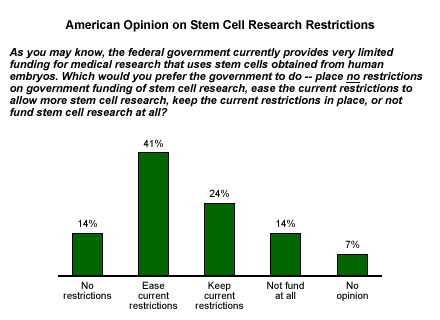
Gallup recently asked Americans what role they would like the federal government to play in the funding of stem cell research. In a survey completed on Oct. 10* -- the day of Reeve's death but before its announcement in the national media -- a plurality of Americans (41%) say that they would prefer the government to ease current restrictions on embryonic stem cell research, while a quarter (24%) would like to keep those restrictions in place. Similarly small percentages of Americans choose the two most extreme positions on the issue, with 14% preferring no government funding of stem cell research, and 14% preferring that no restrictions be placed on its funding.
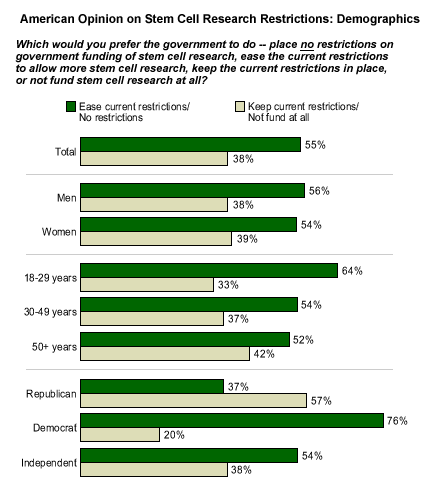
Americans' positions on government funding for stem cell research are clearly partisan. A majority of Democrats (76%) would like to see the government ease restrictions or do away with them to allow more stem cell research, while only 12% would like to keep the current restrictions in place (8% of Democrats would not want to fund research at all). Republicans, on the other hand, are more divided between those who would like to expand the research and those who would like to keep restrictions in place (37% vs. 36%).
The Candidates' Stances
In July 2004, the U.S. Department of Health and Human Services issued a press release expressing President George W. Bush's position on limiting stem cell research. The release states, "The President is committed to pursuing stem cell research without crossing a fundamental moral line by providing taxpayer funding that would sanction or encourage further destruction of human embryos."
Sen. John Kerry's Web site expounds his position for lifting current restrictions, saying that a Kerry/Edwards administration "…will lift the ideologically driven restrictions on stem cell research that are impeding progress toward cures for millions of Americans suffering from debilitating diseases …Without federal funding, the nation's top researchers at universities, medical schools, and teaching hospitals cannot be part of the work to find new cures and treatments."
Bottom Line
What impact will the issue of stem cell research have on the presidential election? In this same survey, Americans were asked which candidate they felt would do a better job of handling the issue of stem cell research. Kerry enjoys a 20-point advantage over Bush, 53% vs. 33%.
*These results are based on telephone interviews with a randomly selected national sample of 1,015 adults, aged 18 and older, conducted Oct. 9-10, 2004. For results based on this sample, one can say with 95% confidence that the maximum error attributable to sampling and other random effects is ±3 percentage points. In addition to sampling error, question wording and practical difficulties in conducting surveys can introduce error or bias into the findings of public opinion polls.