On Nov. 30, the U.S. Army Court of Criminal Appeals overturned the conviction of Army Spc. Kenneth Bullock, who engaged in consensual sodomy with a woman in a military barracks. In its decision, the appeals court cited Lawrence v. Texas, a July 2003 U.S. Supreme Court ruling that found a Texas anti-sodomy law unconstitutional. Although the United States v. Bullock decision is not related to the "don't ask, don't tell" policy, which allows gays and lesbians to serve in the military as long as they don't disclose their sexuality, some believe that the decision could lay the groundwork for the Pentagon abandoning the policy.
How do Americans feel about gays in the military? After the Clinton administration enacted "don't ask, don't tell" in 1993, an NBC/Wall Street Journal poll showed 40% of Americans favored allowing openly gay men and lesbians to serve in the military, while 52% opposed it. A Gallup Poll on the same subject 11 years later finds public opinion much changed. A Nov. 19-21 CNN/USA Today/Gallup poll* asked Americans the same question the NBC/Wall Street Journal asked 1993: "Do you favor or oppose allowing openly gay men and lesbian women to serve in the military?" Sixty-three percent of Americans favor allowing openly gay people to serve in the military, and about a third (32%) oppose it.
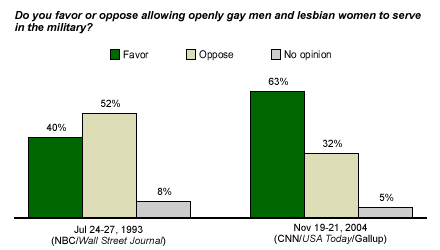
Since 1994, polling organizations including Gallup have found consistent majority support for allowing gays to serve in the military. The level of support does vary though, likely because of the way the question is phrased. The current results fall in the middle range of support.
Liberals, Women Most Likely to Support Gays in Military
There are some wide demographic variations in support for gays in the military. For example, 83% of self-identified liberals and 72% of moderates favor allowing gays to serve in the military, while less than half (46%) of self-identified conservatives agree. Three-fourths (73%) of people who rarely attend church support gays in the military, compared with about half (49%) of weekly attendees.
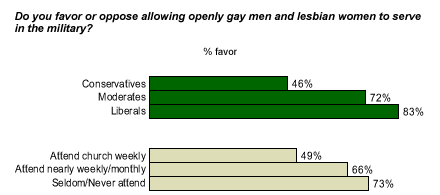
Women are also somewhat more likely than men to favor allowing openly gay people in the military; 69% of women favor it, compared with 57% of men.
Bottom Line
There is some question as to whether the recent United States v. Bullock decision will actually lead to the abolition of "don't ask, don't tell" and allow openly gay men and women in the military. Diane H. Mazur, a professor at the Levin College of Law at the University of Florida, was quoted in a Dec. 13 New York Times article as saying that the decision will lead to the "eventual demise of 'don't ask don't tell.'" But Eugene R. Fidell, who teaches military justice at Harvard Law School, ventures only so far as to say, "The effect on 'don't ask, don't tell' will be indirect."
Regardless of what current military law says, and despite more minimal support for other gay rights issues such as gay marriage (see "Gay Rights: U.S. More Conservative Than Britain, Canada" in Related Items), a clear majority of Americans support the right of openly gay people to serve in the military. It seems inevitable that military law will yield to the public's will at some point in the near future.
*Results are based on telephone interviews with 1,015 national adults, aged 18 and older, conducted Nov. 19-21, 2004. For results based on the total sample of national adults, one can say with 95% confidence that the maximum margin of sampling error is ±3 percentage points.
