When patients visit the emergency room, it goes without saying that they expect fast service. But "fast" is a relative term, especially among patients in different age groups. When it comes to satisfaction with the emergency department, there is a generation gap.
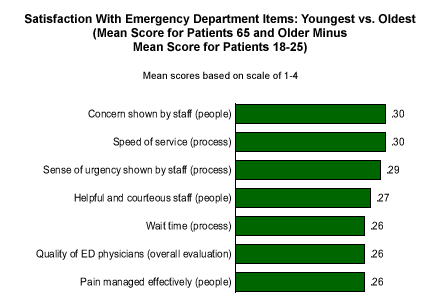
Looking at the core items Gallup uses to measure patients' satisfaction with the emergency department, the youngest adult patients (aged 18 to 25) rate every single item substantially lower than do the oldest patients (aged 65 and older). When the mean scores for all the core items are averaged together, 18- to 25-year-olds score significantly below 65+ year-olds.
The Biggest Differentiators Between Younger and Older Patients
The seven core emergency department items that most differentiate the youngest and oldest patients cover the gamut of emergency department services. Three of the questions are "process" items (relating primarily to hospital operations), three are "people" items (relating primarily to human interactions), and one -- quality of emergency department physicians -- is considered an overall evaluation item. Younger patients appear to be generally less pleased with everything.
The Role of Expectations
It's easy to see why younger patients would be more demanding from a process perspective. People between the ages of 18 and 25 came of age in an era of fast food and high-speed Internet service. Many of them see the ideal emergency department as a "McMergency Room," demanding service fast and with a smile. They see emergency department operations through computer-literate, systems-oriented eyes -- but many emergency department systems are still comparatively primitive and inefficient. Older patients, on the other hand, are more accustomed to waiting for services and tend to be less judgmental about delays.
Younger patients and older patients also tend to have different perspectives on interacting with people. Younger patients are less formal about relationships. They may view a formal, business-like employee as lacking compassion or concern, while older patients may expect more formal interactions.
Bottom Line
If emergency department staff members treat all patients the same, they will risk alienating either the young or the old. Instead, employees must adjust to the diverse expectations of different age groups. When it comes to the youngest patients, hospitals may want to consider how their emergency department stacks up to the fast, friendly service at the nearest fast food franchise.