The emergency department is the toughest healthcare environment in which to achieve high patient satisfaction. Complaints about the speed of service and operational processes are common. In such a stressful environment, it may make all the difference to patients simply whether staff members are nice to them. Is this basic expectation being met?
Data from Gallup's 2001-2003 healthcare databases include thousands of patient ratings of the "caring and compassion" of both ER doctors and nurses. Despite the much-publicized operational challenges America's emergency departments have been dealing with over the past few years, and the subsequent obstacles ER doctors and nurses face, satisfaction with the care and compassion of both doctors and nurses remained stable between 2001 and 2003. In each of the three years, nurses received higher mean scores than doctors on the caring and compassion question. In 2003, nurses received a score of 3.42 (on a 1-to-4 scale) for care and compassion, while doctors scored 3.32.
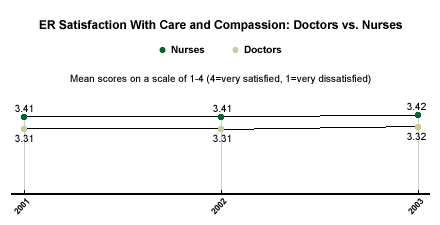
Mean scores are a good indication of general satisfaction levels. But Gallup research has shown that the most predictive gaps (namely, those that best determine those who will return to the hospital from those who won't) are between patients who give ratings of "very satisfied" and all other patients (those giving ratings of "satisfied," "somewhat dissatisfied," and "very dissatisfied"). Therefore it is helpful to examine the percentage of patients giving "very satisfied" ratings to the care and compassion of nurses and doctors.
Regarding both nurses and doctors, about half of patients say they are very satisfied with the care and compassion shown. As with the mean scores, nurses outscore doctors, but only slightly (by 51% to 48% in 2003).
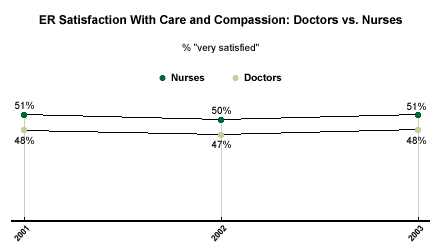
What do these findings tell us? First, regardless of how the data are examined, patients see ER nurses as more caring and compassionate than ER doctors. Second, doctors don't lag far behind nurses in the percentage of patients who are "very satisfied." Rather, doctors are more likely than nurses to receive dissatisfied ratings on the care and compassion question.
Why Are Nurses Viewed as More Compassionate?
It's no surprise that nurses outscore doctors on care and compassion. On Gallup's annual honesty and ethics poll, Americans routinely rate nurses as the profession with the highest level of honesty and ethics. Doctors also score very highly on the honesty and ethics poll, but significantly below nurses (see "Nurses Top List in Honesty and Ethics Poll" in Related Items). Also, nurses are frequently portrayed in the media as short-staffed, overworked, and underpaid. Before they even enter the emergency room, most patients probably have a more favorable and sympathetic impression of nurses than they do doctors.
Sexual stereotyping may also come into play. Women are traditionally viewed as the more caring and compassionate sex. And even in the 21st century, nurses are frequently stereotyped as female and doctors are stereotyped as male.
The ER environment itself is another possible contributor to the perception that nurses are more caring than doctors. Time is of the essence, and Gallup has found the No. 1 complaint among ER patients is that it took too long to see the doctor. In many cases, doctors may have to choose between taking extra time to interact socially with each patient, or dispatching with small talk in the name of efficiency. Doctors who choose the first option may see fewer patients and increase wait times; doctors who choose the second option run the risk of being seen as uncaring.
Doctors with poor ratings in the "care and compassion" department may simply not realize the power of a few simple guidelines for patient interactions:
- Address each patient by name.
- Fully enter the treatment area and sit down while talking to
the patient.
- Ask patients if they understand and have them repeat back
critical information.
- Always finish by asking if the patient has any questions.
- Smile.