As graduation parties rage and millions of high school students look forward to a summer free from classes, the increased opportunity for alcohol-related automobile accidents has many parents worried.
Recent media reports on youth drinking certainly offer cause for concern. The National Institute on Alcohol Abuse and Alcoholism (NIAAA) Task Force on College Drinking issued a number of disturbing statistics in April, including the fact that 1,400 college students die from unintended alcohol-related injuries each year.
In an April 12, 2002 letter to the New York Times editor, Ohio First Lady Hope Taft wrote, "Binge drinking is a problem that campuses often inherit: many kids come to college with established habits of drinking." Do college drinking problems begin in high school? Gallup data indicate that contrary to popular belief, the majority of high school students are not heavy drinkers.
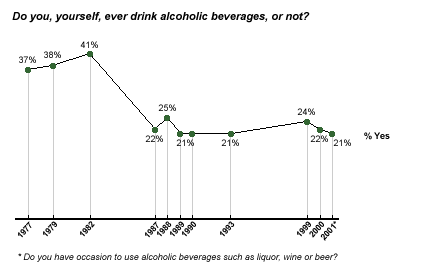
Although it is illegal for anyone under age 21 to buy or drink alcohol in all 50 states, some minors do. A May 2001 Gallup Youth Survey (GYS)* found that 21% of teens between the ages of 13 and 17 admit to drinking alcohol. Ten percent of them say they drink more than they should. Fifty-four percent say that it's very or fairly easy to get alcoholic beverages. Americans have been persistently warned about the perils of drunk driving, yet in a 2000 GYS**, 5% of teens admitted to having driven shortly after drinking alcohol. Thirteen percent of teens say they have been passengers of a drunk driver.
According to Gallup data, teen-agers are drinking less than they used to and fewer teens drink at all. Gallup trends dating back to 1987 show the percentage of teens who admit to drinking hovering between 21% and 25%. However, in 1982, 41% of kids admitted to drinking.
Several fretful cover stories have proclaimed increased alcoholism among teen-aged girls: In February 2002, the National Center on Addiction and Substance Abuse at Columbia University reported that 41% of female ninth-graders drink and 20% binge drink (compared to 40% and 22%, respectively, for ninth-grade boys). But Gallup numbers don't reflect this trend. According to the May 2001 GYS, it's true that young teen-age girls, aged 13 to 15, are slightly more likely to admit to drinking than boys (5% and 3%, respectively). But the older teens get, the more the drinking gap widens in the opposite direction. Twenty-five percent of 16- to 17-year-old boys who drink say they "drink more than they think they should" -- 11 percentage points higher than the same statistic for girls (14%). Of all kids between the ages of 13 and 17, 12% of boys say they drink more than they think they should, compared to 9% of girls.
There's no question that heavy drinking takes place among college students, and drinking is also a problem for many high school-aged kids. But Gallup data suggest that the incidence of teen drinking is significantly lower than it was 20 years ago. Parents and educators can take heart that the long-term perspective suggests a positive trend that will hopefully continue through the 21st century.
*Findings are based on telephone interviews with a national cross section of 501 teen-agers, aged 13 to 17, conducted in May 2001. For results based on this sample, one can say with 95% confidence that the margin of sampling error is ±5%.
**Findings are based on telephone interviews with a national cross section of 501 teen-agers, aged 13 to 17, conducted in January through April 2000. For results based on this sample, one can say with 95% confidence that the margin of sampling error is ±5%.