Thursday's deadly shooting at Los Angeles International Airport provided a grim underscore to FBI Director Robert Mueller's words at the American Muslim Council's annual convention last week. Mueller stressed the need for the American Muslim and law enforcement communities to work together in the war on terrorism. The convention, which carried the theme "American Muslims: Part of America," included discussion of new FBI surveillance tactics and racial profiling.
Racial profiling of Muslims may seem like a relatively new problem for Americans, but discussion of its practice with regard to other American minorities has been part of the public dialogue for more than a decade. A new Gallup poll* on racial attitudes examines how the civil rights of many minority groups, including Muslims and Arabs, are respected in the American criminal justice system.
Generally, a majority of Americans believe that the civil rights of all the racial groups tested in the poll are being respected by the criminal justice system. However, the public expresses the belief that some racial groups' civil rights are respected more than others'. More than eight in 10 Americans (82%) believe the civil rights of whites are respected, and 73% believe the same is true for Asians. Significantly fewer believe that the rights of blacks or Hispanics are respected: 62% for blacks, and 63% for Hispanics. And just over half believe the criminal justice system respects the rights of Muslims (55%) and Arabs (53%).
Civil Rights of Muslims and Arabs
Last October, President Bush signed the Patriot Act into law, significantly expanding the government's surveillance and intelligence gathering powers, and strengthening penalties for terrorist acts. The law's supporters believe it will help law enforcement agencies prevent terrorist attacks, rather than respond to them after the fact. Its detractors say the government is incorrectly de-emphasizing the public's civil rights. Specific debate on this issue has centered on the civil rights of Muslims and Arabs in America.
Though more than half of the general public believes the civil rights of Muslims and Arabs are respected in this country's criminal justice system, clear differences of opinion exist along racial and gender lines. Men are more likely than are women to say that the civil rights of Muslims are respected (64% to 48%, respectively); a similar gap exists with regard to Arabs' civil rights. Also, whites are more likely than Hispanics and blacks to believe that Muslims' civil rights are respected -- specifically, 60% of whites believe this is so, compared to 43% of Hispanics and just 36% of blacks. Again, a similar racial gap exists when respondents are asked about Arabs' civil rights.
The Racial Divide
While its application to Arabs and Muslims has only been a major topic of discussion since the Sept. 11 attacks, racial profiling has been an important issue in the black community for some time. As the summary table shows, whites and blacks have significantly different opinions regarding the respect of civil rights in the country's criminal justice system.
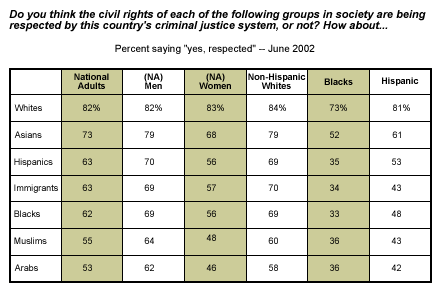
For every group tested, whites are significantly more likely than blacks to say they think civil rights are respected by the criminal justice system. Specifically, just a third of black respondents (33%) believe the system respects the civil rights of blacks, compared to a majority of whites (69%) who think so. Blacks are even significantly less likely than whites to believe that the civil rights of whites are respected in the country's criminal justice system, 73% to 84%. These findings suggest that blacks have more general distrust of the system as a whole, rather than a belief that the system is specifically targeting the black minority.
*These results are based on telephone interviews with a randomly selected national sample of 1,360 adults, aged 18 and older, conducted June 3-9, 2002, including oversamples of 236 blacks and 263 Hispanics, which are weighted to reflect their proportions in the population. For results based on the total sample, one can say with 95% confidence that the maximum error attributable to sampling and other random effects is ±3%. For results based on the samples of blacks and Hispanics, one can say with 95% confidence that the maximum error attributable to sampling error is ±7%. In addition to sampling error, question wording and practical difficulties in conducting surveys can introduce error or bias into the findings of public opinion polls.
