The rights and privileges associated with civil liberty are so ingrained in the American psyche that only a truly traumatic event can alter public opinion where they are concerned. Such an event occurred on Sept. 11, 2001. In the wake of that day, many Americans expressed willingness to sacrifice their civil liberties in the name of preventing additional acts of terrorism. However, new Gallup polling conducted for the anniversary of the Sept. 11 attacks* suggests that public commitment to civil liberties is returning.
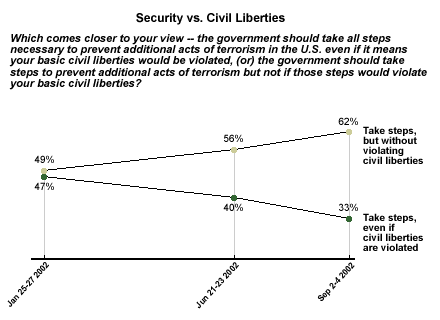
In January 2002, 47% of the public told Gallup that the government should take all steps necessary to prevent terrorism in the United States, even if it meant that basic civil liberties would be violated. Forty-nine percent said that steps should be taken to prevent terrorism, but stop short of violating civil liberties. Earlier this summer, the percentage of adults willing to have their civil liberties violated in order to prevent terrorism had decreased seven points to 40%. Now, roughly a year after the attacks, that percentage is down again to one in three Americans (33%), while 62% think that civil liberties should not be violated in the effort to prevent terrorism.
The oldest Americans, those aged 65 and older, are the most willing to say that the government may violate civil liberties in the name of terrorism prevention. Nearly half of this age group (49%) would be willing to make this trade-off -- at least 15 percentage points higher than any other age group. Perhaps not surprisingly, political conservatives (40%) are more likely than moderates (27%) or liberals (32%) to feel that preventing terrorism should be given a higher priority than civil liberty.
When asked about the state of individual rights and freedoms in the United States since Sept. 11, 11% say they have gotten better, 30% say they have gotten worse, and 58% say they have stayed the same. Among those who say they have gotten worse, a majority, 57% say this was necessary to combat terrorism, while 39% say it was not.
The Bush Administration
Currently, 15% of Americans say they believe the Bush administration has gone too far in restricting civil liberties in order to fight terrorism, while more than half (55%) say the administration has been "about right" in this respect. Twenty-six percent say the administration has not gone far enough. The percent saying the administration has gone too far has increased very slightly from 11% in June 2002.
Americans who describe themselves as nonwhite are more willing than white Americans to say that the Bush administration has gone too far in restricting people's civil liberties in order to fight terrorism, by a margin of 23% to 13%. Again, there is a difference in opinion by political ideology, with liberals (26%) far more likely than moderates (14%) and conservatives (9%) to say that the Bush administration has gone too far.
Key Points
Americans are generally less willing than they were nine months ago to have their civil liberties violated in order to prevent acts of terrorism. Along those same lines, a slightly larger percentage of the public believes that the Bush administration has gone too far in restricting civil liberties in order to fight terrorism. This trend is indicative of the "normalization" of Americans' priorities as the shock of the attacks subsides with time.
*Results are based on telephone interviews with 1,003 national adults, aged 18 and older, conducted Sept. 2-4, 2002. For results based on the total sample of national adults, one can say that with 95% confidence that the maximum margin of sampling error is ±3%.
