The vast majority of findings reported to date from the 2002 Gallup Poll of the Islamic World concern perceptions of the West, rather than of Islam. They have provided a detailed picture of residents' assessments of Western culture, of non-Islamic values and of the perceived characteristics of Western societies -- both collectively and on a country-specific basis.
However, Gallup's survey also asked those within these predominantly Islamic societies how they view their own sphere -- specifically, what traits they think are characteristic of the Islamic world. Each survey respondent was read a series of descriptive statements and asked which, if any, they felt applied to the Islamic world.
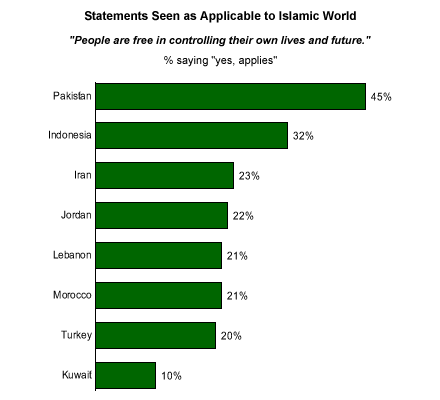
Of the eight statements tested, perhaps the most provocative was the assertion: "People are free in controlling their own lives and future." Outsiders have commented widely on the social and political structures of these societies -- but what is the view of the residents themselves on this score?
Personal Freedom of Opportunity in the Islamic World -- "Damning With Faint Praise"?
In none of the eight countries in which this question was asked did a majority of respondents express the view that the Islamic world is a realm in which people are generally free to control their own lives and future. In fact, only in Pakistan (45%) and Indonesia (32%) did more than a quarter of all respondents accept this as an apt description of Islamic societies.
In Iran (23%), Jordan (22%), Lebanon (21%), Morocco (21%) and Turkey (20%), the view that residents of the Islamic world enjoy considerable personal freedom is a rare one, and in Kuwait that perspective is rarer still (10%). This question -- along with a handful of others deemed to be excessively sensitive -- was not included in the Saudi Arabia questionnaire.
It is worth stressing that the question was asked with reference to the Islamic world in general, and did not constitute an assessment of the level of personal freedom of opportunity within the respondent's own country. It is thus possible for residents of countries with comparatively high levels of personal political freedom (among the nations surveyed) to offer relatively harsh assessments of the level of freedom that residents of the Islamic world generally enjoy.
Indeed, Kuwaitis and Turks are the least likely to describe the Islamic world as one characterized by personal freedom -- notwithstanding the fact that Turkey itself enjoys a vigorous multiparty democracy and Kuwait's parliament and press are among the most contentious and outspoken in the region.
It should also be noted that the phrase, "people are free to control their own lives and future," does not necessarily have an exclusively political connotation. In addition to the degree of formal political freedom enjoyed in a given society, a wide variety of factors may constrain economic and social mobility -- unequal access to education, rigidly prescribed ethnic, class or tribal hierarchies, etc. -- all of which may sharply limit an individual's ability to determine his or her personal future.
Perceptions of Political Equality in the West
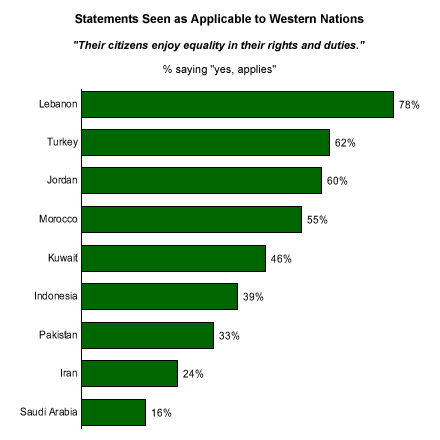
In contrast, residents of these same societies are considerably more likely to say they see the West as a region in which citizens enjoy equality with regard to their individual liberties and duties.
In four of the nine countries in which this question was asked with regard to the West, outright majorities accept it as an appropriate description (Lebanon: 78%, Jordan: 60%, Turkey: 62%, Morocco: 55%). Furthermore, in three others -- Kuwait (46%), Indonesia (39%) and Pakistan (33%) -- at least a third of those interviewed did so. Only in Saudi Arabia (16%) do fewer than one in five accept the notion that citizens in the West enjoy substantive political equality.
In general, younger adults are somewhat more likely than their older compatriots to view the West as a region in which the word "equality" can fairly be used to describe citizens' enjoyment of civic rights and responsibilities.