One of the main goals of any healthcare organization is to earn the satisfaction and loyalty of its patients. But most hospital stays aren't perfect, and one of the keys to ensuring that patients leave with a sense of satisfaction is a hospital's ability to resolve problems swiftly and thoroughly when they arise.
Numerous studies of service industries indicate that when a problem occurs and is handled effectively, consumers affected by the problem may be just as satisfied as those for whom everything went perfectly. Gallup's frequent analyses of patient satisfaction and loyalty scores reveal that, as in the case of overall patient satisfaction, satisfaction with problem resolution depends on hospitals' placement of both effective processes and effective people.
How Are Hospitals Doing on Problem Resolution?
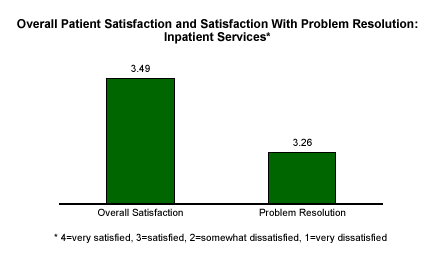
Problem resolution is an area with significant room for improvement in many hospitals. It is one of the lower-scoring attributes in Gallup's 2001 patient satisfaction and loyalty database. Mean scores for inpatient satisfaction with problem resolution are significantly below those for overall patient satisfaction.
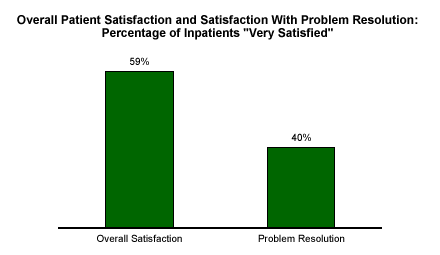
Ratings of satisfaction with problem resolution are equally striking when examining the percentages of "very satisfied" patients (those giving a score of 4 on a scale of 1 to 4). Among Gallup's core patient loyalty attributes, only satisfaction with food service scores below satisfaction with problem resolution with regard to the percentage of "very satisfied" inpatients.
How Can Hospitals Improve Problem Resolution?
One key to improving problem resolution is empowering staff members to resolve problems on their own, without having to consult management. Gallup best practice analysis indicates that the most successful healthcare managers give their staff members the power to immediately resolve problems they encounter, but that they are also readily available to support their staff when needed. The same managers report that there is no easy way to motivate staff members to take ownership for problem resolution -- it is a talent that they must look for in the recruiting process.
Empowered employees are not the only crucial factor for successful problem resolution. Hospitals must have effective processes in place by which patients are encouraged to alert staff members when a problem arises. Many patients are hesitant to inform nurses of problems, perhaps because they are in a dependent position and fear retaliation. Patients must have other ways to make their voices heard. Highly visible promotion of a patient hotline is one formal option. Another option is incorporating housekeeping and food service employees (who patients may find less threatening than actual care providers) in the patient communication process. In any case, success should be measured not in terms of a reduced number of complaints, but by signs that problems are being communicated and resolved effectively.
Once employees are empowered and processes are in place, speed and communication are critical. Inpatient complaints are usually relatively minor -- e.g., the television, telephone, or call button are not working. If these problems are uncovered, they can be resolved quickly and easily, rather than being allowed to fester. More complex clinical concerns may require the assignment of a problem resolution SWAT team, consisting of members of different departments (nursing, lab, radiology, etc.), to guarantee follow-up on all problems within 24 hours. Often, all patients and family members want is someone to be concerned and listen to them.
Bottom Line
Things may not always go perfectly at the hospital, but if employees can identify patients' problems, are empowered to immediately resolve simple issues, and can communicate with patients effectively about the timeline and process for resolution, the outcome will be more satisfied and loyal patients.