According to Gallup focus group research, healthcare consumers believe overwhelmingly that the most important criterion in selecting a physician is "quality." But when focus group participants are asked how they evaluate quality, the room falls silent. Once the silence lifts, the most common answer to the question is whether the physician is board-certified -- while board certification doesn't provide comprehensive information about the quality of a physician's care, at least the information is readily available.
But once patients have taken the step of selecting a physician, do they then have a clearer idea of how to evaluate the quality of care they actually receive from their doctors?
Patient Evaluations of Physician Quality
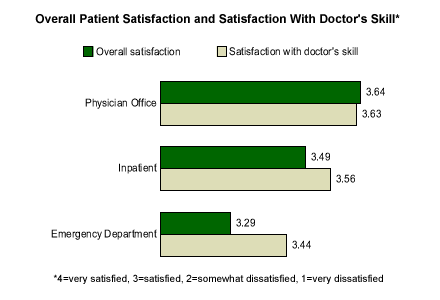
According to the 2001 Gallup patient satisfaction database, patients visiting physicians' offices are more likely than either hospital inpatients or emergency room patients to highly rate the skill of their physicians. Among physician-office patients, there is a high correlation (.60) between satisfaction with the doctor's skill and overall satisfaction with the office visit. Clearly, patient perceptions of the doctor's skill level are extremely important in an office setting.
In fact, in that setting there is no significant difference between patients' perceptions of the doctor's skill and their overall satisfaction with their visit. By comparison, in both inpatient and emergency settings, patient ratings of doctors' skills are much higher than their ratings of overall satisfaction -- indicating there is less correlation between these two measures.
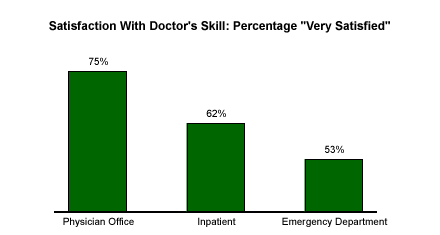
In the inpatient, outpatient, and emergency department settings, the majority of patients are "very satisfied" with the skill of their doctor (giving a score of 4 on a scale of 1 to 4). Three-fourths of physician-office patients are very satisfied, compared with 62% of inpatients and only 53% of emergency department patients.
Obviously, in a hospital setting there are more factors competing with the skill level of the doctor in patients' overall evaluation than there are in an office setting. Thus, in the doctor's office, the physician/patient relationship has a greater positive impact on perceptions of the doctor's skill. On the other hand, the urgent nature of emergency department experiences may allow less opportunity for personal interaction between doctor and patient. The inpatient setting falls somewhere in between; here the level of patient-physician interaction the hospital manages to sustain has a powerful effect on patients' perceptions of their doctors' skills.
Bottom Line
Patient evaluations of physician quality tend to be based largely on personal interaction between physician and patient. Rarely do patients have the expertise or access to information to make objective judgments about broad-based outcomes. Therefore, patient evaluations of their physicians, while very important, may be only part of the solution to evaluating physician quality.
More clinically based evaluations of physician quality, such as the Doctors' Office Quality Project currently being piloted by the U.S. Centers for Medicare & Medicaid Services (see American Medical News article in Related Sites), can provide another way of measuring physician quality that may be more objective. But for consumers seeking to determine the quality of physicians, neither patient evaluations nor clinical evaluations are enough. Patient evaluations may not sufficiently address whether or not physicians achieve desired clinical outcomes with their patients. But clinical evaluations may not sufficiently address a physician's bedside manner and ability to develop rapport with patients. Considered together, however, results from these two evaluation methods may give consumers the information they need to make accurate judgments about physicians.