Like many American kids in the 1950s, Ed Fisher dreamed of space travel. Comic strips and movies made it seem possible, and the work of scientists made it seem probable, that people would soon travel beyond the Earth. "Willy Ley's Rockets, Missiles, and Space Travel changed my life," he said, "and I knew by fifth grade that people would travel in space."
In 1960, Fisher fulfilled his dream of joining the space program. As a project manager for NASA, he helped lay the groundwork for the Apollo program. Clearly, the advance of technology captured Fisher's imagination early on, and guided the development of his career.
How do today's teens feel about the incredible pace of developing technology, and how do they think technology will affect the future? The 2003 Gallup Youth Survey shows that what was mere speculation and science fiction now seems commonplace to most American teens. And what is now the far curve of scientific advancement will become, according to teens, a major influence on their everyday lives.
DNA and WWW
The poll asked teens to rate how much influence each of eight items would have upon their futures.
Lawmakers, religious leaders, scientists, doctors, and ethicists have all had a hand in the future of genetic engineering; its visibility on so many fronts may have contributed to kids' expectations that it will be a lingering issue. Thirty-four percent expect genetic engineering to have "a lot of influence" on their futures. A plurality, 43%, expects it to have "some influence," and only 22% expect it to have "not much influence."
And there is no doubt about the staying power of the Internet. Forty-five percent of kids expect it to have a lot of influence, 42% expect some influence, and only 12% feel the Internet won't have much influence on their future lives. Moreover, there is very little difference among the demographic groups. All American teens -- regardless of religious inclination, political ideology, region, academic standing, age, or race -- have similar expectations about the future of genetic engineering and the Internet.
The Space Case
Genetic engineering is already here and could affect millions of young Americans over the course of their lifetimes. The Internet is now no more exotic than satellite television. But chances are only a few of today's teens will end up actually traveling in space. Nonetheless, most teens expect it to influence their lives in some way. Twenty-six percent say space travel will have a lot of influence, 44% say it will have some influence, and 30% say it won't have much influence on them in the future.
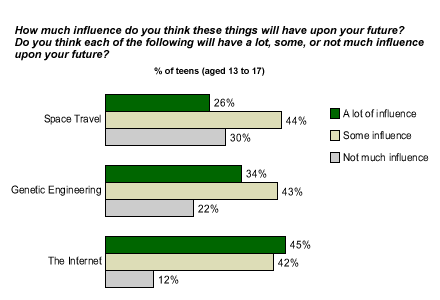
Among the items discussed here, the Internet was among the highest on the list of eight rated by teens, placing behind "political terrorists," rated as likely to have a lot of influence by 52% of American teens. Genetic engineering placed farther down the list, while space travel placed at the bottom, along with "religious fanatics."
As Fisher notes, research into space travel has more influence on teens' lives right now than they may think: satellite television, cryogenics, the protective clothes of firefighters, some branches of robotics, much computer programming, and many other technological advances are byproducts of the space program.
*The Gallup Youth Survey is conducted via an Internet methodology provided by Knowledge Networks, using an online research panel that is designed to be representative of the entire U.S. population. The current questionnaire was completed by 1,200 respondents, aged 13 to 17, between Jan. 23-Feb. 10, 2003. For results based on the total sample, one can say with 95% confidence that the maximum margin of sampling error is ±3%. For a complete description of the sampling and weighting procedures used to conduct the survey, click here.