Many applications of gene therapy offer enormous potential for preventing disease and easing suffering. But data from a January Gallup Poll indicate that most Americans are wary of gene manipulation, as an overwhelming majority would oppose its use for selecting the genetic traits of children.
Among the supporting arguments are that this type of technology is needed for some couples to avoid passing on genes that could predispose their children to inheriting a condition they would like to avoid, such as a serious genetic disease. Opponents counter this argument by claiming that there are alternatives to genetic manipulation to avoid passing on hereditary illnesses, such as pre-implantation diagnosis, egg and sperm donation, and adoption, and that scientists are not yet able to fully predict the effect modification will have on inherited traits.
The moral implications of these applications are highly complex, and change rapidly with ongoing scientific progress in genetics. However, public opinion is clear on one level: when it comes to more frivolous potential applications, Americans do not support genetic manipulation.
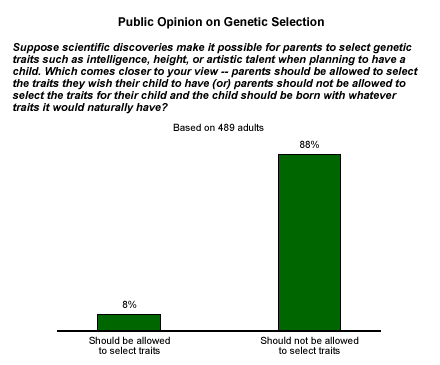
When asked about scientific discoveries that may someday make it possible for parents planning to have a child to select genetic traits such as intelligence, height, or artistic talent, 88% of respondents to the poll indicated that they believe that parents should not be allowed to select the traits for their child, and instead, the child should be born with whatever traits it would naturally have. Fewer than 1 in 10 Americans (8%) believe parents should be allowed to select the traits they wish their child to have*.
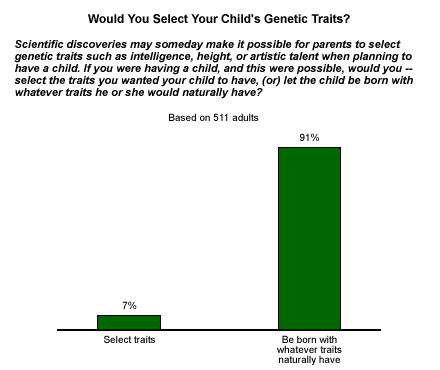
When asked if they personally would take advantage of this type of technology if available, only 7% of Americans indicated that they would select the traits they wanted their child to have. More than 9 in 10 Americans (91%) said they would let their child be born with whatever traits he or she would naturally have**.
*Results are based on telephone interviews with 489 national adults, aged 18 and older, conducted Jan. 23-25, 2003. For results based on these samples of national adults, one can say with 95% confidence that the maximum margin of sampling error is ±5%.
**Results are based on telephone interviews with 511 national adults, aged 18 and older, conducted Jan. 23-25, 2003. For results based on these samples of national adults, one can say with 95% confidence that the maximum margin of sampling error is ±5%.