Parents often teach their kids that when they are out in public they shouldn't talk to strangers. Good advice -- but what about strangers on the Internet? Certainly there have been horror stories in that regard: In March, two teen girls from Kentucky, Jeanne Rohrig, 14, and Whitney Irvin, 15, were lured from their homes by a man with whom they had been talking in an Internet chat room. According to the police, the two girls had recently received a package containing bus tickets, false identification, and money. But such extreme cases aside, are kids who talk with strangers on the Internet more likely to engage in other risky behaviors?
In the 2003 Gallup Youth Survey*, teens were asked whether they use the Internet to visit with people they don't know in chat rooms. Twenty-six percent of teens said they use the Internet this way. They also were asked whether they engaged in other risky behaviors such as using alcohol, having tried marijuana, or smoking cigarettes in the past week. Teens who said that they visit with strangers in chat rooms were more likely than those who don't to report using alcohol or having tried marijuana (a slightly higher proportion said they smoked cigarettes).
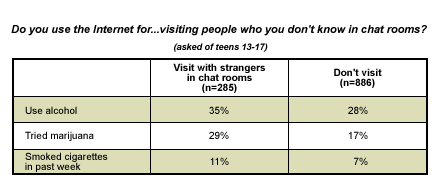
By way of comparison, consistent differences with regard to risk behaviors do not appear among teens who do and do not use the Internet for more innocuous purposes, such as chatting with friends using an instant messaging service.
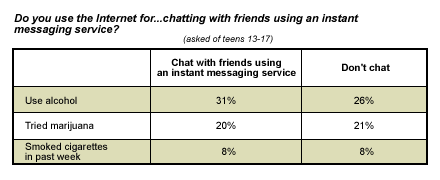
One of the eternal maxims of survey research is that "correlation does not prove causality." Are visits to chat rooms causing teens to experiment with drugs, or might there be something else at work that causes teens both to visit strangers in chat rooms and experiment with drugs? We can't answer this question, but Gallup's data do suggest that chatting with strangers on the Internet may be part of a larger group of unhealthy and possibly reckless behaviors for some teens. Parents would be well advised to monitor their kids' online activities.
For tips on how to protect children from dangers posed by Internet use, see the FBI's "Parent's Guide to Internet Safety" in Related Sites.
*The Gallup Youth Survey is conducted via an Internet methodology provided by Knowledge Networks, using an online research panel that is designed to be representative of the entire U.S. population. The current questionnaire was completed by 1,200 respondents, aged 13 to 17, between Jan. 23-Feb. 10, 2003. One can say with 95% confidence that the maximum margin of sampling error is ±7% for teens who visited chat rooms and ±4% for teens who had not visited chat rooms. For a complete description of the sampling and weighting procedures used to conduct the survey, click here.