In its February 2002 publication, A Nation Online: How Americans Are Expanding Their Use of the Internet, the U.S. Department of Commerce reported that while blacks and Hispanics were among the most rapidly growing groups of Internet users at that time, they still lagged significantly behind non-Hispanic white Americans in their Internet use. The report also cited a similar gap between black teens and Hispanic teens, and white teens. The report discussed several possible reasons for this gap, including the expense of home Internet use and "network effects" -- that is, people begin to use new technologies when they see their family, friends, and their broader community adopting them.
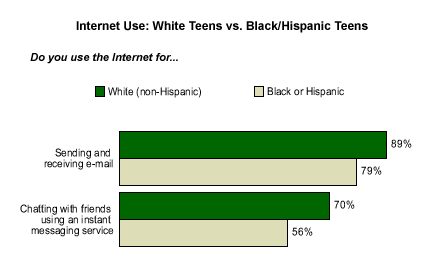
Gallup's most recent Web-based survey of teens* (all of whom had Internet access or were provided with access so they could participate as members of Internet panels) found that black teens and Hispanic teens were slightly less likely than non-Hispanic white teens to say that they use the Internet for sending and receiving e-mail or chatting with friends using an instant messaging service. Given that all survey participants had their own Internet capabilities, the percentages reported here may not be an accurate estimate of the percentage of teens overall and percentage of teens of all races who use the Internet (they likely overestimate the percentages). Nevertheless, the differences found by race are instructive, and suggest that the social networks in which black teens and Hispanic teens participate are probably less likely to have thoroughly embraced Internet-based communication.
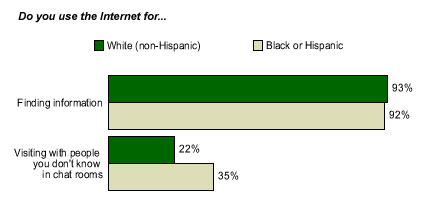
The data show, however, that black teens and Hispanic teens are no less likely than white teens to report using the Internet for things that do not involve an immediate social network, such as finding information or chatting with strangers. In fact, black teens and Hispanic teens were more likely than white teens to report having conversations with strangers in chat rooms. The implication is that minority teens who do have Internet access are no less likely to use it per se – that is, they have no less inherent interest in the Web. But, given that they remain more likely to fall into lower socioeconomic levels, they may have smaller networks of close friends and family capable of receiving e-mail or instant messages they may send.
Bottom Line
Given the growth rates reported by the U.S. Department of Commerce, it may simply be a matter of time before the Internet-use gap closes between black teens and Hispanic teens, and white teens. Increased efficiency and competition in the computer and telecommunications industries are likely to make Internet access increasingly affordable to all Americans. But these findings illustrate not only the remaining technology gap, but also possibly the insular nature of teens' social networks. As more minority and low-income teens find they have friends like them with Internet access, usage patterns may shift dramatically.
*The Gallup Youth Survey is conducted via an Internet methodology provided by Knowledge Networks, using an online research panel that is designed to be representative of the entire U.S. population. The current questionnaire was completed by respondents aged 13 to 17, between Jan. 23-Feb. 10, 2003. One can say with 95% confidence that the maximum margin of sampling error is ±7% for black or Hispanic teens and ±4% for white (non-Hispanic) teens. For a complete description of the sampling and weighting procedures used to conduct the survey, click here.