GALLUP NEWS SERVICE
PRINCETON, NJ -- Attorney General John Ashcroft continues his tour of America this week, touting the merits of the 2001 anti-terrorism law known as the Patriot Act. A recent CNN/USA Today/Gallup poll suggests that even if he allowed all Americans to attend his presentations (which are by invitation only, and consist mostly of military and law-enforcement personnel), he would find a concerned, but mostly receptive audience. The poll shows that while a substantial majority of Americans say the government should not take actions in the war on terrorism that would violate their basic civil liberties, an even larger majority says the Bush administration has not done so.
The poll, conducted Aug. 25-26, finds 67% of Americans saying the government should not take steps to prevent terrorism if those steps would violate their basic civil liberties, while 29% say the government should take "all steps necessary" to prevent additional acts of terrorism in the United States, even if it means their basic civil liberties would be violated.
| Which comes closer to your view -- the government should take all steps necessary to prevent additional acts of terrorism in the U.S. even if it means your basic civil liberties would be violated, or the government should take steps to prevent additional acts of terrorism but not if those steps would violate your basic civil liberties? |
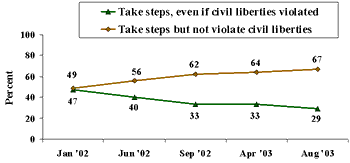 |
These views are quite different from those expressed in January 2002, just four months after 9/11, when the public was evenly divided about protection of civil liberties vs. aggressive action to counter terrorists. By June 2002, Americans had tilted in favor of civil liberties, 56% to 40%. A year after 9/11, in a Sept. 2-4 poll, Americans emphasized civil liberties by a 62% to 33% margin. With the current poll, the trend continues in the same direction, though the change over the past year has been small compared with the change over the first year.
Despite this substantial preference for protecting civil liberties, most Americans are not critical of the anti-terrorism actions of the Bush administration, nor of the provisions of the Patriot Act. Just 21% of Americans believe the administration has gone "too far" in restricting people's liberties, but about an equal number, 19%, say "not far enough." A majority, 55%, says the administration has done "about right."
Do you think the Bush administration -- [ROTATED: has gone too far, has been about right, or has not gone far enough] -- in restricting people's civil liberties in order to fight terrorism]?
BASED ON -- 514 -- NATIONAL ADULTS IN FORM A
|
Too far |
About right |
Not far enough |
No opinion |
|
|
2003 Aug 25-26 |
21% |
55 |
19 |
5 |
|
2002 Sep 2-4 |
15% |
55 |
26 |
4 |
|
2002 Jun 21-23 |
11% |
60 |
25 |
4 |
Since June 2002, there has been a slight shift in opinion, suggesting some people are becoming more concerned about the Bush administration's actions. Still, three-quarters of Americans, 74%, are not worried that their civil liberties are in danger.
A similar result is found when the question focuses on the Patriot Act. Just 22% say the legislation goes "too far," while about the same number, 21%, say "not far enough." A plurality, 48%, says the Act is "about right."
Based on what you have read or heard, do you think the Patriot Act -- [ROTATED: goes too far, is about right, or does not go far enough] -- in restricting people's civil liberties in order to fight terrorism?
BASED ON -- 495 -- NATIONAL ADULTS IN FORM B
|
Too far |
About right |
Not far enough |
No opinion |
|
|
2003 Aug 25-26 |
22% |
48 |
21 |
9 |
The poll shows that about half of the public is either "very" or "somewhat" familiar with the Patriot Act.
As you may know, shortly after the terrorist attacks on September 11, 2001, a law called the Patriot Act was passed which makes it easier for the federal government to get information on suspected terrorists through court-ordered wiretaps and searches. How familiar are you with the Patriot Act -- very familiar, somewhat familiar, not too familiar, or not at all familiar?
BASED ON -- 495 -- NATIONAL ADULTS IN FORM B
|
Very |
Somewhat familiar |
Not too familiar |
Not at all familiar |
No |
|
|
2003 Aug 25-26 |
10% |
40 |
25 |
25 |
-- |
This group of Americans, who are most familiar with the Patriot Act, is more critical than the rest of Americans, with 28% saying the Act goes too far in restricting liberties, compared with 15% of Americans who say that and are not familiar with the Act. Still, even among the more attentive Americans, 70% are not worried about the legislation posing a threat to their civil liberties.
Survey Methods
Results are based on telephone interviews with 1,009 national adults, aged 18+, conducted Aug. 25-26, 2003. For results based on the total sample of national adults, one can say with 95% confidence that the maximum margin of sampling error is ±3 percentage points.
In addition to sampling error, question wording and practical difficulties in conducting surveys can introduce error or bias into the findings of public opinion polls.
42. Which comes closer to your view -- [ROTATED: the government should take all steps necessary to prevent additional acts of terrorism in the U.S. even if it means your basic civil liberties would be violated, (or) the government should take steps to prevent additional acts of terrorism but not if those steps would violate your basic civil liberties]?
BASED ON -- 514 -- NATIONAL ADULTS IN FORM A
|
Take steps, even if |
Take steps but not violate civil liberties |
No |
||
|
% |
% |
% |
||
|
2003 Aug 25-26 ^ |
29 |
67 |
4 |
|
|
2003 Apr 22-23 |
33 |
64 |
3 |
|
|
2002 Sep 2-4 ^ |
33 |
62 |
5 |
|
|
2002 Jun 21-23 |
40 |
56 |
4 |
|
|
2002 Jan 25-27 |
47 |
49 |
4 |
|
|
^ |
Asked of a half sample. |
|||
43. Do you think the Bush administration -- [ROTATED: has gone too far, has been about right, or has not gone far enough] -- in restricting people's civil liberties in order to fight terrorism]?
BASED ON -- 514 -- NATIONAL ADULTS IN FORM A
|
Too far |
About right |
Not far enough |
No opinion |
|
|
2003 Aug 25-26 |
21% |
55 |
19 |
5 |
|
2002 Sep 2-4 |
15% |
55 |
26 |
4 |
|
2002 Jun 21-23 |
11% |
60 |
25 |
4 |
44. As you may know, shortly after the terrorist attacks on September 11, 2001, a law called the Patriot Act was passed which makes it easier for the federal government to get information on suspected terrorists through court-ordered wiretaps and searches. How familiar are you with the Patriot Act -- very familiar, somewhat familiar, not too familiar, or not at all familiar?
BASED ON -- 495 -- NATIONAL ADULTS IN FORM B
|
Very |
Somewhat familiar |
Not too familiar |
Not at all familiar |
No |
|
|
2003 Aug 25-26 |
10% |
40 |
25 |
25 |
-- |
45. Based on what you have read or heard, do you think the Patriot Act -- [ROTATED: goes too far, is about right, or does not go far enough] -- in restricting people's civil liberties in order to fight terrorism?
BASED ON -- 495 -- NATIONAL ADULTS IN FORM B
|
Too far |
About right |
Not far enough |
No opinion |
|
|
2003 Aug 25-26 |
22% |
48 |
21 |
9 |
