Whether they are sitting in front of their televisions or in their classrooms, America's teens are constantly bombarded with competing and often contradictory messages about sex: "Everybody does it," "No sex is safe sex," "No glove, no love."
It appears that some teens are heeding the messages about the risks of unsafe sex and unwanted pregnancy. A 2002 Centers for Disease Control (CDC) report indicates that the number of teenage pregnancies has declined 30% in the last decade. And although still extremely high (a recent study published in Perspectives on Sexual and Reproductive Health estimates that 15- to 24-year-olds account for 48% of sexually transmitted diseases), cases of STDs have declined as well. But how do teens view the seriousness of sexually related problems among their peers?
A new Gallup Youth Survey* asked teens (aged 13 to 17) how serious they feel the problems of pregnancy and STDs are among their teenaged friends. Overall, about two-thirds of teens surveyed feel that teenage pregnancy and STDs are either "somewhat serious" or "very serious" problems among their friends (69% feel this way about pregnancy; 66% about STDs).
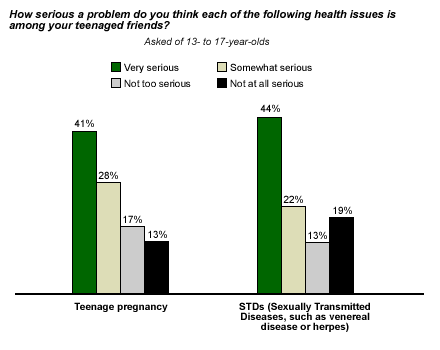
Given that the average age of first intercourse is 16½, according to the CDC, it's not surprising that older teens think pregnancy and STDs are more serious among their peers than younger teens do. Eighty-four percent of 16- and 17-year-olds see pregnancy as a serious problem among their friends, while 59% of 13- to 15-year-olds say the same. Similar age differences are apparent on teens' estimations of the STD problem, with younger teens thinking it is less serious than older teens do. In fact, a majority of 16- and 17-year-olds say both are "very serious" problems among their friends.
Opinions differ slightly by race on the subject of STDs, but not significantly on teen pregnancy: 73% of nonwhite teens rate both pregnancy and STDs as serious problems; 66% of white teens say the same about pregnancy, 62% about STDs.
Greater differences in seriousness ratings are seen between the teenagers' political orientation and geographic region. Seventy-six percent of teens who say they will vote Democratic when they are old enough rate teen pregnancy as a very or somewhat serious problem among their friends, as do only 58% of those who say they will vote Republican. Teens who say they plan to remain politically independent are more in line with the Democratic group, at 71%. Similarly, 74% of future Democrats and 68% of independents rate STDs as a very or somewhat serious problem, compared with just 56% of future Republicans.
According to geographic region, Northeastern teens seem to be more worried than teens in other parts of the country are about these problems. Eighty-six percent of teens living in the Northeast rate pregnancy among their friends as a very or somewhat serious problem, compared with 68% in the West, 67% in the South, and 59% in the Midwest. Geographic differences among STD ratings fall similarly to the ratings of pregnancy.
Bottom Line
Gallup results suggest that American teens' views on the risks of pregnancy and STDs divide along racial, political, and geographic lines. These differences of opinion may reflect urban vs. rural factors, socioeconomic factors, and/or family values. However, the poll also shows that teens in general are somewhat more likely to say smoking, drugs, and alcohol are problems among their friends than pregnancy and STDs.
*The Gallup Youth Survey is conducted via an Internet methodology provided by Knowledge Networks, using an online research panel that is designed to be representative of the entire U.S. population. The current questionnaire was completed by 785 respondents, aged 13 to 17, between Jan. 22 and March 9, 2004. For results based on the total sample, one can say with 95% confidence that the maximum margin of sampling error is ±4 percentage points.