The start of the new school year heralds the end of fun in the summer sun for many American teens. Yet the potential for exposure to dangerous UV rays does not go away after Labor Day. The risk of skin cancer from sun exposure does not dim whenever one spends time outdoors, regardless of the season and whether it's a sunny or cloudy day.
According to the U.S. Centers for Disease Control and Prevention (CDC), more than 1 million cases of basal cell or squamous cell cancer are diagnosed annually. And, the American Cancer Society estimates 55,100 new cases of the most serious form of skin cancer, malignant melanoma, will be diagnosed in 2004. Melanoma is the most common cancer among people 25 to 29 years old. Given the potential for so much harm, what are teens doing today to protect themselves from the effects of overexposure to the sun?
An August 2004 Gallup Youth Survey* finds only 10% of teenagers "always" wear sunscreen when visiting a beach or pool or when taking part in other outdoor activities when it is hot outside. An additional quarter (26%) wear sunscreen "most of the time." Unfortunately, nearly two-thirds of teens (63%) say that they wear sunscreen "only sometimes" (38%) or "never" (25%).
"Teens can't see themselves as aging or developing skin cancer or any other problems, so I'm not surprised that so few of them use sunscreen on a regular basis," says Dr. Andrew Kaufman, who specializes in treating all types of skin cancers.
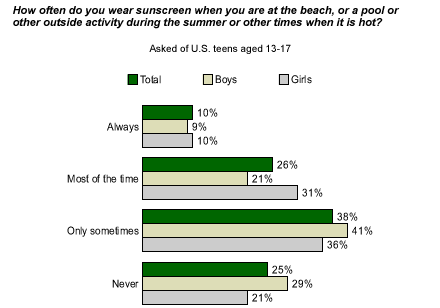
Boys are less likely than girls to use sunscreen on a regular basis. Thirty percent of boys wear it always (9%) or most of the time (21%), compared with 41% of girls (10% always, 31% most of the time). Seventy percent of boys report using of sunscreen "only sometimes" or "never" when taking part in outdoor activities, compared with 57% of girls. The American Cancer Society has found that as adults, men have a higher rate of melanoma cancer than women do. It is unknown if this is mainly the result of the use of sunscreen by gender.
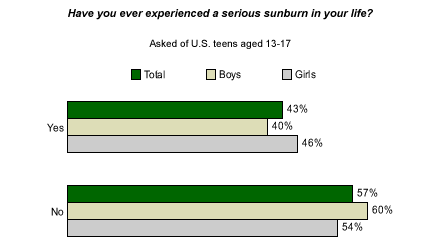
The CDC has found that it takes only a few serious burns during childhood to increase a person's risk of developing skin cancer later in life, and that kids do not have to be at a beach or pool to suffer harmful effects from the sun's UV rays. A majority of teens, 57%, say they have never experienced a serious sunburn in their lives. However, given the small number of teens who wear sunscreen all the time when exposed to the summer sun, it is no surprise that 43% of teenagers say that they have had a serious sunburn.
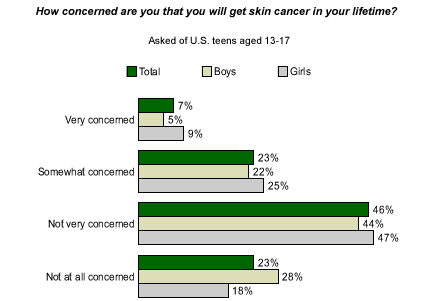
It is a common observation that young people tend to be unmindful of their own mortality, or at least unworried about real health and safety dangers. The Gallup Youth Survey data confirm this: Few teenagers worry about getting skin cancer in the future -- only 7% are "very concerned" and 23% are "somewhat concerned." Nearly 7 in 10 (69%) teens are either "not very" or "not at all concerned" that they will get skin cancer in their lifetimes.
Kaufman says it's particularly important for kids to be aware of the dangers of skin cancer. "Fifty to 80% of all sun exposure of a lifetime is received by age 18," he says. "Most non-melanoma skin cancers are caused by a long-term history of blistering sun exposures during one's youth."
The CDC warns that while sun exposure may be the most important environmental factor in developing skin cancer, artificial sources of UV rays, such as tanning beds and sun lamps, are just as dangerous and should be avoided for the same reason. Efforts to teach young people, both at home and at school, about all the risks of UV exposure are fundamental to helping teens reduce their risk of developing skin cancer later in life.
"Clearly they need proper education about the risks associated with excessive sun exposure," Kaufman says, "And we need to educate people to stop thinking of tanned skin as a healthy look."
*The Gallup Youth Survey is conducted via an Internet methodology provided by Knowledge Networks, using an online research panel that is designed to be representative of the entire U.S. population. The current questionnaire was completed by 439 respondents, aged 13 to 17, Aug. 8-19, 2004. For results based on the total sample, one can say with 95% confidence that the maximum margin of sampling error is ±5 percentage points.