There were nearly 20,000 alcohol-induced deaths in 2001, the last year for which data are available from the National Center for Health Statistics. And these numbers do not include deaths resulting from unintentional injuries or homicides, many of which may indirectly be related to alcohol use. Alcohol consumption is clearly a major health risk factor.
Aggregated data from three Gallup Consumption Habits polls conducted between July 2002 and July 2004* provide some insight into which Americans drink, how much they drink and whether they think they overindulge, and if alcohol has ever caused problems in their families.
Who Drinks?
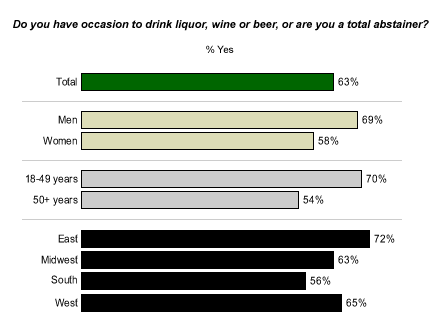
According to the aggregated data, 63% of Americans report that they drink alcoholic beverages such as liquor, wine, or beer, while 37% totally abstain. Men are more likely than women to drink (69% vs. 58%), and adults under 50 are substantially more likely than adults over 50 to drink (70% of adults aged 18 to 49 drink alcoholic beverages, as do only 54% of those over 50).
Drinking Frequency
Occasional drinking does not necessarily indicate a drinking problem, but even small amounts of alcohol can cause slurred speech, slowed reaction times, or impaired judgment. The Centers for Disease Control and Prevention defines "excessive drinking" as an average of more than one drink per day for women, and an average of more than two drinks per day for men.
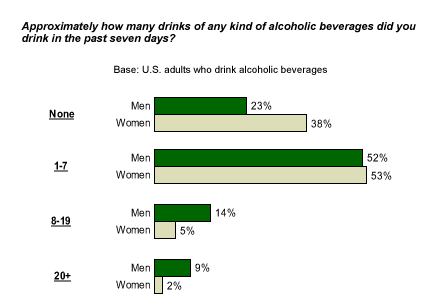
So how much do American drinkers drink? According to the Gallup data, the mean number of drinks that male drinkers consume in a week is 6.6 (about one per day), compared with 2.9 for female drinkers (less than half a drink per day). Seven percent of female drinkers report having eight or more drinks in the past seven days -- the CDC standard for "excessive drinking" among women. Twenty-one percent of male drinkers report consuming 10 or more drinks in the last seven days, including 9% who said they drank 20 or more -- well over the "excessive drinking" limit for men.
Self-Assessments of Excessive Drinking
Objective measures of how many drinks one has in a week can only go so far in defining problems with alcohol. Regardless of how much a person drinks, alcohol consumption is a problem if it negatively affects the way the person thinks, feels, or interacts with others.
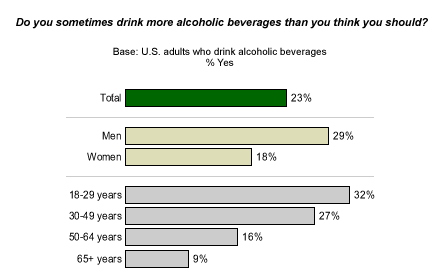
Gallup asked the respondents themselves if they ever drink more alcohol than they should. Nearly a quarter (23%) of drinkers said they sometimes drink more than they should. Again, men outnumber women in this response, and younger drinkers are far more likely than older drinkers to say they drink too much.
Drinking as a Problem in the Family
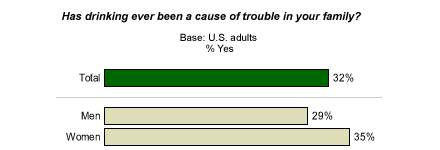
Alcohol problems affect not only the individuals who drink, but also those around them. Nearly a third (32%) of Americans say that drinking has been a cause of trouble in their families. Interestingly, women (who are less likely than men to drink and to report drinking too much) are slightly more likely than men to report that drinking has been a problem in their families (35% compared with 29%).
Bottom Line
Anyone who watches football on Sunday afternoons can see that alcohol, especially beer, is marketed most heavily to men and the under-50 crowd -- the groups that drink the most. And while men are much more likely to drink alcohol and admit to overindulging, the data show women are more likely to see it as a problem for their families.
*Results are based on telephone interviews with 3,016 national adults, aged 18 and older, conducted in July 2002, July 2003, and July 2004.
For results based on the sample of 1,444 men and 1,571 women, the maximum margin of sampling error is ±3 percentage points.
For results based on the sample of 428 adults, aged 18 to 29, the maximum margin of sampling error is ±5 percentage points. For results based on the sample of 1,179 adults, aged 30 to 49, the maximum margin of sampling error is ±3 percentage points. For results based on the sample of 814 adults, aged 50 to 64, the maximum margin of sampling error is ±4 percentage points. For results based on the sample of 568 adults, aged 65 and older, the maximum margin of sampling error is ±4 percentage points.
For results based on the sample of 1,908 U.S. adults who drink, the maximum margin of sampling error is ±2 percentage points.
For results based on the sample of 991 men and 917 women who drink, the maximum margin of sampling error is ±3 percentage points.
For results based on the sample of 385 adults, aged 18 to 29 who drink, the maximum margin of sampling error is ±5 percentage points. For results based on the sample of 873 adults, aged 30 to 49 who drink, the maximum margin of sampling error is ±3 percentage points. For results based on the sample of 417 adults, aged 50 to 64 who drink, the maximum margin of sampling error is ±5 percentage points. For results based on the sample of 224 adults, aged 65 and older, the maximum margin of sampling error is ±7 percentage points.