Many hospitals are facing shortages of nurses and other professional staff, forcing tired employees to work longer and longer hours. At the same time, the fifth anniversary of To Err Is Human -- a 1999 Institute of Medicine report showing that up to 98,000 people die each year from medical errors -- is approaching and many studies show that medical errors continue to be rampant.
Does all the negative publicity about healthcare workplaces reflect the actual work environment? How do healthcare employees' feelings about their workplaces compare with those of other types of employees? One way to answer these questions is by asking the healthcare employees themselves.
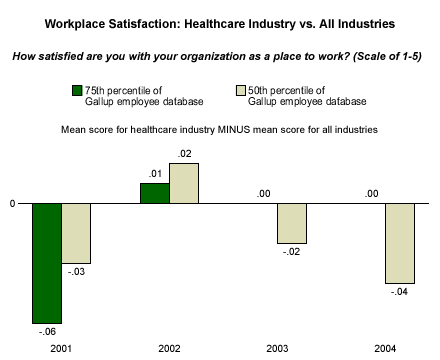
Gallup's employee database contains satisfaction and engagement data for hundreds of thousands of healthcare employees, as well as hundreds of thousands of employees in other industries. In a special analysis, Gallup researchers compared the mean satisfaction scores from 2001 to 2004 (as measured by the question, "How satisfied are with your organization as a place to work?") for employees of "average" healthcare organizations and employees of "average" organizations in all U.S. industries. "Average" organizations are defined as those scoring in the 50th percentile of the Gallup database for employee satisfaction. Scores for best-practice organizations (those scoring in the 75th percentile of the database) were also compared.
How do healthcare organizations measure up? With the exception of a slight jump in 2002, employees of average healthcare workplaces are consistently less satisfied with their organizations as a place to work than are employees in all U.S. industries. However, for the past three years, employee satisfaction at best-practice healthcare organizations has been on par with that of employees working for best-practice organizations in all industries.
Are Healthcare Employees Engaged?
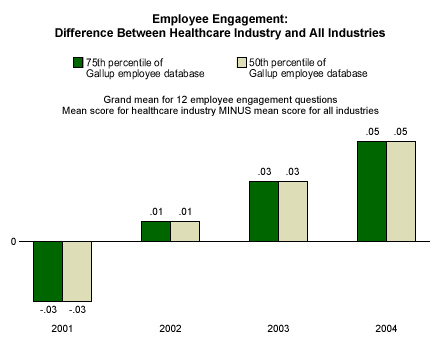
Productive employees must be more than satisfied with their workplaces -- they must also be engaged with their workgroups (see "Engagement vs. Satisfaction Among Hospital Teams" in Related Items). Engagement, as measured by Gallup's Q12 survey, indicates a strong level of psychological commitment to one's job and to his or her workgroup.
The "GrandMean" for the Q12 is measured by averaging the scores for all 12 questions. In 2001, the GrandMean scores for healthcare workers in both the 50th and 75th percentiles were lower than those for the 50th and 75th percentiles of all industries. However, the healthcare industry no longer lags behind at either level. Relative to U.S. workers as a whole, employees of both average and best-practice healthcare organizations have increased engagement with their workgroups every year. Healthcare worker engagement is now above that of U.S. workers.
Bottom Line
Despite the challenges they face, healthcare organizations have made progress over the past few years in improving the cohesiveness of their workgroups. Employee engagement is directly related to positive outcomes such as turnover and safety. A study of hospitals in Gallup's database showed that facilities with high levels of employee engagement also tend to have lower levels of patient mortality and medical errors.
The true strength of today's healthcare organizations is in the performance of their individual workgroups. The overall images of many healthcare workplaces are suffering, and those negative images may be reflected in lagging employee satisfaction scores in those average healthcare organizations. However, strong employee engagement scores for healthcare organizations give cause for greater optimism.