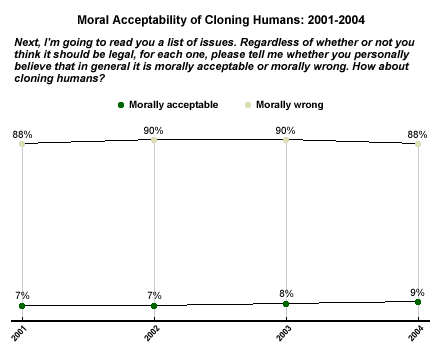
The 1996 birth of Dolly the cloned sheep moved the cloning of human beings from science fiction to possibility, but Americans remain overwhelmingly opposed to the idea. According to a May 2004 Gallup Poll*, 88% think cloning humans is morally wrong -- essentially unchanged since Gallup began asking the question regularly in 2001. Only 9% of Americans say human cloning is morally acceptable.
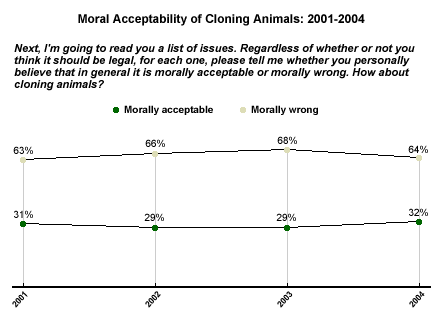
Americans are less rigid about the moral acceptability of cloning animals, although they say this practice is morally wrong rather than morally acceptable by a 2-to-1 margin.
In follow-up interviews, a number of respondents were given the opportunity to comment further on the issue. Their remarks illustrate how the topic of cloning tends to provoke strong feelings, involving in many cases Americans' powerful religious beliefs as well as the typical American appreciation of the need for scientific progress. Two comments in particular illustrate the opposite viewpoints:
"Call me old-fashioned, but I think all cloning is morally wrong," says Veda Hobbs of Arkansas. "I'm a Christian who believes in creationism, and I think these things should be left up to God."
Kevin, a 52-year-old Pennsylvanian who asked that his last name not be used, disagrees -- he feels that all cloning is morally acceptable. "We have to medically and scientifically move the human race forward," he says. "If everyone was afraid of the unknown, we'd all still think the world was flat."
What Does "Cloning" Mean?
The May 2004 poll question does not differentiate among the various types of cloning -- such as reproductive cloning (a process designed to result in the live birth of an animal or a human) or cloning for research purposes (which may only involve cloning cells or organs). The results of the current survey, taken in the context of a 2002 Gallup survey asking about different types of cloning, strongly suggests that respondents are thinking about cloning that results in the creation of a human being when they are simply asked for their views on "human cloning."
In that poll, 8% of Americans favored and 90% opposed "cloning that is designed specifically to result in the birth of a human being," nearly identical to the results from the current poll. But the 2002 poll found higher support for more limited types of cloning, including 59% for cloning organs to be used in medical transplants and 51% for cloning human cells from adults to use in medical research.
As those numbers suggest, the views of many Americans may have grown more nuanced as the issues surrounding cloning research have grown more complex -- and more controversial -- in the last few years. When called back for further comments on their cloning opinions, several respondents brought up the related issue of stem cells. "Are you asking me about stem cell research?" was the first thing Dolores (last name not used by request), a 73-year-old respondent from Washington wanted to know when asked if she felt cloning was morally acceptable or morally wrong. Regardless of her opinion on stem cell research, Dolores feels strongly that cloning both animals and humans for reproductive purposes is always wrong. She does not see cloning as a moral or religious matter, but rather as a pragmatic issue. "It's not natural and I can see no purpose to it," she says.
But not all Americans automatically equate "cloning" with reproductive duplication. Another respondent to the 2004 survey, a Texas mother of 11-year-old identical twins who asked not to be named, defines cloning primarily in terms of stem cell development. "Twins run in my family," she explains, indicating there was no scientific intervention in the twins' conception. "Cloning is not only morally acceptable, it's absolutely necessary. If Congress prohibits cloning to harvest stem cells for research, many scientific possibilities may go undiscovered -- from replicating cells to producing whole organs for transplant."
Bottom Line
Former President Ronald Reagan recently died after a 10-year battle with Alzheimer's, a disease whose cure many scientists feel can be greatly advanced through stem cell research. Former first lady Nancy Reagan continues to advocate for the Human Cloning Ban and Stem Cell Research Protection Act of 2003 currently being considered in Congress, a bill that specifically prohibits reproductive cloning but allows for the creation of new embryos for stem cell research.
The bill's middle-ground approach may appeal to Americans looking for a solution that addresses both ethical and medical challenges. Walter Hochbaum, a 79-year-old retiree from Texas, has serious moral concerns about cloning in general, but he makes distinctions. "While I don't condone cloning for the purpose of reproducing live animals or humans," Hochbaum explains, "I do feel that cloning for therapeutic purposes and stem cell research is morally acceptable."
*Results are based on telephone interviews with 1,000 national adults, aged 18 and older, conducted May 2-4, 2004. For results based on the total sample of national adults, one can say with 95% confidence that the margin of sampling error is ±3 percentage points.
