As the name implies, emergency rooms were originally designed to handle serious medical emergencies. But as the U.S. healthcare system has become increasingly complex, emergency departments have suffered from overuse for non-emergencies. Blame for the situation often falls on low-income or uninsured patients, who go to the emergency room for routine treatment because they can't get it elsewhere.
An earlier analysis of inpatient satisfaction scores in Gallup's database, broken down by payor category, shows that inpatients in those less "desirable" payor categories (e.g., Medicaid and self-pay) do not have lower levels of satisfaction than inpatients in other categories (see "Does Satisfaction Cost Patients Extra?" in Related Items). Does the same thing hold true in the emergency department?
Emergency department satisfaction scores do vary more widely by payor category than do inpatient satisfaction scores. Two of the six payor categories measured -- Medicare and self-pay -- vary significantly from the mean emergency department satisfaction score, Medicare scores falling above the overall mean and self-pay scores (the category most likely to include uninsured patients) falling below the mean (neither of these categories differs significantly from the mean among inpatient satisfaction scores).
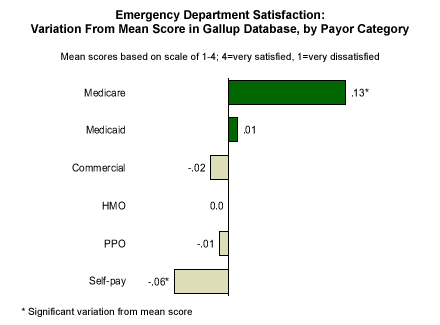
The Medicaid group, which tends to include lower-income patients, does not vary significantly from the overall mean emergency department satisfaction score. Managed care patients -- those in the HMO and PPO categories -- also score right at the overall mean in emergency department satisfaction, even though they gave scores significantly below the mean among inpatient satisfaction ratings. Lower-than-average inpatient satisfaction among managed care patients may be related to restricted doctor/hospital choice, co-pays, and pre-certification procedures -- none of which frequently plays a role in emergency department visits.
Although Medicare patients fall in the middle of the pack when it comes to inpatient satisfaction, they tend to be considerably more satisfied with emergency department services than those in any other payor category. Does that mean older Americans are receiving better care in the emergency department? In my experience, it's probably more likely that older people, who have more familiarity with the U.S. healthcare system, may better recognize its limitations and be more patient with its overextended aspects.
Bottom Line
Patients' satisfaction with emergency departments is on average lower than satisfaction with inpatient services; in fact, emergency departments receive the lowest satisfaction scores of all four healthcare service areas that Gallup measures. Emergency departments tend to be overcrowded and understaffed, with poorly functioning processes. But despite these difficulties, one would think that the emergency department would be a relatively egalitarian environment when it comes to payor categories. Triage systems are designed to treat patients based on their medical need, regardless of their means of payment.
A study published last month in the Annals of Emergency Medicine argues that despite the commonly held belief that uninsured patients overuse and overcrowd emergency departments, only 15% of emergency department patients are actually uninsured. So although the numbers don't suggest that uninsured patients are causing emergency department overcrowding, could it be that low satisfaction scores in the self-pay category result from subtle staff discrimination against these patients? Let's hope this is not the case, but the numbers raise some interesting questions.