This article is the first of a two-part series on polling results in Turkey.
Turkey forms a bridge between two worlds -- both figuratively and literally.
The country boasts a variety of unique distinctions. Surveys indicate that the majority of Turks support the country's pending application to join the European Union. Yet, while a portion of its territory lies in Europe, the country also borders Syria, Iraq, Iran and Azerbaijan. While more than 99% of all Turks practice Islam, Turkey has been an active member of NATO since 1952 and remains its only Islamic member.
Turkey was a key geographic linchpin of NATO throughout the Cold War. More recently, Turkish air bases played an important role in the U.N.-sanctioned ouster of Iraqi forces from Kuwait in 1991, as well as in the U.S.-led offensive in Afghanistan. Any attempt to oust Iraq's Saddam Hussein would almost certainly involve the use of Turkish airfields -- particularly in view of Saudi Arabia's assertion that its territory will not be used for any such action.
The country's immediate political future is in flux. Prime Minister Bulent Ecevit lost his parliamentary majority last month, and an early national election has been scheduled for November. If economic conditions worsen, recent polls suggest that his Democratic Left Party could fail to meet even the 10% threshold necessary to ensure continued parliamentary representation. At least nine other political parties are now jockeying for power, and another coalition government appears likely.
The unique political and economic conditions in Turkey today beg the question of what it is like to be a Turk in the 21st century. What do the residents of this strategically important Islamic country think about their recent past, their present and their future?
The Economy
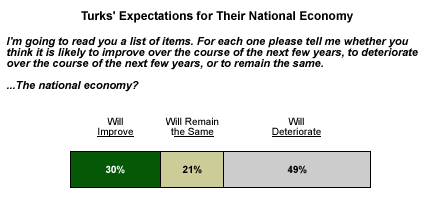
Turkey's continuing current economic difficulties have cast a pall over expectations for the country's near-term future. Nearly half (49%) of Turkish adults interviewed in Gallup's 2002 poll of nine predominantly Islamic countries say they expect that the condition of the country's economy will worsen over the course of the next few years, while 30% expect it to improve and 21% expect it to remain essentially unchanged.
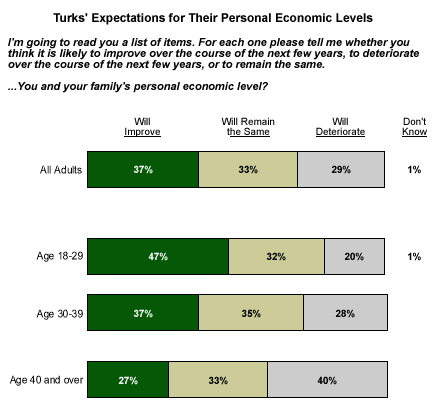
There is somewhat less pessimism expressed about the state of personal economic well-being over this same period. More than a third (37%) of all Turks say they expect their own economic lot to improve over the next few years, while 29% take the opposite view. It is worth noting that this relatively optimistic assessment is largely restricted to the country's younger adults. Among those aged 40 or older, those expecting their personal economic fortune to improve over the next few years (27%) are outnumbered by those who say they think their personal economic condition will deteriorate (40%).
Quality of Life and Expectations for the Future
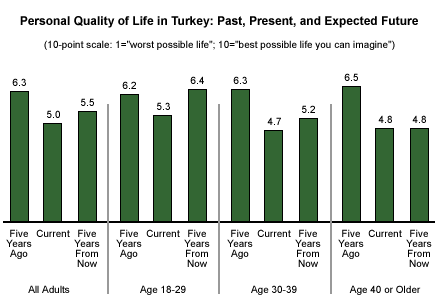
When Turks are asked how they rate their own personal quality of life, the typical rating given is a moderate 5.0 on a 10-point scale (one which ranges from the "worst possible life" to the "best possible life you can imagine"). Asked how they would have rated their own quality of life five years earlier, the average response is that they would have rated it a 6.3 on this same scale. In other words, on average, Turks perceive their quality of life to have declined significantly, if not drastically, over the past five years.
Looking to the future, Turks expect a modest improvement in the quality of their lives five years hence. The average Turk expects to rate his or her quality of life at 5.5 on this scale five years from now -- an improvement from today's 5.0 rating, but still lower than the average rating of five years ago (6.3).
As with personal economic expectations, however, this optimism is largely restricted to the country's younger adults. Adults under the age of 30 say they expect their quality of life to improve from an average of 5.3 to 6.4 over the next five years. Those in their 30s expect a more modest improvement -- from 4.7 to 5.2. Those aged 40 or older, however, expect no improvement at all in quality of life over the coming five years (4.8, 4.8).
Part II of this series will focus on Turks' views of the religious landscape in their country.
