Politics
Explore Gallup's research.
Ahead of Israel's election next week, public confidence in the honesty of elections has fallen and has grown increasingly divided.
Ratings of federal government Cabinet departments are mostly down this year, with the Defense, State and Justice Departments at new lows.
Americans rate the Democratic Party better than the Republican Party on several measures, including favorability and handling the economy.
Americans' levels of trust in the government to handle domestic and international problems are at record lows, as is their trust in each of its three branches.
Confidence in both grocery food safety and in the government to ensure its safety are at new lows, as more people avoid certain foods after recalls.
Confidence in the honesty of elections is highest among those disapproving of national leadership, a dynamic not seen anywhere else in the world.
Americans associate courage most with first responders and military personnel and least with elected officials, yet majorities have seen elected leaders take actions they view as courageous.
Americans' trust in the judicial branch of the federal government and their job approval of the U.S. Supreme Court are at or near historical lows.
A third of Americans say they trust the media, up slightly from last year's record low, driven mainly by a sharp increase among Republicans.
President Donald Trump's job approval rating has slipped to a new second-term low point and is approaching his all-time low of 34%.

Over half of residents in the Greater Washington area say federal job cuts have negatively impacted their household. Positive ratings of the job market have fallen 14 points since 2023.
Socialism's appeal is at a new high, but it remains less popular than capitalism and well below free enterprise.
Majorities of Americans express doubts about political accountability, the fair application of laws, and the balance of power in the federal government.
Americans say the UN is doing a poor rather than a good job in each of five key areas, with its best ratings for providing humanitarian aid.
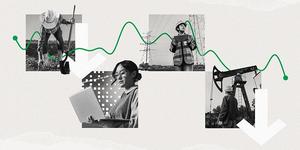
Americans' ratings of the computer industry, farming, electric and gas utilities, and oil and gas have declined, with computers reaching a record low.
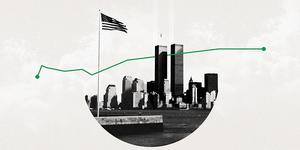
Sixty-four percent of U.S. adults, tied for the high, say Americans have permanently changed the way they live as a result of the 9/11 terrorist attacks.
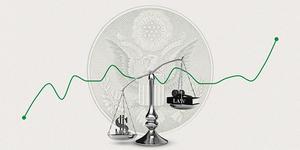
Perceptions of government corruption in the U.S. hit a record high in 2026, with broad agreement across partisan lines.
Support for labor unions is at its modern-day peak in the U.S., both in approval and in Americans' desire for unions to gain influence.
Americans are more likely to attribute UFO sightings to human activity or natural phenomena than alien activity; 17% say they have seen a UFO.
Forty-five percent of U.S. adults say they have participated in at least one of 13 different forms of gambling in the past year, well below prior measures.