
Rebuilding Indian Workplaces for the Future
How great managers, strong cultures and purpose-driven work can unleash employee performance
Rebuilding Indian Workplaces for the Future reveals important insights into the current state of India’s workplaces, drawing upon findings from Gallup’s State of the Global Workplace: 2026 Report; wider Gallup research on manager effectiveness, strengths, organisational culture, employee engagement and business performance; and an online survey of Institute of Directors (India) members.
Download the report to learn about key challenges facing India’s workplaces and how organisational leaders can address them to power the country’s next phase of growth.
Foreword
Foreword
India’s next chapter of growth will be shaped not only by investment, technology and market opportunity, but also by the quality of leadership that turns those drivers into sustained performance and long-term prosperity.
As businesses navigate technological disruption, geopolitical uncertainty and rising stakeholder scrutiny, the ability to align people around a shared purpose and enable them to perform at their best has become one of the defining responsibilities of corporate leadership.
At the Institute of Directors (India), we have believed since our founding in 1990 that good governance extends beyond compliance. It requires visionary boards, accountable leadership and ethical decision-making, but it also requires a real understanding of the human dimension — how strategy gets executed, how culture is experienced, how resilience is built. Over three decades, that conviction has become a shared view across our community of directors, independent directors, policymakers and corporate leaders.
The Institute of Directors is pleased to partner with Gallup on this report. It combines Gallup’s research on India’s workplaces with the perspectives of 181 IOD members and extensive conversations with senior leaders, offering insight into how organisations can strengthen employee engagement as workplace and leadership expectations continue to shift.
Employee engagement is often treated as an HR responsibility. It is better understood as a strategic indicator of organisational health — whether employees know what’s expected of them, feel connected to the organisation’s purpose, trust their leaders, and are able to contribute meaningfully. These conditions shape an organisation’s ability to execute strategy, retain talent and deliver sustainable performance.
Boards don’t manage the day-to-day employee experience, but they shape the conditions in which it takes place — leadership quality, culture, succession planning, and the governance frameworks that enable performance. Their role isn’t just to oversee engagement initiatives; it’s to ensure the organisation has the leadership and operating conditions for people and performance to thrive together.
Ultimately, governance is about performance, performance is driven by people, and people are inspired by purpose. Sustainable value creation lies at the intersection of all three. This report is a reminder that organisations investing in engaged people and purpose-driven leadership are better placed to build resilient institutions and remain competitive.
The evidence here is compelling, and the direction is clear. What remains is the resolve of leaders to act on it. We hope this report encourages directors and executive teams to look past engagement metrics and treat employee engagement as a boardroom priority rather than an operational one. Today, Indian boards must be prepared to lead their organisations in an era characterised by rapid AI adoption, constant change and an increasingly diverse, multigenerational workforce.
Manoj K. Raut
CEO & Secretary-General, Institute of Directors (India)

For more on the Institute of Directors and Gallup partnership, download the press release.
Executive Summary
Executive Summary
“Quiet quitting” is India's biggest engagement challenge. The managers expected to tackle it are under pressure.
India is not facing a sudden surge of employees working against their organisations. Rather, a major risk to India’s workplaces arises from the growing number of employees who are present at work but not psychologically invested in their role, team or organisation. Gallup’s State of the Global Workplace: 2026 Report shows that 23% of Indian employees were engaged in 2025 — the lowest point in four years — while 18% were actively disengaged (based on three-year rolling averages). The majority of the country’s workforce (59%) consists of “not engaged” employees who are physically present but psychologically detached from their work and employer.
For the country’s CEOs and executive teams, this lack of workforce engagement is an issue affecting their organisations’ capacity to execute. When employees become psychologically detached, organisations lose more than enthusiasm and commitment; disengagement dissipates employee initiative, adaptability, resilience, discretionary effort, and the willingness to solve problems beyond the minimum requirements of the role.
India’s managers are feeling the pressure, and it is affecting their own engagement. Engagement among Indian managers fell from 39% in 2024 to 30% in 2025 — a steeper decline than among individual contributors. Yet managers are the essential link between organisational priorities and the employee experience. They clarify team expectations, coach performance, recognise individual contributions, manage trade-offs, and help employees connect the work they do to a larger purpose. Organisations cannot expect managers to strengthen the engagement of their teams unless they are provided with adequate support.
This report combines Gallup’s national workplace findings with the perspectives of 181 IOD members and leadership conversations representing multiple sectors. We examine three critical questions: What is driving “quiet quitting” in India’s workplaces? What do stretched managers need to engage and lead their teams effectively? Finally, what should senior leaders change to strengthen manager engagement? Our report findings indicate the necessity of one connected people-performance system rather than a collection of isolated human resources initiatives.
Four Findings for Leaders
23% Engaged Employees India's lowest level in four years
59% Not Engaged Employees The greatest opportunity for building psychological attachment
30% Engaged Managers Down nine percentage points from 2024
42% IOD members citing culture misalignment A primary factor behind “quiet quitting”
The report’s insights also echo the discoveries revealed in Gallup’s India Culture Risk Report 2025. Many Indian organisations benefit from a strong foundation of ethics, inclusion and purpose. The challenge facing leaders is to build on this foundation by ensuring consistent employee experiences of clarity, feedback, accountability, growth and leadership inspiration.
Employees experience culture less through a values statement than through everyday decisions and experiences: how managers are selected, how performance is evaluated and discussed, how individual contributions are recognised, where employees can apply their strengths, and whether leaders’ actions match their words.
Four Priorities for Action
-
Select, equip and support great managers. Treat management as a distinct role requiring talent, training and support.
-
Put talent where it performs best. Design roles and careers around employee strengths, fit and accountability.
-
Bring culture to life every day. Translate values into clarity, feedback, recognition and team habits.
-
Turn engagement into stakeholder value. Track the progress of customer, productivity, quality and retention outcomes.
Taken together, the findings and leadership priorities identified in this report assert that engagement is an operational imperative that must be managed continually, not as an annual programme. The Gallup Path illustrates how people create organisational value: Great managers ensure that individuals are in the right role and are able to boost their performance by harnessing their natural strengths, and engaged employees deliver positive customer experiences and increase customer loyalty. These experiences contribute to greater, sustainable organisational performance.
The report concludes with Gallup’s “net gain” analysis, advancing the leadership conversation from whether engagement matters to how organisations can connect meaningful improvements in engagement with progress towards key outcomes. The opportunity for Indian organisations is not merely to improve engagement scores, but to build management capability, role fit and cultural consistency to align organisational objectives and ambitions with those of every team and employee.
Rashi Singh Regional Director, Gallup South Asia
Gallup associates who contributed to this study:
- Puneet Singh Regional Director, Research and Analytics, APAC
- Suma Kaashyap Consultant
- Bhumika Shah Consultant
- Business Development Team, Gallup India
India's Growing Engagement Crisis
Stuck Between Commitment and Defiance
India's engagement decline is driven by increasing numbers of “not engaged” employees.
The biggest challenge confronting India’s employers is reversing the growth of not engaged employees — workers who may feel “stuck” between their engaged colleagues who are committed to the success of the organisation and actively disengaged employees who openly defy it. India’s share of engaged employees declined sharply from a historic high of 33% in 2022 to 23% in 2025. Over the same period, the country’s share of not engaged workers rose from 46% to 59%, while the percentage of actively disengaged employees fell slightly from 21% to 18%.
Engaged employees are involved in and enthusiastic about their work and workplace. Not engaged employees (sometimes described as “quiet quitting”) are psychologically unattached: They meet basic job requirements but invest far less discretionary effort. Actively disengaged employees are more frustrated and may act in ways that work against organisational goals.
The greatest productivity opportunity is to transition employees from detachment to commitment by rebuilding clarity, connection and commitment in the daily work experience.
Gallup estimates that India’s current level of disengagement costs USD351 billion, or approximately INR32.7 trillion, in lost workplace productivity each year, equivalent to about 9% of GDP. This figure should sound an alarm and make the country’s declining engagement a national economic crisis. The response must be led by Indian organisations and teams.
The Manager Pressure Point
Managers Are Expected to Fix India’s Engagement Crisis. They Are Struggling.
Manager engagement fell more sharply than individual contributor engagement.
In 2025, 30% of Indian managers were engaged, down sharply from 39% in 2024. Engagement among individual contributors also fell, from 24% to 19%, possibly attributable in part to the lower engagement of their managers. This matters because managers translate organisational strategy into day-to-day work: They clarify expectations, coach performance, recognise contributions, manage trade-offs, and help employees connect the work they do to a larger purpose.
The pattern in India is part of a wider manager strain. Globally, manager engagement fell by five points between 2024 and 2025, from 27% to 22%. Managers are being asked to reconcile growing executive demands with changing employee expectations, organisational restructuring, AI adoption and tighter resources — often without additional support or a redesign of their role.
70% of the variance in team engagement is attributable solely to the manager.
This means managers affect many aspects of a team’s success.
Larger spans of control may be one factor in declining manager engagement, although expanded team sizes do not necessarily undermine manager engagement. Talented and well-supported managers can lead larger teams while remaining engaged. The critical factors include managerial talent, team collaboration, time, authority and empowerment, technology, process design, and ongoing support.
Deep Dive With IOD (India)
Key IOD Member Insights
Three leadership perspectives on “quiet quitting” and manager pressures
Gallup’s workplace research highlights the scale of India’s engagement challenge. Company leaders must now decide what actions to take to address it.
Gallup and the Institute of Directors (India) surveyed 181 IOD members, including board members and senior business and governance leaders, to share their perspectives on three interconnected issues affecting India’s workplaces:
-
What is weakening employees’ psychological commitment?
-
What conditions do stretched managers need in order to lead effectively?
-
What can senior leaders change upstream to strengthen manager engagement?
These are not three separate workforce questions. Together, they connect the employee experience, manager capability and capacity, and the leadership decisions that shape both.
42% Why is “quiet quitting” rising? 42% of members say weak organisational culture or values misalignment is the leading factor.
43% What do stretched managers need? 43% of members say organisations must foster a team culture in which members support and rely on one another.
41% How do leaders improve manager engagement? 41% of members say organisations need to select managers for talent and role fit, not just past performance.
According to leaders, organisational culture is the primary cause of quiet quitting, not employee attitude. Culture affects the degree to which employees are invested in their work. Team design and clear operating procedures determine whether managers have the capacity to lead effectively. And manager selection determines who should be entrusted with shaping the daily employee experience to improve team engagement.
The engagement challenge begins well before an employee disengages — and so must leadership’s response.
1. Making Sense of India’s “Quiet Quitting”
Culture, trust and meaning shape employees’ willingness to invest in their work.
Weak organisational culture or values misalignment is the factor cited most frequently, named by 42% of IOD members. Low trust in leadership or poor communication, lack of meaningful work or purpose, limited career growth and development opportunities, and poor recognition and appreciation were all selected by 31% of IOD members surveyed.
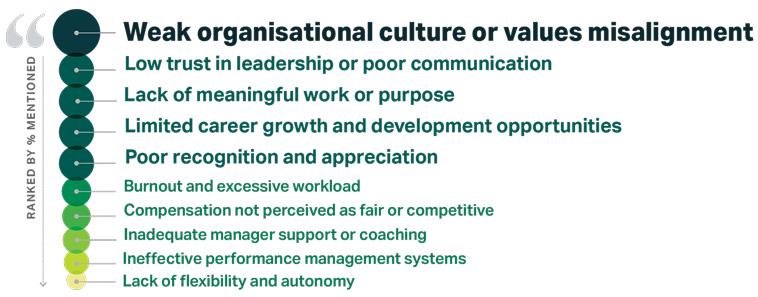
These findings do not imply that pay, workload or flexibility are irrelevant. Rather, they indicate that quiet quitting is primarily a cultural issue. Employees continually assess whether decisions are aligned with organisational values, leaders communicate credibly, effort is acknowledged, and career growth feels possible. When these cultural elements weaken, employees’ discretionary effort declines along with them.
Gallup’s India Culture Risk Report 2025 found strong foundations in ethics, inclusion and mission, while performance management, disruption readiness and leadership inspiration remained areas of risk. The implication is clear: Cultural strengths must become consistent experiences of feedback, accountability, agility and hope.
Culture is a valuable asset when organisational values are reflected in promotion decisions, resource allocation, change communications, performance conversations and recognition. Leadership credibility grows when employees clearly understand the reasons behind organisational behaviour and leadership decision-making.
2. Stretched Managers Need Support
Manager effectiveness is greatly influenced by team culture, individual capability and streamlined processes.
Fostering a team culture in which employees support and rely on one another is the leading priority identified by IOD members, cited by 43%. Three other priorities were selected by 40% of members: Build manager capability for meaningful coaching conversations, use technology to simplify work, and streamline processes to reduce complexity. Enabling managers to drive accountability and performance follows closely, identified by 39% of IOD members.
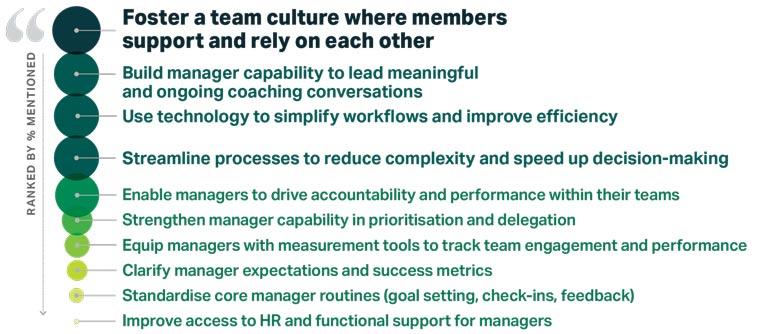
These findings reveal that respondents do not expect managers to lead larger teams through personal heroics. Rather, leaders describe a system that optimises managerial capacity and capability: collaborative teams, meaningful performance conversations, reduced workflow friction and clearer accountability. Technology creates value when it frees up manager time and delivers greater insight and focus; however, it becomes counterproductive when it adds administrative burden or weakens human collaboration and relationships.
Worldwide, only 44% of managers say they have received management training. Managers who receive training are half as likely as those who do not to be actively disengaged. Role clarity matters; coaching and development strengthen the effect.
As team sizes increase, organisations should redesign the workplace environment around the manager: Simplify routines, remove low-value approval processes, create clear team operating procedures, strengthen peer support, and equip managers to coach their teams. A larger span of control is more likely to work when managerial capacity and capability grow with it.
3. Manager Engagement Starts With Talent
Selecting managers based on their talent for the role is crucial to improving their engagement.
Forty-one percent of IOD members surveyed say senior leaders should select managers based on talent and role fit rather than simply past performance. Respondents also prioritise recognising and elevating the manager role (38%), strengthening communication between senior leaders and managers (35%), investing in manager development (34%), and providing clear career pathways for managers and individual contributors (33%).
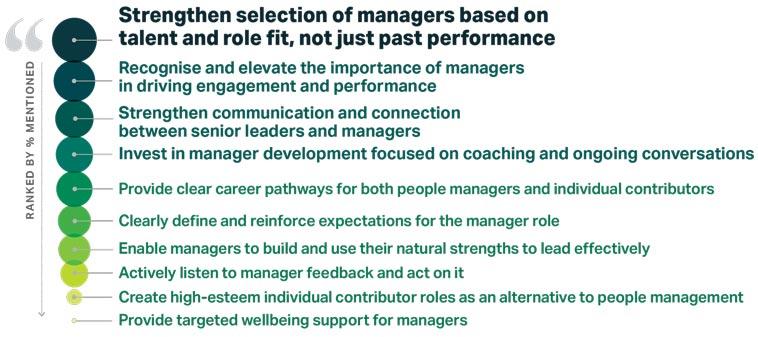
Being promoted to manager should not be an automatic reward for strong performance or technical excellence. People management is a distinct role requiring the ability to build relationships, create accountability, individualise support, communicate with clarity and inspire others. A strong individual contributor may understand the work deeply without having the talent or motivation to help other people perform at their best.
Move from "Who has earned the next step?" to "Who has the talent and motivation to help other people perform at their best?" In parallel, establish high-esteem career paths that allow individual contributors and technical experts to progress without having to be people managers.
Selection based on manager talent is only the beginning. The manager’s role also requires clear expectations, focused training, a strong connection to enterprise priorities, targeted development and visible recognition. When organisations choose the right people to be managers but place them in an untenable position, they waste managerial talent.
From Diagnosis to Action
The Diagnosis Reveals What’s Broken. The Gallup Path® Shows How to Rebuild It.
Leaders multiply their impact through engaging employee, customer and stakeholder experiences.
Engaging “quiet quitting” workers starts with the manager — the person who shapes employees’ day-to-day workplace experience. Great managers create clarity, build trust and promote accountability. Having the optimal role fit enables people to apply their unique individual strengths in ways that are both challenging and energising. An engaging workplace culture makes purpose, recognition, development and employee voice essential elements of everyday work. Engaged employees, in turn, create better experiences for the colleagues, customers and other stakeholders with whom they interact.
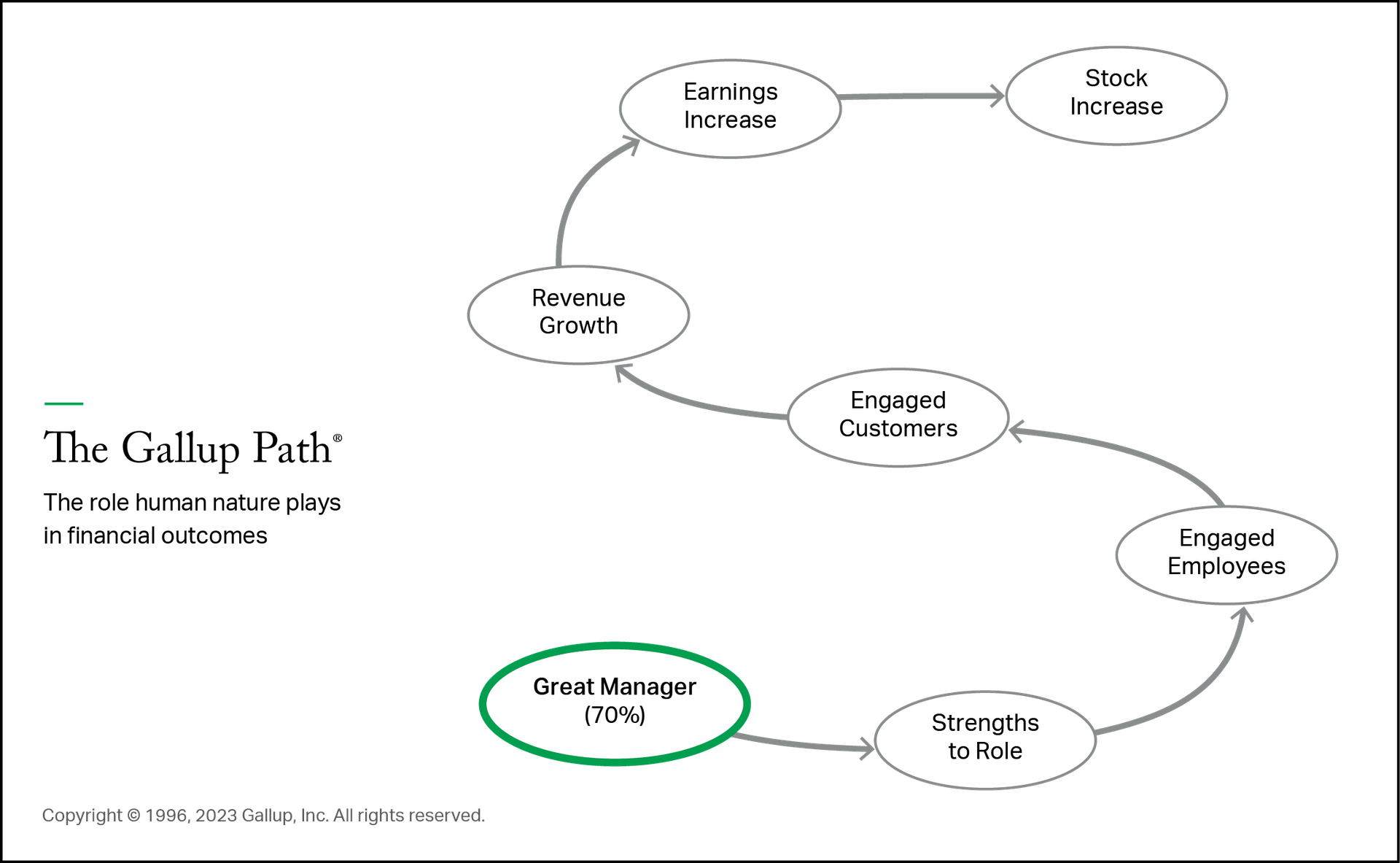
The Gallup Path leads to financial outcomes, but it doesn’t require each step in the path to be followed in a precise order. Organisations may choose to start with their greatest point of weakness. The important principle is that each of the path’s elements reinforces the others: Talent-based manager selection without adequate development is unlikely to drive better performance; measuring employee engagement without manager role clarity or empowerment may result in a set of scores but little else; building employee strengths without setting clear expectations will not boost team engagement; and actions that engage customers without fostering employee trust and collaboration are not sustainable.
1. Select, Equip and Support Great Managers
Manager talent determines potential. Training and support determine whether that potential is realised.
Employees do not experience culture in the abstract. They experience it through decisions about priorities, workload, recognition, development and fairness — many of which are made by their manager. A great manager makes strategy understandable, builds trust during times of change and helps people see how their contribution matters. In contrast, bad managers often create ambiguity, increase friction, weaken trust and undermine team engagement.
Leadership’s first decision is selecting the right people for manager roles. Great management requires a set of talents that differ from those needed for technical expertise: the ability to motivate people, build relationships, make sound judgements, hold people accountable and offer individualised support. Promotion history and subject-matter knowledge may be relevant, but these do not provide sufficient evidence of manager potential.
Leadership’s second decision is about improving manager capability. Even naturally talented managers need role training, coaching skills and a positive operating environment. Gallup's global research shows that effective coaching can be learned. Participants in coaching-focused manager training have experienced up to 22% higher engagement than non-participants; their teams have seen engagement rise by up to 18%; and manager performance metrics have improved by 20% to 28% nine to 18 months after training.
Select managers with the talent to lead people, and then sustain their performance in the role through training, clear decision-making authority, and ongoing support and development.
Leadership’s third decision is about sustainability. Managers need someone who actively encourages their development, ensures access to useful data, empowers them with the authority to act, and allows sufficient time to have meaningful conversations with their team members. Ongoing development greatly increases the chance that managers themselves will be engaged and thrive. And a manager who is engaged and thriving is better positioned to create the right conditions for others to perform.
Great Management Is Defined by Moments of Truth
Seemingly minor management decisions can build enduring trust and loyalty.
The Manager He Still Remembers — Two Decades Later
A senior technology leader still recalls two decisions made 20 years ago by a manager who led a team of more than 400 people. After the future leader missed two early-morning meetings with his manager, he was not reprimanded. Instead, his manager asked him whether another time would work better. Later, when a colleague with strong technical expertise was creating friction within the team, the manager again resisted asserting his authority. Rather, he expressed confidence that the future leader could resolve the situation and allowed him the freedom to act on his own. Each of these responses reflected solid judgement, demonstrating the manager’s ability to know when to adapt, when to preserve accountability and when to entrust someone to solve a problem. Today, the senior leader associates his manager’s skilled approach with the loyalty he felt towards the organisation during the next five years. What he vividly remembers is not the manager's authority but the confidence he placed in others.
—Senior technology leader, IOD leadership conversation
- Use talent and role criteria before making promotion decisions.
- Train managers to coach, recognise performance, set expectations and hold teams accountable.
- Review span of control, workload and time available for individual conversations.
- How do we select managers today, and what evidence matters most to manager performance?
- Do managers have sufficient time to manage people, or only to coordinate work?
- Can strong technical experts progress their careers without becoming people managers?
2. Put Talent Where It Performs Best
Engagement increases when people can harness their strengths and make meaningful contributions.
Great managers do not treat their people like interchangeable components. They look for individual patterns of talent, energy and learning, and they match those patterns with the requirements of the role. This is not about allowing employees to do only what they enjoy. Rather, it is about matching talents and skills with accountability and opportunity.
Role fit affects both performance and engagement. People who work against their natural talents may still be able to perform, but at great expense and with much less consistency. An employee whose talents are a good fit for their role is more likely to learn faster, use their judgement to solve problems and sustain a high level of effort. Leadership’s task is to identify individuals who demonstrate a near perfect fit, show how their performance can be improved, and decide whether a different role or team would deliver greater value.
Strengths-based development transforms talent into consistent performance through knowledge, practice and feedback. It does not ignore weaknesses but rather distinguishes between areas of weakness that must be managed to reduce risk and those areas where additional energy or investment is unlikely to lead to meaningful improvement. The goal of strengths-based development is not to create well-rounded employees but to foster well-rounded teams in which complementary strengths combine to achieve a common purpose.
Move from succession lists and vacancy filling to a more dynamic view of talent: what each person does best, where the organisation most needs that contribution and how the role can be shaped without weakening accountability.
This approach becomes especially important during times of change or transformation. As technology reshapes how work is done, leaders should avoid redesigning jobs around yesterday's requirements or to accommodate technology alone.
Effective role design seeks to answer three questions:
-
What must the role accomplish?
-
Which individual strengths will matter most?
-
How can technology automate low-value tasks so employees can apply their judgement and creativity, build relationships, and create the greatest value?
Retention Begins With Better Role Design
Challenge, recognition, growth and ownership can be more effective and durable than a counteroffer.
Beyond the Retention Band-Aid
A senior leader in a multinational company described the challenges of managing high-demand functions such as regulatory affairs, compliance, research and quality engineering — areas where highly skilled employees have many external opportunities. Rather than relying primarily on bonus payments or perks, he maintained demanding job requirements and adjusted responsibilities based on individual strengths while upholding shared team goals. Good work was recognised publicly. Performance conversations invited employees to identify where they could improve and how they would tackle the next challenge.
The leader reported exceptionally low attrition across these functions. Multiple factors contributed to this result, but the experience illustrates a wider point: Retention improves when employees are in the right role, feel challenged, believe their performance is recognised and have a shared sense of ownership and accountability.
—Senior multinational-company leader, IOD leadership conversation
- Add strengths and role fit to talent reviews and succession discussions.
- Use project assignments and role redesign to harness underused talent.
- Equip managers to recognise patterns of energy, excellence and rapid learning.
- Where is talent underutilised or poorly matched with the role today?
- Do performance conversations clarify each person's distinctive contribution?
- Are future roles being designed around both technology and individual strengths?
3. Bring Culture to Life Every Day
Engagement is not a happiness score. It is about how workplace culture enables employees to perform.
Many organisations confuse engagement with contentment. A favourable pulse score can indicate that people feel satisfied without providing insight into whether work expectations are clear, adequate resources are available, contributions are recognised or performance goals are achieved. Gallup’s employee engagement metric is a measure of workplace conditions that are relevant to performance: clarity of expectations, materials and equipment, opportunity to do one's best work, recognition, development, having one's opinions count, mission and purpose, and quality of relationships with colleagues, among others.
Organisational culture stimulates engagement when employees experience these conditions consistently. Employees assess the organisation's values in everyday moments — how priorities change, how trade-offs are explained, whether good work is acknowledged, how mistakes are handled, whether leaders act on feedback, and whether the future seems worth investing in. Benefits and perks can augment the employee experience, but they cannot deliver engagement.
The greatest opportunity to improve engagement is to move from episodic management to continuous coaching conversations. Annual surveys and appraisals are too infrequent to sustain a consistently positive employee experience. Meaningful conversations help employees know what is expected, how they are doing, where they can grow and how their work connects to the organisation's purpose. They also allow managers to identify and discuss performance obstacles before they become a source of employee frustration and disengagement.
Employees do not disengage from a values statement. They disengage from repeated experiences that make the statement hard to believe.
Frequency alone, however, is not enough. A weekly conversation that is vague, one-sided or disconnected from real work becomes just another meaningless ritual. The most impactful conversations are specific, future-focused and individualised. They combine care with accountability: The employee is seen, empowered and directed towards high performance.
The 12 Elements of Great Management




Listening at Scale Makes Culture Tangible
Focused manager development and a structured listening strategy bring culture to life during rapid growth.
How Listening at Scale Made Culture Real
A senior leader described how a company expanding from 500 to 35,000 employees across four geographies avoided treating engagement as an annual event. Before taking on a people leader role for the first time, each manager was required to complete a programme covering client, people and process management. Future people leaders were prepared before being promoted, not after. The organisation also integrated a structured listening strategy into their employee journey, with touchpoints at 30, 45, 90, 180 and 275 days, followed by twice-yearly check-ins.
Together, these conversations generated hundreds of daily indicators about communication gaps, local friction or emerging workplace toxicity. The technology helped identify patterns of concern, while the operating discipline around the process helped deliver valuable and precise feedback. Leaders could take appropriate action earlier, managers were given clearer expectations, and employees had repeated opportunities for their voice to be heard. The experience shows how culture can be made tangible, even during times of rapid growth and constant change, through manager support, frequent listening and visibly responding to employee feedback.
—Senior organisational leader, IOD leadership conversation
- Translate values and purpose into a focused set of observable team practices.
- Make recognition specific, credible and connected to contribution.
- Replace episodic appraisal with frequent, meaningful performance conversations.
- Where does the lived culture contradict the stated culture?
- Do team routines create trust and accountability or merely more meetings?
- Can employees explain how their work contributes to a shared ambition?
4. Turn Engagement Into Stakeholder Value
Engagement becomes visible in the moments that matter to customers, colleagues and communities.
The true value of employee engagement is much more than a score. It is a measure of how involved, enthusiastic and committed employees are to their work and their organisation. Engaged employees use judgement, take ownership and contribute beyond the minimum. They are more likely to notice a customer problem before it escalates, share pertinent information across functions, make extra efforts to improve quality, adapt quickly when circumstances change and persevere through difficult work.
The first stakeholder to feel the impact of employee engagement is often internal. When coworkers treat each other like internal customers, collaboration is more fluid, work moves with greater speed, and there is less defensive behaviour. Trust makes it easier to identify a mistake, ask for help or challenge an assumption before it becomes a costly error. This internal customer experience then travels outward in the form of project execution, product and service quality, and brand reputation.
Customer experience and business performance are downstream of the employee experience — especially the quality of management, teamwork and accountability that employees encounter every day.
Managers create the conditions that determine the quality and impact of the customer/stakeholder value chain. They either foster or discourage team collaboration, signal whether people will be praised or blamed for pointing out a problem, determine the importance of delivering on customer promises, and decide who is empowered to make decisions. When employees work in a culture of fear, they hide risk and stay well within their own protected boundaries. When employees experience encouragement and support from their manager, they are more likely to work in ways that create value for the whole organisation.
Business impact of highly engaged business units
Gallup's research of more than 180,000 teams — over 3.3 million employees — revealed that teams in the top quartile of employee engagement achieved higher performance on positive outcomes and realised fewer negative outcomes than bottom-quartile teams.
Percent Differences in Outcomes Between Top-Quartile and Bottom-Quartile Teams
Difference between top- and bottom-quartile teams/business units within a typical organisation
 78% in absenteeism
21% in less turnover for high-turnover organisations*
51% in less turnover for low-turnover organisations*
28% in shrinkage (theft)
63% in safety incidents (accidents)
58% in patient safety incidents (mortality and fails)
32% in quality (defects)
 10% in customer loyalty/engagement
18% in productivity (sales)
14% in productivity (production records and evaluations)
23% in profitability
70% in wellbeing (net thriving employees)
22% in organisational citizenship (participation)
*The above figures are median percent differences across companies in Gallup's database. High-turnover organisations are those with more than 40% annualised turnover. Low-turnover organisations are those with 40% or lower annualised turnover.
Gallup’s most recent Q12 meta-analysis establishes correlations between team engagement and 11 performance outcomes, including customer loyalty, profitability, productivity, employee turnover, safety incidents, absenteeism, quality defects, wellbeing and organisational citizenship. The relationships are substantial and highly generalisable across organisations. This does not imply that engagement is the only driver of performance. Engagement differentiates between top- and bottom-quartile teams or business units within a typical organisation.
How Transparency Can Benefit Both the Customer and the Company
Psychological safety and transparency matter most when commercial considerations are at stake.
From Loss-Making Deal to Customer Win-Win
A miscommunication between sales and procurement led a team to quote the wrong products and services in a customer contract, meaning they risked losing money on the deal. Middle management identified and escalated the issue rather than concealing it. Senior leaders backed the team, asking it to minimise losses as much as possible without shifting costs to the customer. The pre-sales team discussed the situation with the customer, clarified the underlying needs and reconfigured the solution.
The revised approach transformed the loss-making deal into a positive gross profit for the company while still saving the customer money. This episode combined employee vulnerability and psychological safety with cross-functional problem-solving and executive support. The commercial results certainly mattered, but the more valuable lesson was that people could identify a problem and resolve it collaboratively without assigning blame.
—Senior customer and sales leader, IOD leadership conversation
- Define the stakeholder and operational outcomes that engagement should influence.
- Review engagement alongside customer, quality, productivity, retention and risk data at the team level.
- Identify high-performing, experienced teams, and then identify and scale the management practices and workplace environment that support them.
- Where should engagement create the greatest value in our operating model?
- Which comparable teams deliver very different stakeholder outcomes, and what explains the variation?
- What management practices distinguish teams that sustain both strong engagement and performance?
Conclusion: The Integrated Leadership System
One Integrated System, Not Four Initiatives
Manager talent, employee talent, engagement and strengths all add value — and reinforce one another.
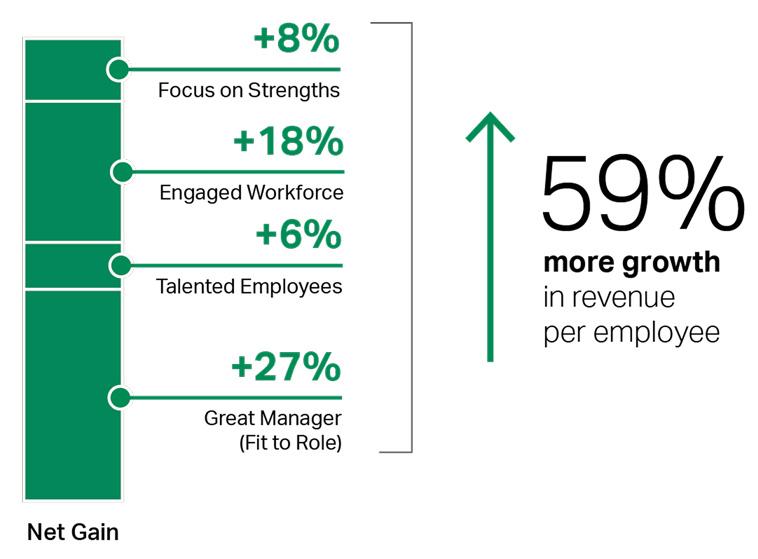
Gallup's additive effect research shows how four workplace components combine to boost revenue per employee. Selecting and deploying the right managers is the largest single component, contributing a net gain of up to 27% higher revenue per employee. Selecting employees based on their role-specific talent adds a further 6% of net gain, an engaged workforce contributes another 18%, and strengths-based development adds a net gain of 8%. A comprehensive best-practice implementation would result in a combined 59% net gain in revenue per employee. The maximum potential impact is made attainable when the four components are implemented as a fully integrated system.
The Gallup Path explains how value is created throughout the organisation. The additive effect research demonstrates how the combined potential value increases when the individual components are deployed together.
Methodology and Sources
About This Report
This report brings together three complementary sources of evidence to examine employee engagement in India and identify practical solutions for boards and senior leaders.
Methodology
This report draws on Gallup’s global and India-specific workplace research, including findings from the State of the Global Workplace: 2026 Report. Published in 2026, the report draws on data collected between January and December 2025. India’s employee and manager engagement trends are reported using three-year rolling averages.
This report also uses Gallup’s wider research on manager effectiveness, strengths, organisational culture, employee engagement and business performance. This includes the Gallup Path, the Q12 engagement framework, manager development research and the Q12 meta-analysis.
Gallup and the Institute of Directors (India) conducted an online survey using the IOD platform between 14 May and 22 June 2026. The survey received responses from 181 IOD members, including board members and senior business and governance leaders. It explored three interconnected questions: What is contributing to the rise of psychological withdrawal or “quiet quitting” in Indian workplaces? What should organisations prioritise to help stretched managers lead effectively? What can senior leaders do to strengthen manager engagement?
For each question, respondents were asked to select up to three of 10 multiple-choice options.
Additionally, Gallup conducted 27 interviews with senior leaders across multiple sectors. Participants were invited to reflect on the report’s central themes and share specific experiences of how leadership and management decisions have affected their employees, teams, customers and organisational outcomes. The interviews were designed to capture lived experiences and leadership stories that bring the quantitative findings to life. The examples featured in this report were selected for their relevance to manager effectiveness, strengths and role fit, the daily employee experience, and the connection between engagement and stakeholder value.
Sources
- Gallup. (2026). State of the global workplace: 2026 report.
- Gallup & Institute of Directors (India). (2026). IOD member survey.
- Gallup & Institute of Directors (India). (2026). Senior leader interviews.
- Gallup & NHRDN. (2025). The culture imperative: Insights for India's next chapter.
- Gallup. (2024). The relationship between engagement at work and organizational outcomes: Q12 meta-analysis (11th ed.).
- Beck, R., & Harter, J. (2015). Companies are missing opportunities for growth and revenue.
Action Agenda
What Leaders Can Do Now
Start with a few high-impact decisions, and then build a leadership system that sustains engagement at scale.
Diagnose the system
- Review how managers are selected and promoted.
- Identify the processes that consume manager time without creating value.
- Examine manager engagement, span of control, training and support by business unit.
- Choose three business outcomes to link to engagement.
Redesign the experience
- Train managers in role fundamentals and coaching conversations.
- Simplify core routines, approvals and meeting workload.
- Pilot strengths and role fit reviews in mission-critical teams.
- Identify the leadership behaviours that make culture tangible.
Scale and govern
- Build a manager talent pipeline and expert individual career paths.
- Embed frequent performance conversations and team accountability.
- Track engagement scores alongside customer, productivity, quality and retention metrics.
- Review culture as a strategic asset and operational risk.
Which part of the system is currently limiting performance most? Manager selection, manager capacity, role fit, the daily employee experience, or the connection between engagement and business outcomes?
- The CEO and executive team set the operational expectations.
- Business leaders own local change and outcomes.
- HR provides science, systems, capability and governance.
- Review manager and culture risk as part of human capital oversight.
- Ask for trends, variation and actions — not just an annual enterprise score.
- Connect workforce indicators with strategy execution and stakeholder outcomes.
Get This Report Via Email
We will send you a copy of this full report and updates about our latest global analytics research and polling.