
Employee Wellbeing: What It Is, Why It Matters and How to Improve It
Employee wellbeing is a powerful predictor of organizational resilience, engagement and performance. Gallup research shows that organizations that prioritize wellbeing at work create workplaces with less burnout, stronger engagement and greater employee retention, even amid global stress and shifting work expectations.
Executive Summary: What Leaders Need to Know About Wellbeing
Executive Summary: What Leaders Need to Know About Wellbeing
- The Framework: Employee wellbeing is a holistic measure of how people experience their lives, defined by five universal elements: career, social, financial, physical and community wellbeing.
- The Financial Cost: Neglecting wellbeing costs large organizations an estimated $20 million in lost opportunity for every 10,000 employees.
- The Burnout Buffer: Employees who are thriving in their wellbeing are 46% less likely to experience frequent burnout and 65% less likely to watch for or actively seek a new job.
- The Priority: While all elements matter, career wellbeing is the foundation; it is the strongest predictor of overall life evaluation and the element organizations can influence most directly.
- The Engagement Link: Wellbeing stabilizes engagement. Without it, even highly engaged employees face a much higher risk of daily stress, worry and sadness.
What Is Employee Wellbeing?
What Is Employee Wellbeing?
It reflects the things that are important to all employees, including the work they do, the relationships they have and how their organization supports them as whole people.
What Employee Wellbeing Includes
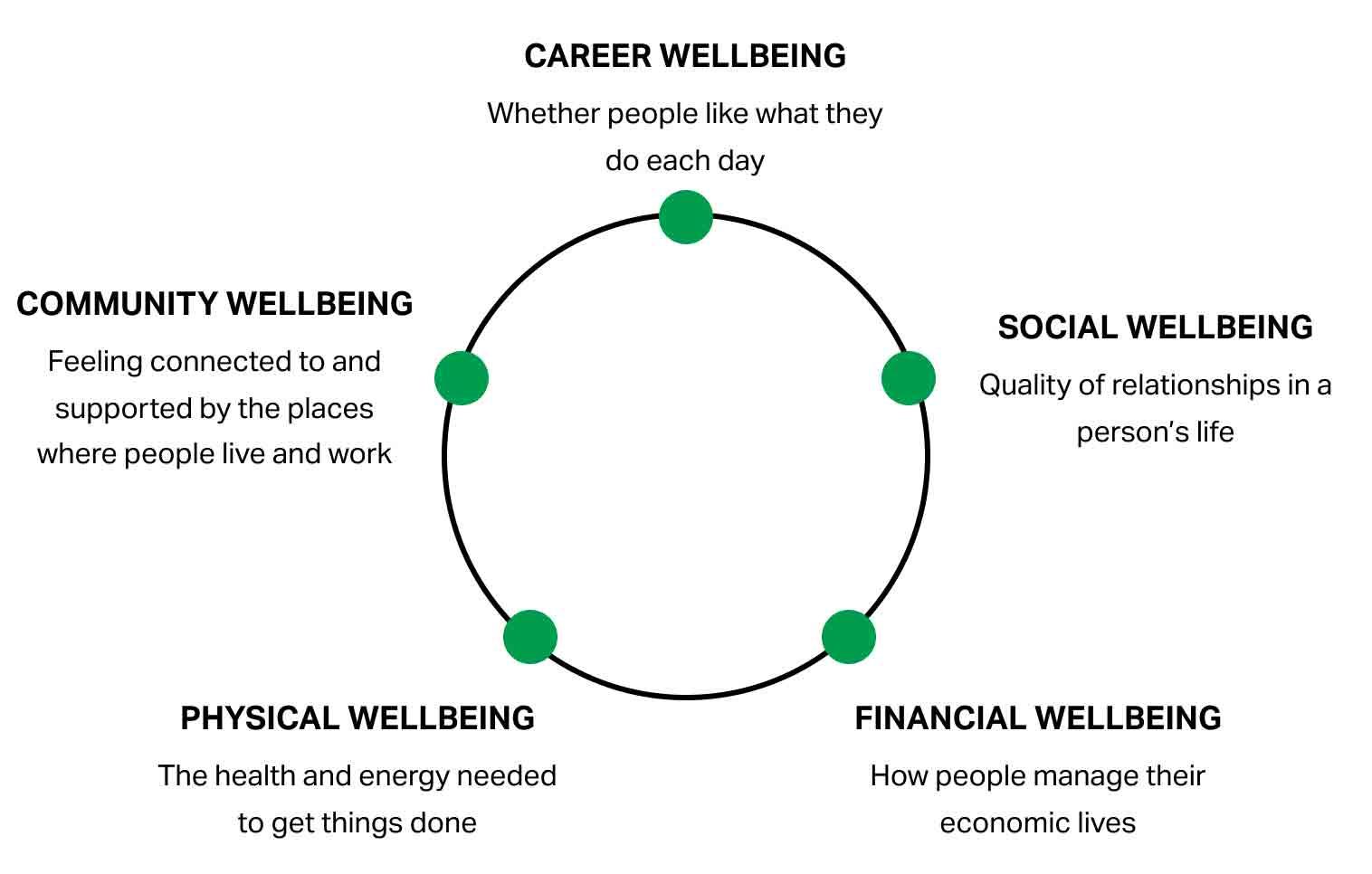
Five interconnected elements define employee wellbeing and reflect how people experience their lives and their work.
These elements provide a practical framework for understanding whether employees are thriving, struggling or suffering.
-
Career wellbeing
-
Social wellbeing
-
Financial wellbeing
-
Physical wellbeing
-
Community wellbeing
Together, these elements form the foundation of Gallup’s wellbeing framework, explained in detail below.

Wellbeing vs. Wellness: What’s the Difference?
Employee wellbeing and employee wellness are related, but they are not the same.
Employee wellness programs typically focus on physical health and behaviors such as exercise, nutrition, and medical care. Employee wellbeing is broader. It reflects how people evaluate their lives overall and how work, relationships, and daily experiences influence that evaluation.
Organizations that focus only on employee wellness programs may improve physical health outcomes, but they often overlook the workplace factors that shape stress, burnout and long-term performance.
Improving employee wellbeing requires understanding the full experience of work and life, not just individual health habits.
| Employee Wellness | Employee Wellbeing | |
|---|---|---|
| Focus | Physical health and safety | Whole-person experience and life evaluation |
| Scope | Exercise, nutrition, medical care | Career, social, financial, physical, community |
| Outcome | Improved biometric health markers | Higher engagement, lower burnout, resilience |
| Primary Factors | Individual habits and perks | Management, job design, life experience |
What Are the Elements of Employee Wellbeing?
What Are the Elements of Employee Wellbeing?
Employee wellbeing includes five elements: career, social, financial, physical and community.
Gallup’s decades-long global research shows that people experience their lives through these five universal elements. Each element represents a distinct but interconnected area of life that together determines whether individuals are thriving, struggling or suffering.
The Five Elements of Wellbeing
Career wellbeing reflects whether people like what they do each day. It includes having meaningful work, opportunities to use one’s strengths and a sense that work contributes to purpose. Career wellbeing forms the foundation for the other elements.
Social wellbeing refers to the quality of relationships in a person’s life. Strong social connections, including supportive relationships at work, contribute to resilience, belonging and daily wellbeing.
Financial wellbeing describes how people manage their economic lives. When individuals feel secure and in control of their finances, they experience less stress and can focus more fully on their work.
Physical wellbeing reflects having the health and energy needed to get things done. Daily habits, access to care and the ability to sustain energy over time influence physical wellbeing.
Community wellbeing refers to feeling connected to and supported by the places where people live and work. It includes a sense of belonging, safety and pride in one’s community.
How the Elements of Wellbeing Work Together
The five elements of wellbeing are additive, meaning that thriving in more elements leads to better outcomes than thriving in just one.
Gallup research shows that as people thrive in more elements of wellbeing, risk factors such as stress, burnout, disease burden and negative daily emotions decline. Thriving in physical wellbeing alone, for example, is less powerful than thriving across multiple elements.
Because the elements are interconnected, challenges in one area often spill into others. A holistic view of employee health and wellbeing helps organizations identify where employees face the greatest risk and where targeted improvements can matter most.
A Universally Applicable Framework for Employee Wellbeing
The five elements of wellbeing provide a consistent framework for understanding employee wellbeing in any organization. Because these elements apply across cultures and industries, they help leaders see where employees are thriving and where they are at risk, beyond what traditional health or engagement metrics reveal.
Why Career Wellbeing Matters Most
While all five elements of wellbeing are important, career wellbeing serves as the foundation for the others.
Gallup research shows that how people experience their work each day strongly influences their overall wellbeing because work affects purpose, identity, relationships and daily energy.
For organizations, career wellbeing is also the element they can influence most directly. The nature of the work, the quality of management and opportunities to use strengths shape whether employees feel supported or depleted.
When career wellbeing is strong, it creates momentum that supports improvements across the other elements of wellbeing.

How Mental Health Relates to Wellbeing
Gallup’s research shows that workplace and life factors tied to the five elements of wellbeing help predict future mental health outcomes, including the likelihood of experiencing stress, anxiety, and depression.
High-quality work experiences, particularly those shaped by engagement and supportive management, are associated with a lower risk of negative mental health outcomes.
Why Is Employee Wellbeing Important?
Why Is Employee Wellbeing Important?
Gallup research shows that when wellbeing is low, productivity and engagement decline, burnout rises, and turnover accelerates. When employees are thriving in their lives, they perform better, show greater reliability and strengthen the organizations they work for.
Employee Wellbeing Predicts Organizational Outcomes
Gallup’s economic research shows that wellbeing reliably predicts future absenteeism, performance, healthcare use, employee engagement and turnover. In this way, wellbeing functions as a leading indicator of organizational health. It signals risk and opportunity before those conditions appear in traditional performance or cost metrics.

Employee Wellbeing Has a Direct Effect on Performance
The benefits of employee wellbeing are clear: Gallup’s research shows that employees who feel their best do their best.
Organizations with higher employee wellbeing show stronger performance fundamentals, including higher engagement, fewer sick days and fewer safety incidents.
When leaders underestimate the importance of wellbeing at work and allow it to drop, productivity and engagement suffer, weakening day-to-day performance and long-term results.
Poor Wellbeing Creates Significant Financial and Operational Cost
The cost of neglecting employee wellbeing is substantial and measurable:
$20 million in lost opportunity for every 10,000 employees because of low wellbeing and reduced performance
$322 billion in turnover and lost productivity when low wellbeing shows up as burnout
15% to 20% of total payroll lost annually to voluntary turnover driven by burnout alone
These costs compound over time, affecting retention rates, customer experience and organizational effectiveness.
Wellbeing Supports Organizational Resilience
Gallup research shows that employee wellbeing directly affects an organization’s ability to sustain performance and recover from disruption. When wellbeing is weak, resilience breaks down in predictable ways:
- Employees who experience frequent burnout are 63% more likely to be absent, reducing workforce reliability.
- Burned out employees are more than twice as likely to look for another job, increasing instability and turnover.
- Low wellbeing undermines employees’ energy, focus and capacity to perform under pressure, increasing operational risk.
When employees are thriving in their lives, they bring greater stability, adaptability and endurance to their work, strengthening organizational resilience over time.
Low Wellbeing Undermines Organizational Resilience Through Burnout and Instability
Employee burnout poses a direct threat to organizational resilience. Gallup data show:
- 27% of U.S. employees experience burnout very often or always.
- Employees who frequently experience burnout are 2.6 times as likely to leave their employer.
- Burnout is associated with lower confidence, weaker goal alignment and disengagement.
Organizations with widespread burnout face higher volatility, slower recovery and greater talent loss during periods of stress.
When Employees Believe Their Organization Cares About Their Wellbeing, Outcomes Improve
Gallup research consistently shows that employees who strongly agree that their organization cares about their overall wellbeing deliver better results for their organizations. Compared with other employees, they are:
-
54% less likely to be watching for or actively seeking a new job
-
3.2x less likely to report experiencing frequent burnout
-
65% more likely to be thriving in their lives
-
4.6x as likely to be engaged at work
-
6.2x as likely to strongly advocate for their organization as a place to work
Teams that believe their organization cares about their wellbeing also perform better. They reach higher levels of customer engagement, productivity, and profitability, while seeing fewer safety incidents and lower turnover.
Thriving Employees Compared With Those Struggling or Suffering
| Turnover Intent | 65% less likely to watch for or actively seek a new job |
|---|---|
| Burnout Risk | 46% less likely to report frequent burnout |
| Productivity | $2 million to over $20 million saved in lost opportunity per 10,000 employees |
| Engagement | 2.2x as likely to be engaged at work |
| Advocacy | 2x as likely to strongly agree they would recommend their org as a great place to work |
How to Measure Employee Wellbeing
How to Measure Employee Wellbeing
Organizations can measure employee wellbeing using the Life Evaluation Index.
Gallup measures wellbeing consistently and at scale by asking employees to evaluate their lives overall, not just how they feel at work on a given day. This approach to measuring employee wellbeing provides workforce analytics that give leaders a reliable view of current wellbeing and future resilience.
Measuring Wellbeing Through Life Evaluation
The most powerful method Gallup uses to measure wellbeing is through life evaluation. This measure captures how people view their lives today and how they expect their lives to be in the future, offering insight into both present wellbeing and long-term outlook.
Gallup uses simple employee wellbeing survey questions that ask employees to rate:
-
their current life
-
their expected life five years from now
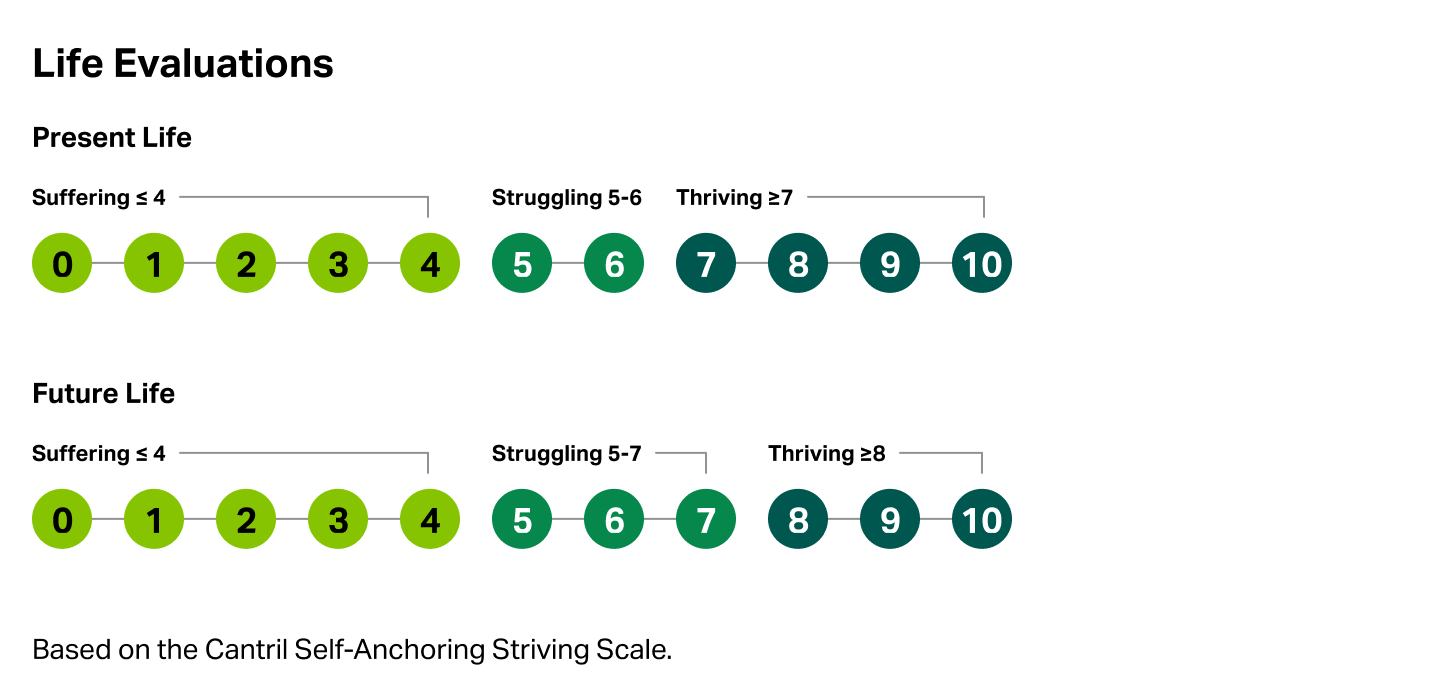
Based on these responses, Gallup classifies employees into three wellbeing categories:
-
Thriving: Employees with positive views of their present life and the next five years
-
Struggling: Employees who manage day to day but express concern about the future
-
Suffering: Employees who report that their lives are going poorly and are likely experiencing significant challenges
This framework helps organizations understand overall workforce wellbeing and identify risks that engagement or health metrics alone may not reveal.
| Life Evaluation Criteria | Organizational Risk | |
|---|---|---|
| Thriving | Positive view of current life and the next five years | Low; higher resilience and performance |
| Struggling | Moderate view with concerns about the future | Medium; more vulnerable to stress and burnout |
| Suffering | Poor view of current life with significant challenges | High; greater likelihood of absence or disengagement |
Why This Measurement Matters
Life evaluation serves as a leading indicator of workforce stability and resilience. Organizations with a higher proportion of thriving employees sustain performance, adapt to change more readily, and reduce risk associated with burnout, absenteeism, and turnover.
Because leaders can measure life evaluation consistently over time, they can track wellbeing trends, assess progress and understand how workplace changes affect employees’ lives.
How to Use Wellbeing to Prevent Burnout
How to Use Wellbeing to Prevent Burnout
Gallup research shows that employee burnout is far more likely when employee wellbeing is low. Employees who are thriving in their lives show greater resilience, experience less chronic stress and sustain performance under pressure more effectively.
Conversely, employees who are struggling or suffering face significantly higher risk of burnout. In this way, employee wellbeing acts as a preventive buffer, reducing burnout before it becomes widespread and costly.
What Gallup Research Shows About Burnout Risk
Gallup’s research consistently shows that how people experience their work and their lives overall affects burnout, not simply by how many hours they work:
-
The quality of the work experience has 2.5 to 3 times more impact on overall wellbeing than the number of hours or days worked. This makes wellbeing a stronger predictor of burnout than workload alone.
-
Employees with high career wellbeing are more than twice as likely to be thriving in their lives, lowering vulnerability to chronic stress and exhaustion.
-
Burned out employees are 2.6 times more likely to leave their organization and 63% more likely to be absent, increasing instability and operational risk.
-
Gallup research shows that burnout is most often linked to poor management, unclear expectations, and a lack of support, rather than to individual resilience or motivation.
These findings show that organizations can largely prevent burnout when they address the conditions that shape employee wellbeing.
Why Wellbeing Is More Effective Than Reactive Burnout Solutions
Many organizations attempt to address burnout only after it appears. This approach is often less effective than strengthening wellbeing proactively.
When organizations improve the quality of work, management practices, and career experiences that influence wellbeing, they reduce burnout risk before it escalates into turnover, absenteeism, and performance loss.
Wellbeing Reveals Signs of Burnout Early
Gallup research shows that declines in employee wellbeing often appear before symptoms of burnout become widespread. When employees shift from thriving to struggling, organizations begin to see higher stress, increased absenteeism and disengagement, and stronger turnover intent.
By monitoring wellbeing, leaders can identify early warning signs of employee burnout and intervene before performance declines become sustained and costly.

How to Use Wellbeing to Improve Employee Retention Strategies
How to Use Wellbeing to Improve Employee Retention Strategies
Employee wellbeing plays an important role in building the employee experience, including employee attraction strategies. Gallup research shows that employees who are thriving in their lives are significantly less likely to look for another job, while organizations that neglect wellbeing face higher turnover risk and a weaker employee value proposition.
In tight labor markets, wellbeing influences employee retention strategies and shapes how job seekers decide where to apply.
Employee Wellbeing and Retention: What the Data Show
Gallup research shows that employee wellbeing strongly predicts whether employees stay or leave. Employees who are thriving in their lives are significantly less likely to be actively seeking another job, while those who are struggling or suffering face much higher risk of turnover.
Employees who strongly agree that their organization cares about their overall wellbeing are:
-
54% less likely to be actively searching for a new job
-
More likely to remain committed to their organization during periods of change
-
Less vulnerable to burnout-driven turnover that disrupts teams and performance
Because turnover is costly and destabilizing, organizations that improve employee wellbeing protect talent retention, preserve institutional knowledge, maintain team continuity, and support long-term performance.
Low Wellbeing Accelerates the Loss of Top Talent
Gallup research shows that burnout and low wellbeing do not affect attrition evenly across the workforce. Engaged, capable and in-demand employees are often the first to leave when wellbeing deteriorates. As burnout rises, these employees are more likely to seek roles that offer better work experiences, stability and support.
Neglecting wellbeing doesn’t simply increase turnover. It raises the risk of losing high performers, weakens teams, and increases the cost of employee turnover.
The Link Between Employee Engagement and Wellbeing
The Link Between Employee Engagement and Wellbeing
Gallup research shows that employee engagement and wellbeing reinforce one another. Engagement improves employees’ day-to-day work experiences, while wellbeing strengthens employees’ capacity to sustain engagement over time.
Employees who are both engaged and thriving show substantially lower absenteeism and turnover and demonstrate greater adaptability and resilience than employees who are engaged but have low wellbeing.
Engagement motivates effort. Wellbeing sustains it.
These are your most reliable high performers. They are psychological owners of their work and have high resilience to stress.
This is the "hidden risk" category. These employees are highly committed and productive in the short term, but because their life evaluation is low, they are 61% more likely to experience frequent burnout.
These employees have great lives outside of work but are "quietly quitting" or unattached to their company’s mission. They represent lost discretionary effort.
The highest risk group. They are likely to be actively disengaged, spreading negativity, and have high rates of absenteeism and medical issues.
Wellbeing Sustains Engagement Over Time
Employee wellbeing strengthens employees’ ability to remain engaged, particularly during periods of pressure, change or high workload.
Employees who are thriving show greater energy, emotional stability and resilience. These qualities allow them to sustain discretionary effort and stay committed to their work. When wellbeing is low, engagement may persist temporarily, but stress often erodes it.

Low Wellbeing Undermines Engagement
Gallup research shows that low wellbeing actively increases risk even among engaged employees. Employees who are engaged but not thriving are significantly more likely to experience burnout, stress, worry and negative daily emotions.
Over time, these conditions make engagement difficult to sustain, increasing the likelihood of disengagement, absenteeism and turnover. In this way, wellbeing stabilizes engagement. Without it, engagement becomes fragile.
Why Engagement Alone Isn’t Enough
Gallup research shows that engagement improves performance, but engagement without wellbeing carries risk. Employees can be highly engaged in their work while still experiencing low wellbeing, leaving them more vulnerable to burnout, stress and negative daily emotions. In these cases, engagement may support short-term effort but becomes difficult to sustain.
Comparing employees who are engaged but not thriving with those who are both engaged and thriving reveals meaningful differences. Engaged employees who are not thriving are:
-
are 61% more likely to experience burnout often or always
-
48% more likely to report daily stress
-
66% more likely to experience daily worry
-
2x as likely to report daily sadness and anger
These findings show that engagement and wellbeing must work together.
Career Wellbeing Connects Engagement and Wellbeing
Career wellbeing, or liking what you do every day, forms the strongest link between engagement and overall wellbeing. Gallup research shows that engagement is the single biggest factor in career wellbeing, and career wellbeing has the strongest impact on overall wellbeing.
When employees find their work meaningful and aligned with their strengths, engagement and wellbeing reinforce one another. Without a fulfilling work experience, sustained engagement is unlikely.
Managers Sit at the Center of Engagement and Wellbeing
Managers play a decisive role in shaping both employee engagement and employee wellbeing. Gallup research shows that managers account for the majority of variance in team-level engagement. The same factors managers influence — role clarity, feedback, recognition and workload experience — also strongly affect wellbeing and burnout risk. At the manager level, engagement and wellbeing rise or fall together.
When Engagement and Wellbeing Work Together
When employees are both engaged and thriving, organizations experience stronger performance and lower risk.
Together, engagement and wellbeing create a high-performance workplace culture where effort is consistent, burnout is lower and performance is more durable.
How to Improve Employee Wellbeing
How to Improve Employee Wellbeing
To improve employee wellbeing, organizations must focus on the full employee experience. They do this by strengthening career wellbeing, equipping managers, addressing wellbeing holistically and measuring progress over time. The most effective employee wellbeing strategy treats wellbeing as a system, not a one-off employee wellbeing program.
Yet many organizations begin their efforts with employee wellbeing programs, but initiatives alone rarely address the underlying conditions that shape how people experience work. Improving employee wellbeing requires more than isolated wellbeing programs at work or perks.

Start With Career Wellbeing
Organizations should start their wellbeing efforts by focusing on career wellbeing. Career wellbeing forms the foundation for all the other elements of employee wellbeing. Because work plays a central role in people’s lives, improving the quality of employees’ daily work experiences produces the strongest and fastest gains.
To improve career wellbeing, organizations should:
-
Build work around strengths. Ensure every employee understands what they naturally do best and has regular opportunities to apply those strengths.
-
Set a clear standard for manager behavior. Organizations cannot afford leaders who diminish trust, undermine confidence or create fear. Manager quality is one of the greatest influences on career wellbeing.
-
Develop managers as performance coaches. Managers must learn to set clear expectations, hold frequent performance conversations and provide specific, forward-looking feedback that helps employees grow.
-
Integrate wellbeing into career development. Career conversations should extend beyond role progression to include long-term aspirations, purpose and overall wellbeing.
When employees like what they do each day, improvements extend to other elements of wellbeing.
How Can Managers Support Employee Wellbeing?
Managers connect organizational intent to employee experience.
Gallup’s research shows that leadership and management practices strongly influence whether improvements in wellbeing translate into sustained performance and reduced costs over time. Organizations that invest in how managers lead see greater returns from their wellbeing efforts than those that rely solely on programs.
Organizations that improve wellbeing prioritize management training and leadership development, equipping managers to:
-
clarify priorities and reduce unnecessary stress
-
hold frequent, meaningful conversations
-
recognize contributions and progress
-
support employees as whole people, not just performers
-
promote psychological safety at work
Wellbeing improves when managers are equipped to lead with consistency, clarity and care.
Address Wellbeing Holistically
Employee wellbeing is multidimensional. Improving one element in isolation is less effective than addressing how the elements work together. Organizations make greater progress when they consider how work affects employees’ social connections, financial stability, physical energy and sense of belonging, not just productivity.
A holistic approach helps leaders identify where employees are thriving, where they are at risk and where targeted improvements can matter most.
Measure Progress and Adjust Over Time
Wellbeing improvement requires ongoing attention. Gallup’s research shows that organizations make the most progress when they measure wellbeing consistently, track changes over time and adjust employee wellbeing initiatives based on what employees are experiencing.
By monitoring wellbeing, leaders can:
-
identify rising risk early
-
evaluate whether changes are working
-
focus resources where they matter most
Measurement turns wellbeing from an aspiration into a manageable, measurable part of organizational performance.