Singapore Workplace Report 2026

Powering Singapore’s Future: The Case for a National Engagement Infrastructure
Powering Singapore’s Future: The Case for a National Engagement Infrastructure features critical insights into employee engagement in Singapore, drawing upon findings from the Gallup World Poll, Gallup’s 2026 State of the Global Workplace report and in-depth interviews with senior leaders of major Singapore employers.
Download the report to explore the forces reshaping Singapore's workplaces. Whether you are a board director, senior executive or HR leader, this report sets out a clear case for building the employee engagement infrastructure Singapore needs to power its next phase of growth.
Foreword
Foreword
Singapore has long distinguished itself as a high-performing, globally connected economy built on resilience, adaptability and trust. Yet this inaugural Singapore Workplace Report 2026 by Singapore Institute of Directors and Gallup reveals an important paradox: Despite our economic strength, employee engagement levels remain persistently low.
This finding should matter to every board and leadership team. In an increasingly complex environment shaped by technological disruption, demographic change, evolving workforce expectations and rising global uncertainty, the ability to engage, develop and inspire people is becoming a defining source of competitive advantage.
At the Singapore Institute of Directors, we believe that governance and leadership are fundamentally about people. Strong organisations are built not only through sound strategy and financial discipline, but also through workplace cultures that enable individuals and teams to perform at their best. The quality of leadership shapes the quality of the employee experience, and ultimately, organisational resilience and long-term value creation.
This report, developed in partnership with Gallup, provides timely and evidence-based insights into the realities of Singapore’s workplaces. Drawing on Gallup’s extensive global research, leadership interviews and roundtable discussions with senior executives and directors, the report surfaces critical issues that leaders can no longer afford to ignore. These include the central role of managers in driving engagement, the growing disconnect between wellbeing initiatives and workplace realities, the widening generational divide, and the disruptive impact of artificial intelligence and changing work models.
The report also highlights practical pathways forward. It underscores the need for organisations to strengthen manager capability, align culture with lived employee experience, reposition HR as a strategic partner, and optimise the workforce potential through a more intentional approach to talent development and engagement.
For boards, these findings carry significant implications. Workforce engagement, organisational culture and leadership capability are strategic priorities directly linked to productivity, innovation, resilience and sustainable growth. Boards must therefore play an active role in overseeing how organisations build healthy, high-performing workplace cultures that are fit for the future.
We hope this report will encourage deeper reflection and meaningful action across Singapore’s corporate sector. By investing in people, strengthening leadership and fostering cultures of trust and accountability, organisations can unlock the immense potential of Singapore’s workforce and position themselves to thrive in an era of profound change.
The Singapore Institute of Directors is proud to partner with Gallup on this important initiative. Together, we are committed to supporting directors and business leaders in building workplaces where both organisations and people can succeed.

Yeoh Oon Jin Chair of Singapore Institute of Directors
Executive Summary
Executive Summary
Singapore is one of the most prosperous nations on earth, with a high-performing economy that has achieved consistently strong GDP growth. Yet only 14% of its workforce is engaged — well below the regional figure of 25% in Southeast Asia and the global mean of 20%. This is not a recent trend. Singapore’s engagement has stagnated at or near its current level since 2019.
How is it possible for Singapore to achieve such consistently strong economic performance when most of its workforce is disengaged? More importantly, why should leaders be concerned about the country’s disengaged workforce?
While Singapore’s GDP achieved robust 5% growth in 2025, the Ministry of Trade and Industry currently forecasts more modest GDP growth of 2% to 4%. In this context, low engagement may impede the country’s future growth as global market conditions become more challenging. Employee engagement is a bulwark against external market forces and a resource that organisations can utilise to sustain and boost organic growth.
What does the gap between economic performance and low workforce engagement reveal in terms of risks and opportunities for Singapore’s economy and the sustained competitiveness of its corporate sector?
This report aims to answer this question and offer insights into the key barriers to higher workforce engagement, how they can be reduced or eliminated, and the benefits to Singapore’s companies in terms of enhanced performance and global competitiveness.
The insights and discoveries featured in this report are based on global workplace research conducted using the Gallup World Poll and findings published in Gallup’s 2026 State of the Global Workplace annual benchmark report. In-depth interviews were also conducted with senior leaders from Singapore private and public sector employers to learn their perspectives on key issues and challenges affecting their organisations and workforces. In collaboration with the Singapore Institute of Directors, we also facilitated a roundtable session with senior company executives to gather their insights about Singapore’s workplace culture.
Five Key Findings
-
Leaders recognise engagement’s value but lack the ability to execute: Singapore’s leaders are aware of the importance of employee engagement to company performance. However, their organisations often struggle to deploy the infrastructure, processes and support mechanisms necessary to make engagement tangible for employees and managers in their day-to-day workplace experience.
-
Younger workers are disengaging: Singapore’s younger employees (under 35) report significantly lower engagement than their older colleagues. This generational divide will widen unless companies adapt how they structure work, provide development and create meaningful opportunities for career progression.
-
Pivotal role of the manager: Gallup research is unambiguous — managers are the single greatest driver of employee engagement. Most leaders we interviewed acknowledged this, yet their organisations continue to promote high-performing individual contributors into management roles without adequate preparation or support. Investing in manager capability can have a meaningful impact on Singapore company performance.
-
Wellbeing programmes treat symptoms, not causes: The majority of executives confirmed that their organisations offer flexible working, employee assistance programmes and wellness initiatives. Employees value these programmes, but they address the consequences of poor wellbeing and disengagement rather than their root causes. Unmanageable workloads, psychosocial hazards and chronic burnout will not be resolved by wellness days alone.
-
Change and disruption are accelerating: AI adoption, hybrid work, an ageing workforce and the country’s elevated operating costs are major disruptive factors challenging organisational readiness and reshaping the competitive landscape. Organisations that lack an engaged, agile, adaptable workforce will struggle to respond adequately as the pace of change accelerates.
Four Priorities for Action
Drawing on interviews with senior leaders across Singapore’s corporate sector, we have identified four priorities for leaders to consider as they develop their organisation’s engagement strategy.
-
Build manager capability. Define what good management looks like in your organisation. Ensure you are hiring and promoting managers who possess the talent and ability to manage people. Invest in development, coaching and accountability frameworks for every level of people leader.
-
Align culture with employee experience. Communicated organisational values must be reflected in how work is structured and experienced by employees. Reducing the gap between cultural intent and day-to-day employee reality is a necessary first step.
-
Reposition HR as a strategic function. HR’s role must evolve from compliance and administration to active support and delivery of engagement strategy, organisational design and talent strategy.
-
Maximise talent density. Engagement rises sharply when people believe their unique talents are being developed and fully utilised. Role design, internal career mobility, development strategies and recognition systems should all focus on developing the unique talents of every individual in the organisation, regardless of age, tenure or career stage, to unleash their full potential.
Singapore’s Future Prosperity
Singapore’s companies have an opportunity to build on the solid foundation of the country’s economic stability and global competitiveness by unleashing the full potential of its workforce.
The challenges impacting Singapore’s workplaces require greater flexibility and agility to enable organisations to adapt to economic disruption and rapidly take advantage of emerging opportunities. Leaders who take action now to engage their workforces and harness their employees’ talents will be best positioned to thrive.
Kanika Singh
Regional Director, Gallup Singapore
Gallup associates who contributed to this report:
Alon P. Kraitzman, Ph.D.
Senior Research Consultant, Gallup Sydney
Shruti Rastogi
Senior Managing Consultant, Gallup Singapore
Angie Santa Maria
Senior Consultant, Gallup Singapore
Genevieve Ong
Project Manager, Gallup Singapore
A Crisis Hidden in Plain Sight
A Crisis Hidden in Plain Sight
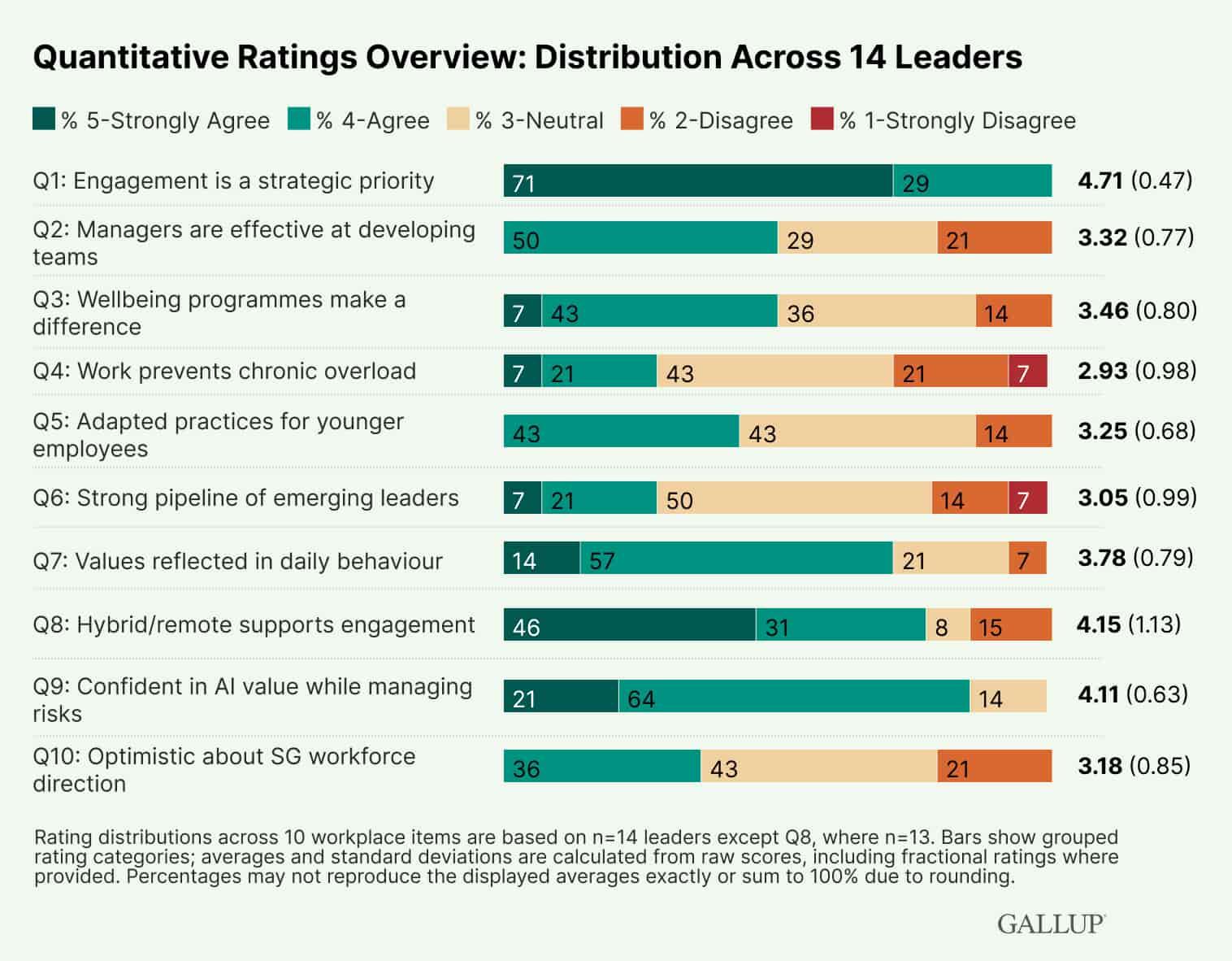
Nearly three-quarters of leaders interviewed for this report strongly agree that engagement at their organisation is a strategic priority, with every leader rating this item either 4 or 5 on a five-point scale. Clearly, engagement matters to these organisations.
However, leaders gave their organisations much lower ratings on key factors in fostering workplace engagement, such as bolstering manager capability and effectiveness, strengthening the leadership pipeline and preventing work overload.
Singapore has built one of the most productive economies in the world. How is it possible that its workforce is among the least engaged globally?
Singapore is one of the wealthiest, most highly educated nations on Earth, with a high-performing economy that delivered GDP growth of 5% in 2025, although 2026 growth is projected to slow to between 2% and 4%. The country’s 2026 per capita GDP is one of the highest in the world, exceeding USD107,000 at purchasing power parity. Over 90% of Singaporeans express confidence in the country’s financial institutions (Gallup World Poll, 2025).
In contrast, only 14% of Singapore’s workforce is engaged at work, according to Gallup’s State of the Global Workplace: 2026 Report, a figure that has remained essentially unchanged since 2019. Singapore’s engagement is well below the Southeast Asia regional average of 25% and the global average of 20%. Considering the country’s projected decline in GDP growth, Singapore’s chronically low engagement may increasingly become a strategic liability that inhibits its future competitiveness.
External Factors Blamed for Low Engagement
Nearly all the 16 leaders we interviewed for this report acknowledged the gap between Singapore’s robust economy and its comparatively low workforce engagement. Many blamed this low level of engagement on external factors beyond their control, such as global market forces, challenging economic conditions or labour market policy. Others attributed the low proportion of engaged employees to the country’s many family-owned small and medium-sized businesses or to the high cost of sustaining business operations in Singapore.
Leaders also recognised the importance of managers in creating an engaged workforce, but most believe that even highly effective managers have only a limited ability to effect real change in Singapore’s economic and business environment.
One executive offered this perspective on Singapore’s workplaces: “If you look at the employment landscape, it’s largely SMEs (small and medium enterprises) and family-owned companies. Sixty-two percent or so of our listed companies in Singapore are family-owned. So, again, if you have a tycoon or some first- or second-generation guy, he’s not going to have all these best practices.”
Another leader shared this same point of view and observed, “SMEs employ about 70% of the workforce in Singapore. So that would also explain why the scores in Singapore are quite low.”
Other leaders said low engagement was due to the highly competitive nature of Singapore’s business environment. One described the pressure that Singapore’s economic structure places on its workforce: “I do think that, in general, in Singapore, the competition is more cutthroat. And it’s a high-cost location out of which we are operating; therefore, the expectation also is that of much higher productivity, much higher focus on results. All of these put extra pressure on the people.”
Finally, a few of the leaders interviewed attributed Singapore’s low engagement to cultural factors that result in employees rating their organisation’s workplace more conservatively than in other countries. An executive offered this perspective: “In the U.S., it tends to be a little bit more vocal, a little bit more buoyant, a little bit more excitable. Whereas, if you come to Asia, people tend to be a little bit more conservative. So, no one does a 5, everyone does a 3, 3.5.”
However, Singapore’s 14% engaged score lags well behind not just the global average but also most regional peers: Gallup’s latest study found that the Philippines (39%), Thailand (34%), Indonesia (27%) and Malaysia (25%) all have higher workforce engagement than Singapore.
Why Engagement Matters
Gallup research shows that when organisations improve employee engagement, it positively affects key performance outcomes.
Gallup's research of more than 180,000 teams — over 3.3 million employees — revealed that teams in the top quartile of employee engagement achieved higher performance on positive outcomes and realized fewer negative outcomes than bottom-quartile teams.
Difference between top- and bottom-quartile teams/business units within a typical organisation
 78% in absenteeism
21% in less turnover for high-turnover organisations
51% in less turnover for low-turnover organisations
28% in shrinkage (theft)
63% in safety incidents (accidents)
58% in patient safety incidents (mortality and fails)
32% in quality (defects)
 10% in customer loyalty/engagement
18% in productivity (sales)
14% in productivity (production records and evaluations)
23% in profitability
70% in wellbeing (net thriving employees)
22% in organisational citizenship (participation)
Developing highly engaged teams results in fewer negative outcomes, more positive outcomes and greater success for your organisation.
Note: Top-quartile teams on engagement achieved higher performance in positive outcomes and realized fewer negative outcomes. Bottom-quartile teams realized more negative outcomes and achieved lower performance on positive outcomes.
Creating and sustaining a highly engaged workforce is arguably even more important in Singapore, given that the country’s economy is highly services-oriented, with professional, managerial, executive and technical (PMET) roles accounting for nearly two-thirds of the workforce.
Gallup research consistently shows that engagement is correlated with key performance outcomes across all sectors, but the impact of engagement is arguably greater in service-intensive industries that rely on discretionary effort and nurturing strong employee-customer relationships.
In our interviews with Singapore organisational leaders, nearly all recognised the positive impact employee engagement has on organisational performance. Improved employee retention was the most frequently mentioned outcome, followed by increased customer satisfaction and loyalty and higher product and service quality. Leaders also observed that an engaged workplace reinforces employee and organisational resilience in situations of change and economic headwinds.
One leader observed, “If the workforce is very engaged, they will work for you. ... They will … fight for you. Look after our customer guests. Which in turn ... will generate higher profit margin.”
The value of engagement to long-term resilience and growth was highlighted by another Singapore company executive:

"The hidden cost is [that] the risk is not immediately obvious. … So, in the short term, it looks like you're more productive, but you may pay the price a little bit." Another leader observed, “Today, we can be maximising short-term efficiency and profit, but what’s the trade-off in terms of long-term when it comes to employee engagement, culture, loyalty?”
A gap exists between the recognition of employee engagement’s importance to organisational performance and resilience, and the support infrastructure deployed to create and sustain engagement. Singapore’s leaders clearly know that engagement matters. However, they also recognise that their organisations must do more to deliver it.
The Generational Divide
The Generational Divide
Singapore’s younger employees (workers under 35 years of age) are less engaged and slightly less likely to be “thriving” in their overall wellbeing than their older counterparts. Younger employees also experience more daily negative emotions.
Structural Conditions Worsen Generational Engagement Divide Most leaders interviewed indicated that structural conditions of Singapore’s business environment negatively influenced generational differences in workplace engagement and wellbeing. Several also cited external factors that pose challenges to younger generations, including housing costs, economic uncertainties, cost-of-living pressure and constrained career paths.
Employee Accountability Several leaders emphasised employee accountability as a key contributor to engagement in addition to structural conditions. This perspective appears to highlight individual responsibility and agency as a key engagement factor.
These interview responses indicate leaders’ sincere acknowledgement of younger workers’ clarity of purpose, curiosity about workplace design changes meant for them and enthusiasm about workplace changes that have resulted in meaningful improvement.
Global differences between younger and older employees follow a similar pattern, although the generational split in Singapore is greater. There is a two-point difference in global engagement between employees under 35 and those 35 and older (19% vs. 21%), compared with Singapore’s six-point difference. Similarly, slightly more global under-35 employees experienced daily stress than their older counterparts (42% vs. 40%), while Singapore’s generational split was considerably wider (53% vs. 37%).
What are the reasons behind the lower engagement of Singapore’s younger workers?
According to perspectives shared by the 16 senior leaders interviewed for this report, the country’s young workers are not less willing to work. Rather, they are working in conditions that foster lower engagement and wellbeing and induce greater levels of stress for them than for their older coworkers.
The “Strawberry Generation”
Singapore’s generational discussions often give rise to unhelpful character generalisations. Younger employees are frequently described as entitled, fragile or insufficiently committed to their employer and career progression. Sometimes labelled the “strawberry generation” to characterise late millennial and Gen Z employees as fragile and ill-equipped to handle life and work pressures, the reality is more complex. The generational split is real and not imagined, and consequently, Singapore’s employers need to respond to the unique needs of younger employees.
On survey item Q5 (the organisation has adapted practices for younger employees), leaders gave a mean score of 3.25, with no leaders reporting strong agreement or strong disagreement. These results indicate that most leaders interviewed believe their organisations likely make minimal efforts to ensure workplace practices help younger employees work effectively.
Most leaders described young employees’ different workplace expectations in terms of reactions to structural economic and labour market conditions rather than differences in character. For example, some leaders mentioned factors that impact young people more than older, established employees, like Singapore’s high cost of living, national service obligations, growing job and career uncertainty, and a new perspective on personal and professional success.
A global company executive rejected the premise that younger workers are the problem:
“They’re just different, and they need to be engaged differently, but I see more gaps on our end. It’s not just work environment, it’s the economic environment. ... The challenges are very different to when we entered the workforce.”
Several leaders discussed how younger employees define professional and personal success. But rather than see this as problematic, some expressed that organisations need to acknowledge this fact and adapt to it.
Another executive described a generational conversation that illustrates the shift:
“They have a very different definition of success. So, they say, ‘Where is this need of getting to the top coming from?’ I find that oddly refreshing, very kind of illuminating.”
Another theme that emerged from the leader interviews was young employees' willingness to speak openly about mental health issues.
One leader compared this attitude to that of older employees’ openness to discussing mental health:
“The younger folks are more prepared and more open to talk about mental wellness, burnout and everything else. The older folks are built with a different background that says suck it up and move on.”
This increased openness among younger generations has implications for the workplace. Leaders need to encourage feedback from this growing cohort of young employees and adapt their organisational culture accordingly.
Redesigning How Different Generations Work Together
A senior executive leading a roughly 100-person government healthcare innovation unit described how the organisation enhanced communication across age groups. Younger colleagues expected a “productive and protective” relationship with managers. “Productive” meant making good use of time and speaking directly. “Protective” meant senior colleagues guiding younger staff and shielding them from avoidable workplace friction.
The executive described the generational shift in concrete terms:
“Our younger colleagues draw a clearer line between work and life. And within their work-related hours, they feel that they acknowledge that the more senior colleagues potentially might have more experiences.”
To act on this, the organisation invested in quarterly temperature-check surveys using start-stop-continue exercises to surface pain points. The executive spoke to all employees in small groups. The unit launched quarterly manager lunches where all 30-plus managers gathered to work through practical tools such as “ladder of inference” and “clear communications.” Each round of feedback produced visible organisational responses.
Over one to two years, the proportion of negative and cynical responses in qualitative survey feedback decreased significantly. Managers began diagnosing and addressing engagement problems within their teams. The approach did not rely on a single programme. It relied on repeated cycles of listening, responding and equipping managers to act.
However, a large minority of leaders interviewed expressed concern about what they perceived as reduced ambition among younger employees.
This concern was expressed most strongly by executives from logistics and professional services firms. For these employers, long hours and weekend availability have historically been non-negotiable employee requirements.
One executive expressed frustration because of the effect this behaviour can have on company operations. Younger junior employees who refused to work weekends — considered a widely accepted obligation at their career stage — caused immediate operational gaps. In sectors where work requires employees to be physically present, and tasks are strictly time-bound, this reduced availability creates a manpower constraint that some companies struggle to manage.
The minority view deserves consideration because it identifies a real tension in Singapore’s workforce. When younger workers set boundaries that previous generations did not, organisations must make a difficult choice: either change their workforce planning strategy or risk losing younger employees.
The Manager Makes or Breaks It
The Manager Makes or Breaks It
Gallup’s global workplace research finds that 70% of the variance in team engagement is attributable to the manager. This means managers affect virtually every aspect of a team’s performance and success. Not the CEO, not HR, not the organisational values statement.
The results of our study of Singapore leaders support this. Most leaders interviewed described the people manager as one of the most important drivers of whether employees are engaged and motivated or merely show up. However, the degree to which leaders’ organisations effectively enable and support their managers is less emphatic.
One of the most consistent findings in the study was that strategic plans, employee town halls or annual surveys do not create engagement. Rather, it is created and sustained by the strength of the day-to-day relationship between employees and their manager.
Manager Effectiveness (Q2)
“The managers in my organisation are effective at developing and engaging their teams.”
Average score: 3.32 out of 5
These leaders rated their organisations’ people managers as only modestly effective.
Leadership Pipeline (Q6)
“My organisation has a strong pipeline of emerging leaders ready to step into senior roles.”
Average score: 3.05 out of 5
The systems designed to identify and develop the next generation of managers scored even lower.
Gallup Insights
Seventy percent of the variance in team engagement is attributable to the manager. Companies fail to choose manager candidates with the right talent 82% of the time.
Key Insight
The manager is the primary link to team engagement, but manager capability and support are inadequate.
Singapore Leader Perspectives on the Manager
Leaders interviewed overwhelmingly expressed the view that managers are critical to the engagement and productivity of their employees and the performance of their organisations. Regardless of the sector represented, all leaders affirmed that the quality of the team manager determines the quality of the employee experience.
“I genuinely think that negative emotions and the employee engagement levels, they are so highly dependent upon the capability of the direct managers.”
“I can see the difference, the leader that works with you, grooms you, listens to you, understands you a little bit. You can see the engagement level is much higher for that property hotel.”
“Nothing beats the day-to-day, and how people walk into their job, and feel supported by people that they interact with, that they see every day, their boss, their peers.”
Several leaders described what they believe good management looks like in practice, noting that highly charismatic managers with a compelling strategic vision are not necessarily the most effective. Rather, the best managers communicate frequently with their teams and treat employees as individuals. When high expectations are placed on employees who are supported by managers who provide them with clear direction, personalised recognition, frequent coaching conversations and individualised development, they can often be highly engaged.
“It all comes down to teamwork. As a leader, do you allow your team to make mistakes? Do you train your team?”
“If the managers are doing a really good job of direction setting, coaching, reward and recognition, even if the workload is very high, I do think the employees remain engaged.”
One leader described how the manager-employee relationship should look in day-to-day operations:
“At the frontline levels, it should include things like how do you give feedback. It’s not OK to shout or to raise your voice. You need to come from the receiving end, how you would take it. Just really pairing it to match the kind of activities on the ground that people need to be able to relate to.”
Managers often lack the authority to change the conditions their teams experience that affect engagement and wellbeing — particularly in organisations that prioritise hierarchy. Organisations that invest in developing manager capability without reviewing work design or span of control may find that even talented, well-supported managers fall victim to burnout.
All leaders interviewed suggested that manager development needs to be fundamentally different from leadership development programmes.
Frontline managers need to acquire the appropriate skills to address the issues and challenges faced by their employees; they must learn to provide their reports with frequent feedback, practise active listening, take action to resolve operational issues that impede employee and team performance, and motivate and hold employees accountable for achieving their performance goals.
However, as one leader commented, many organisations have not invested sufficiently in building frontline manager capability.
“We haven’t invested enough in managerial capability to sort of engage in this format. Which is different.”
Indeed, Singapore’s leading companies have invested in leadership development for senior executives and in technical skills training for employees in individual contributor roles. However, people managers have received far less investment and support.
Singapore Regional Hospitality Group
A senior HR leader at a regional hospitality group described what distinguishes properties with high engagement from those without it. The difference is not a programme. It is a leader who makes personal connections part of daily work. The leader described his own best practice: spending five or 10 minutes with employees who look unsettled, asking what is bothering them and acting on what he has heard. He noted that when leaders sincerely reach out, employees respond by opening up. Some share work frustrations. Others share personal struggles, including family illness or divorce.
During a trip to China, he observed that his HR director was visibly distressed. Her mother had been hospitalised. His immediate response:
“You go and see your mom. We’ll take care of it.”
No approval process or delay. The leader saw the person, not the position. The HR director returned after the crisis and completed her work. The leader also described ensuring that foreign workers, who make up around 40% of his organisation’s Singapore workforce, receive good meals and decent conditions because they are far from home.
The leader reported that properties where managers practise this level of personal attention see associate turnover below the industry average. The approach requires no special technology, just the firm belief that knowing your people beyond their tasks is part of the job.
Singapore Regional Financial Services Company
One regional financial services company succeeded in increasing the engagement of its Singapore workforce to most being actively engaged. As its CHRO described, the organisation invested in a sustained, multi-year programme to build people-manager capability. It also deliberately reduced team sizes to ensure appropriate spans of control.
“We’ve moved five points as a result of this focus. We’re also reducing the number of people managers, getting that org effectiveness right.”
Two features distinguish this case. First, the investment was sustained over multiple years rather than delivered as a single initiative. Second, the organisation paired capability-building with structural redesign, reducing team sizes so that managers can do their jobs well. The CHRO described the result as transformative: Employee engagement is now nearly four times the national average, achieved through sustained investment in manager capability.
Each of these case studies illustrates the same message: engagement is fostered and sustained by managers who possess the talent and skills to do their job effectively and who are afforded the time and organisational support to motivate, coach and develop their teams.
The Wellbeing Disconnect
The Wellbeing Disconnect
In Gallup’s State of the Global Workplace: 2026 Report, Singapore employees rate their overall wellbeing marginally higher than regional and global averages. Forty percent of Singapore’s employees rated their lives positively enough to be considered “thriving” in 2025, a decline of two points from the previous year and above the Southeast Asia average of 36% and global thriving average of 34%. Stress remains elevated, with 43% of Singapore employees experiencing it daily.
Most of the leaders interviewed for this study confirmed that their organisations offer wellbeing initiatives that comprise elements like flexible work arrangements, employee assistance hotlines and wellness days. Although half of the leaders agreed or strongly agreed that their wellbeing programmes make a meaningful difference to employees, most also acknowledged that these programmes were not effective at differentiating their organisations.
When organisations fail to address work overload, the consequences extend beyond lost productivity. Disengaged employees experience significantly greater daily stress, anger, sadness and worry.
The gap between leaders’ ratings of Q3 (wellbeing programmes make a meaningful difference) and Q4 (organisation prevents chronic work overload) raises questions about the purpose of wellbeing programmes and what they are meant to achieve for employees and the organisation. Based on the ratings given by leaders to these two survey items, these programmes do not appear to be effective at preventing work overload.
Wellbeing Programmes (Q3)
“The wellbeing and mental health programmes in my organisation make a meaningful difference to employees’ daily experience.”
Average: 3.46 out of 5
Prevents Work Overload (Q4)
“My organisation designs work in a way that prevents chronic overload.”
Average: 2.93 out of 5 and the only survey item rated below 3.0. Leaders acknowledged that their organisations do not prevent overload.
The Gap
The difference between the leaders’ ratings of their organisations’ wellbeing programmes and how well their organisations prevent chronic work overload suggests the need for greater focus and action to improve work design and employee working conditions.
Values Reflected in Practice (Q7)
“The stated values of my organisation are consistently reflected in day-to-day workplace behaviour.”
Average: 3.78 out of 5
More progress can be made to reduce the distance between stated values and their consistent application in the workplace.
Engagement Correlation With Negative Emotions
Singapore’s actively disengaged workers report 52% daily stress, 25% daily anger, 28% daily sadness and 47% daily worry. In contrast, the country’s engaged workers report 26% daily stress, 8% daily anger, 8% daily sadness and 23% daily worry. Disengaged workers are twice as stressed, three times as angry and 3.5 times as sad as their engaged counterparts.
(Source: Gallup World Poll)
Wellbeing Programmes Treat Symptoms, Not Root Causes
The majority of leaders interviewed confirmed that their organisations offered employee wellbeing programmes; however, most also reported that while these programmes meet baseline expectations, they do not differentiate or create a competitive advantage in the labour market.
For example, annual surveys that assess employee wellbeing without appropriate follow-through on feedback do not address real issues that affect workplace wellbeing or engagement. Similarly, wellness days do not treat the underlying factors that cause daily employee stress or excessive workload.
Most leaders affirmed that the wellbeing initiatives provided by their organisations do not change employees’ day-to-day experience of work.
“Every company has a mile-long employee wellbeing programme. This is standard. I am not surprised that this is not at all a differentiator.”
Another leader described how wellness programmes are adopted haphazardly rather than to address challenges present in the organisation:
“A lot of programmes are not necessarily thought through strategically. It may be everybody’s doing X, so let’s do that as well.”
The result is that organisations end up implementing a patchwork of wellbeing initiatives that treat symptoms rather than causes of poor employee wellbeing and are no substitute for structural change.
“All the employee wellbeing programmes, team bonding, all great, all sounds fantastic, right? But I do not think those fundamentally, or even affect, or make an attempt to address the cause of the stress.”
If a company’s business model is based on placing unreasonable workloads on its employees, wellness initiatives may be effective in helping employees temporarily cope with an unsustainable situation but will not resolve the structural issues caused by factors such as lack of role clarity, blurred or redundant lines of reporting, low empowerment or unclear spans of control.
Fewer, Targeted Wellbeing Programmes
Based on qualitative input from our leader interviews, wellbeing programmes that focused on changing workplace conditions had a meaningful impact on employees in the organisations that deployed them. These programmes targeted workplace issues that affected workload levels and aimed to redesign work structures to address inadequate role clarity, redundant or excessive reporting layers and poorly defined decision-making authority.

Not every leader dismissed wellbeing programmes as purely performative. Some leaders expressed that programmes can work effectively when integrated into daily operations rather than treated as standalone or supplemental benefits.
One CHRO described an employee experience framework used by his organisation, designed to weave wellbeing into the core of how the organisation operates. The framework was not a list of perks. It was an attempt to embed care into processes, communication and management routines. The difference, as this leader described it, was between wellbeing as an add-on and wellbeing as a design principle.
This leader offered an example of this framework. The organisation synchronises its wellness activities with peak operational periods, such as year-end, when air traffic surges and frontline staff face the heaviest workloads.
“We make sure that we time a lot of our wellness activities and events in accordance with the peak period so that people feel that they are supported.”
Employee wellbeing matters most when workload is greatest, not when workplace pressure subsides.
This view does not contradict the disconnect between treating symptoms and root causes of poor employee wellbeing but refines and complements it.
One key insight from our leadership interviews is that wellbeing and wellness programmes are not necessarily ineffective, but they should not be designed and implemented in isolation from the structures and systems that most affect employees’ daily work experience. Rather, wellbeing strategies integrated into management practice and structural work design produce meaningful results, including greater engagement and productivity, as well as enhanced employee wellbeing.
The Impact of Structural Redesign on Wellbeing
An executive chairman of an agri-tech company remarked that most wellbeing problems are the result of poor organisational structure, not a lack of individual employee resilience. This leader strongly believed that wellness programmes, team bonding events and ask-me-anything sessions do not address the root cause of workplace stress.
“In most organisations that are in trouble, it’s really getting the structure right. That removes a big cause of stress.”
This leader pointed out that boards and CEOs spend considerable time on strategy formulation but rarely apply the same rigour to creating the structure necessary to execute the strategy. Roles, accountability, decision-making authority and whether a person’s skill set matches the requirements of the role all shape daily experiences. When any of these elements are misaligned, disengagement and a decline in wellbeing follow.
“We can spend so much time on formulating strategy, but nobody thinks much about the actual structure.”
According to this leader, there is a practical reason for this blind spot: new CEOs face pressure to deliver results within 100 days. They spend their early months reading the company landscape and shaping strategy. Structure becomes an afterthought because it requires deliberate effort and disrupts the status quo. The result is that by default, organisations fit people into existing roles rather than redesigning roles to match the work that must be executed.
This leadership perspective highlights the fundamental difference between these two approaches to employee wellbeing. The deployment of programmes on top of existing structures (EAP helplines, wellness stipends, mental health days) treats symptoms. Redesigning the structures that produce excessive workload, workplace stress and employee burnout addresses the root causes of these symptoms. Most organisations choose the first path because the second requires greater focus, time — and courage.
Attention: Disruption Ahead
Attention: Disruption Ahead
Singapore’s leaders are confident they can manage future challenges. However, they are less confident that the country is prepared to face them successfully.
In this chapter, we examine four forces affecting Singapore’s workplaces and the degree to which the country’s employer organisations are prepared to face the disruption they cause.
Leaders’ anxiety resulting from these disruptive factors coexists with curiosity about possible opportunities that they create. The interviews revealed two clear perspectives: organisations that treat these disruptive factors as threats to manage and those that view them as opportunities.
Hybrid/Remote Work (Q8):
“Our remote or hybrid work arrangements support employee engagement.”
Average: 4.15 out of 5, spread: 1.13. Highest average score, but widest spread. Leaders either strongly endorsed flexible work or rejected it.
AI Confidence (Q9)
“I am confident that my organisation can realise value from AI while managing its risks.”
Average: 4.11 out of 5. No leader rated the item lower than 3. Leaders are confident their organisations can adapt to AI.
Singapore Optimism (Q10)
“I am optimistic about the overall direction of workplace engagement in Singapore.”
Average: 3.18 out of 5. Range = 2.0 to 4.0. Leaders rated Singapore’s overall readiness nearly a full point lower than their own organisations, indicating far more optimism about their own workforces than the country’s.
Organisation AI Confidence and Singapore Workplace Readiness (Q9, Q10)
Leaders rated their own organisation’s AI readiness at 4.11 (Q9) but optimism about Singapore’s overall workplace direction at 3.18 (Q10), a difference of 0.93 points.
The Pandemic Rupture
COVID-19 and AI adoption were identified as inflection points that have had a considerable impact on workplace engagement. Pre-pandemic assumptions about office presence, career trajectories and the nature of work have been considerably disrupted in most organisations.
External Forces Causing Disruption
Major future challenges are outpacing organisational readiness, with uncertainty expressed in every leader interview. Specific factors mentioned included talent shortages, rising cost of living pressures and SMEs’ capacity to manage future challenges.
The AI Career-Stage Split
AI has produced a career-stage divide, which many leaders said benefits experienced workers while harming junior-level employees. The disruption caused by the adoption of generative AI technology has accentuated inequalities between employees who have acquired foundational skills and those who have not yet built them.
Four Disruptive Forces
Four disruptive forces were identified in our leadership interviews. Although these forces are not new, the collective impact of all four on Singapore’s workplaces is considerable and sure to increase.
-
Artificial Intelligence
Leaders are confident their organisations can realise value from AI (survey item Q9 average score: 4.11 out of 5). Of the leaders surveyed, 85% either agreed (64%) or strongly agreed (21%) that they were confident in AI’s value to their organisation while managing potential risks associated with the technology.
However, leaders were less optimistic about the future direction of Singapore’s workforce, perhaps indicating low confidence in the preparedness of the country’s employees to adapt to disruptive forces such as AI adoption. Slightly more than one-third agreed that they were optimistic about the direction and readiness of Singapore’s workforce, with no leaders indicating strong agreement.
However, in our interviews, leaders frequently voiced two important concerns. The first is the “AI incentive conflict.” Employees who are asked to use generative AI tools may believe that their successful deployment could reduce the need for their roles. In this context, the rational response is to resist AI rather than embrace it. Treating AI adoption as a technical rollout without addressing this issue will inevitably produce friction in the workplace.
The second concern is the “AI career-stage split.” In many professional and technical roles with Singapore’s employers, the first few years of a new employee’s career typically involve apprenticeship-based work that is often repetitive and designed to teach entry-level workers the fundamental skills of the job. Several leaders representing a wide range of industries believe AI will eliminate much of this apprenticeship work.
“A lot of junior folks, the first three years, they basically do everything; with AI, I think a lot of this grunt work, and therefore the opportunity for apprenticeship, goes away.”
“For professional service firms, AI will be the most significant professional development ever.”
The implication is that AI not only changes what employees do, it also changes how they learn and develop. Organisations that automate junior-level work without redesigning development paths risk producing mid-career professionals who never had the opportunity to build the foundational skills their roles and organisations require.
“What concerns me is that we are not investing enough to prepare the younger generation for the disruption. Technology, disruption, there will be winners and losers, but the benefits would not be distributed evenly.”
Not every organisation in Singapore has waited to address this AI-related concern. A global FMCG company created a citizen-developer programme built around two-day “digital bootcamps” where employees learn generative AI tools such as Microsoft Copilot alongside other digital productivity and automation applications, then use them to solve a real problem in their work. Employees who complete these bootcamps are much more confident in their use of AI and understand how to apply it to become more productive.
A technology services company acknowledged the need to change its approach and acted to prepare its workforce to use AI technology by scaling quickly from two AI projects to 150 in just two years, and set a goal of training all its 15,000 employees in AI use and proficiency.
Based on our interviews with leaders, these actions are the exception rather than the rule. Few of the 16 organisations included in the study have implemented similar programmes. As a result, organisational preparedness for AI adoption does not appear to be universal.
-
The High Cost of Operating in Singapore
Singapore’s GDP per capita exceeds USD107,000, but this figure masks the cost pressures on employers and employees alike. Singapore’s high cost of doing business and highly competitive labour market compress company margins and create exorbitant employee turnover costs. Even with Singapore’s comparatively high median monthly income of SGD5,500, financial stress affects employees at virtually all income levels in what is one of the most expensive cities in the world.
Singapore’s high costs have a major impact on nearly every aspect of an organisation’s workplace and operations. One is that it can limit organisations’ capacity to invest in employee development. The country’s high cost of living also shapes employees’ willingness to take risks and pursue new career opportunities. This risk aversion exacerbates Singapore’s chronically low workplace engagement, since disengaged employees may reluctantly choose to remain with their current employer rather than leave to find a job where they will be more engaged.
-
Singapore’s Ageing Workforce
Over 37% of Singapore’s working population is aged 55 and older, up from 29% in 2014. As a result, employers face a knowledge-transfer challenge that will only intensify. The PMET share of nearly 64% means that the roles most affected are not production-line positions that can be filled through volume recruitment but knowledge-based jobs that require years of experience to achieve high levels of performance. Experienced workers who have accumulated institutional knowledge over the years are leaving, while junior-level employees are finding fewer entry-level job opportunities and experiencing disruption in apprenticeship and on-the-job learning due to rapidly increasing AI adoption.
-
Hybrid Work
Leaders participating in our survey have significantly different perspectives on hybrid work arrangements. Although nearly half of the leaders surveyed (46%) strongly agreed that hybrid and remote work support workplace engagement, responses to this item produced the study’s most divided result, with an average score of 4.15 out of 5 and the widest spread of any item (1.13).
“We are still keeping our work-from-home policies since COVID. We have no intention to change because it works very well for us.”
One global Singapore-based company has maintained its hybrid work policy without interruption since 2001. A senior executive with this organisation observed that this consistent, long-standing support for hybrid work arrangements enabled the company to minimise disruption since the onset of the global COVID-19 pandemic.
“When I came to Singapore [for the] first time in 2001, this concept was introduced to us. Throughout the ups and downs of the business, during COVID times, that policy did not change. A lot of companies went through where they said, ‘We will be 100% work from home,’ and then they had to scale back. We fortunately never had to go through that painful exercise.”
Some leaders’ organisations have integrated hybrid and flexible working into their operating model, while others maintain the view that hybrid work is an employee concession that erodes organisational culture and productivity.
The Four Forces Will Not Wait
The disruptive forces of AI adoption, high operating costs, an ageing workforce and hybrid work show no signs of abating while Singapore’s organisations design and implement strategies to manage them. The country’s leaders must act immediately to build the engagement infrastructure that will allow their organisations to mitigate the consequences.
Building Future-Ready Workplaces
Building Future-Ready Workplaces
Measurement Infrastructure That Informs Actions
The best-performing organisations participating in the study for this report have built an engagement measurement infrastructure that produces actionable insights, drives leader and manager accountability, and ensures meaningful follow-through. Organisations whose engagement survey data reliably inform key decision-makers and produce tangible changes within designated timeframes reported better workplace conditions, as defined by the key dimensions explored in this report.
For example, a global organisation studied for this report includes engagement survey scores as a distinct KPI in every leader’s performance scorecard. All employees are invited to participate in the company’s annual engagement survey, and the results are published within weeks. The survey scores serve as both “a talking point and a comparison point” across every function and market to ensure consistent, companywide leader follow-up and accountability.
A robust engagement measurement, reporting and action infrastructure is essential and must be established before the recommended priority actions described below can gain traction. Measurement without action fosters employee cynicism; action without measurement quickly loses its required focus since progress cannot be evaluated objectively.
Build Systems to Improve Management:
Role confusion and short-term thinking prevent engagement-building strategies from being deployed. The question is not “how do we get better managers?” but “how do we build systems that make good management possible?”
Measurement That Drives Change:
Organisations in which engagement data reach decision-makers and drive tangible change reported higher scores against other key workplace dimensions measured in the survey.
How Flexibility Is Implemented Matters:
How flexibility is implemented, not merely its existence in the workplace, determines its impact on engagement.
How Leader Priorities Were Identified
The leader interviews conducted for this report enabled us to identify the top priorities for the 16 organisations these leaders represent. The subsequent roundtable session then captured these leaders’ consensus when asked to rank-order priorities as a group. The roundtable session divided leaders into two groups, with each group deliberating on the same questions before presenting their conclusions.
-
Manager Role: 14 leader votes. The most selected priority, consistent with interview findings that identified the manager as the primary driver of team engagement.
-
Culture/Engagement: 13 leader votes. Leaders recognised that stated values and daily practices diverge in most organisations, and that employees notice the gap.
-
HR Transformation: 12 leader votes. The roundtable elevated HR reform from a thread running through interviews into a standalone priority.
-
Talent Density: 12 leader votes. A deliberate reframing from “talent pipeline” to the quality and capability of people already inside the organisation.

Priority 1: Build Manager Capability
Roundtable participants agreed that the people manager is the cornerstone of team engagement and determines whether engagement improves or erodes. Therefore, organisations must rethink their strategies for selecting, onboarding, supporting, developing and rewarding managers.
During the roundtable session, one group developed a management framework based on themes raised in the individual leadership interviews. This framework was titled “The Three Es” (Engage — Enhance — Empower). Engage means establishing the foundation: trust, commitment and regular one-on-one conversations. Enhance is defined as building manager capability through structured development. Empower means delegating authority to managers and granting them the autonomy to make decisions.
Ultimately, reinforcing manager capability depends first and foremost on leadership commitment to support, empower and hold managers accountable.
“At the end of the day, it comes down to senior leadership attitudes. If you have a board and a CEO that puts a value on this, that trickles down.”
— Roundtable participant
Each roundtable group designated the manager as the highest-impact engagement intervention point. One of the groups based this argument on Gallup’s research, indicating that managers account for 70% of the variance in team engagement. The second group also identified the manager as the principal catalyst of team engagement, based on leaders’ extensive combined experience as people managers themselves.
One area of misalignment that impairs managers’ capabilities is the common practice of rewarding managers based on individual performance rather than on how well they manage their teams.
“Managers are rewarded for performance, but they’re not rewarded for being good managers.”
— Roundtable participant
Organisations frequently incentivise managers to achieve individual performance outcomes rather than to coach, develop and improve the engagement and performance of their teams. Since what gets measured gets managed, the result is predictable: managers prioritise their own individual performance goals to the detriment of their people’s engagement.
The roundtable explored possible explanations for why this misalignment persists, with one participant asking, “If you become a CFO, you go through so many trainings ... but to become a people manager, how many people were really trained?” Leaders described how their organisations invest heavily in technical skill development but provide little structured preparation to help employees transition to people manager roles.
Gallup research has identified three things great managers do differently to build highly engaged teams:
-
Harness Team Strengths: Great managers know their team members and know what each of them does best. They use this knowledge to optimise individual coaching and development.
-
Focus on Engagement: Great managers practice frequent individual and team praise and recognition, meaningful feedback, and provide clarity of expectations.
-
Drive Performance: Great managers set high performance standards, provide clear guidance, and reinforce individual and team accountability for achieving goals.
Equipping managers to lead and engage their teams effectively requires:
-
Empowerment and autonomy: time to coach, not just execute.
-
Tools and guidance to help managers have better coaching conversations.
-
Infrastructure and systems to support team-level accountability for engagement.
When managers receive the right support, engagement becomes tangible and real. When they do not, even the best-designed engagement strategies struggle to gain traction.
Priority 2: Align Culture With Employee Experience
Most organisations in Singapore have engagement surveys, values statements and wellbeing programmes — few practise consistent follow-through. Most organisations have much to do to connect survey measurement to action and to integrate the values statement into daily work.
Culture was the most frequently discussed topic during the leader roundtable session, although it was voted second-highest in terms of priority. Leaders deliberated workplace issues directly linked to culture, such as transparency, psychological safety, blame culture, and the gap that nearly always exists between stated values and their meaning and application in the employee experience.
Both roundtable groups repeatedly alluded to a single structural problem: organisations field engagement surveys, collecting vast quantities of survey data, but do not use this feedback to change working conditions or workplace culture.
“We have done employee engagement surveys, but the failure is that we don’t take action.”
— Roundtable participant
Measurement without follow-through does not merely waste resources; it cultivates employee cynicism. Employees who complete a survey and then receive no meaningful feedback and perceive no improvements in their work environment naturally feel that their opinions do not matter.
Regarding psychological safety, roundtable participants pinpointed reasons initiatives designed to improve it tend to fail. One participant observed, “If I raise an issue, I have to be the one to solve it.” This effectively penalises employees who speak out and only serves to foster a culture of silence. This behaviour may be in direct conflict with official company policy, but all too frequently, this is the de facto employee experience when concerns are raised with the manager.
Leaders in the roundtable agreed that Singapore’s workplace blame culture magnifies the penalty for speaking out and encourages employees to keep silent. One leader described the behaviour this blame culture produces: “When an employee makes a mistake, we issue it loudly, with letters and warnings. Where is the learning?”
In contrast, organisations that treat first-time employee errors as learning opportunities and repeated errors as performance issues that can be rectified foster a culture in which people are more likely to take risks and speak out more freely to identify problems.
Priority 3: Reposition HR as a Strategic Function
Roundtable participants agreed that in their organisations, the human resources team was focused principally on administration, transactional task execution, risk management and compliance — at a time when the disruptive forces cited in this report require HR to lead culture change, redesign performance management processes and build vital engagement infrastructure.
“HR is very protective of the status quo and risk-averse. HR teams will say, ‘What about this person or that person?’ If we do this, we’ll set a precedent. But what does the business actually need?”
— Roundtable participant
The roundtable also challenged the hiring practices used by their HR departments, and many leaders expressed the view that HR needs to change its traditional recruitment and hiring approach. One participant observed, “Now I hire based on personality rather than what you’ve done in the last two jobs.” This approach emphasises the identification of a candidate’s innate talents, adaptability, curiosity and collaborative instincts, which predict performance and engagement potential better than educational credentials or technical experience.
Job design was another strategic task called out by roundtable participants that HR should lead and manage. One participant argued that HR needs to “think of the enterprise, upstream and downstream” when redesigning roles. When HR leads enterprise-level role redesign rather than merely filling individual job vacancies, the function works in partnership with the business rather than as a staffing bureau.
These perspectives underscore the need for HR to be transformed into a strategic partner with leadership. However, authentic HR transformation requires changing HR’s role in crafting and executing organisational strategy. HR needs to be integrated with the business, and the business needs to be integrated with HR. There is a clear opportunity for Singapore’s organisations to reposition HR and empower it to change the way leaders and managers engage, motivate and inspire their workforces.
Priority 4: Maximise Talent Density
Traditional talent pipelines are designed to prepare a linear queue of employees to fill future roles. Maximising talent density aims to develop the unique talents of every individual in the organisation, regardless of age, tenure or career stage, to unleash their full potential.
One roundtable group developed a conceptual framework that captured a principle both groups had frequently alluded to throughout their discussions: harnessing collective employee talent to improve performance. The shift from “talent pipeline” to “talent density” fundamentally changes how organisations recruit, hire, onboard, manage, promote and develop talent.
One leader defined talent density and its objectives:
“Talent density is about bringing high performance, which also means that we should let each individual bring to the table what they actually can do. It should be age blind; it should be gender blind, capacity-focused.”
— Roundtable participant
Rather than focusing solely on filling vacant positions and building a talent pipeline, talent density emphasises maximising the potential and contribution of every person employed by the organisation. This reframing greatly expands the purpose of talent management from hiring people to fill positions to ensuring that all employees are fulfilling their full potential.
Leaders participating in the roundtable created the term “career bouldering” to illustrate how talent density works. Career bouldering encourages employees to make lateral moves across different functions or project teams rather than purely promotion-based progression up the company career ladder. Bouldering involves short, intense career journeys in multiple directions — not a long, linear ascent. By creating viable lateral career pathways that foster both upward promotion and cross-functional movement, organisations benefit by keeping more of their high performers engaged in roles where they perform best.
Roundtable participants also agreed that talent retention deserves greater attention, particularly in Singapore’s highly competitive labour market. External hires require considerable time and generate significant training and integration costs that organisations routinely underestimate. A focus on retention preserves valuable institutional knowledge, relationship networks and cultural fluency that can take many years to replace and develop. The cost of replacing a high-performing employee far exceeds the cost of retaining them. Nevertheless, across all 16 organisations, investment in recruitment consistently outweighed investment in retention.
An Integrated Performance Infrastructure
A robust engagement measurement and feedback system and the four priorities identified by the leadership roundtable are interdependent components that function together within a fully integrated performance infrastructure: building manager capability requires a transformed, strategy-focused HR function to deliver it; aligning culture with employee experience requires regular, actionable measurement and feedback; and maximising talent density requires effective managers and an empowered HR function to enable it.

A Leadership Call to Action
A Leadership Call to Action
This report is a call to action for Singapore’s company leaders whose organisations are in a position of strength thanks to the country’s robust economy and perennial global competitiveness. Their organisations now have a singular opportunity to build on this solid foundation to achieve greater levels of growth and productivity.
The creation of a robust and sustainable engagement infrastructure can help Singapore unleash the vast, untapped potential of its workforce. In 2025, 86% of Singapore’s workers were disengaged, costing the country’s economy billions of dollars annually. Last year, low engagement cost the global economy approximately USD10 trillion in lost productivity, or 9% of GDP. Even a marginal increase in employee engagement could boost Singapore’s economic growth and the performance of its companies considerably.
The future of work in Singapore — as in the rest of the global economy — will require resilient workforces that adapt quickly to constant change. Singapore’s employers must act to enhance workforce flexibility and agility to mitigate the impact of the four disruptive forces examined in this report and take advantage of new opportunities.
Leaders who take action now to engage their workforces and harness their employees’ full potential will be best positioned to thrive in this challenging future environment.
Methodology and Participant Summary
Methodology and Participant Summary
Report Methodology
This study draws on three sources of evidence:
-
Gallup’s employee engagement data for Singapore (from the Gallup World Poll and State of the Global Workplace report database)
-
16 in-depth interviews (of which 14 responded to the leadership survey) with senior leaders from organisations representing Singapore’s private and public sectors
-
A facilitated roundtable session with 17 senior leaders convened by the Singapore Institute of Directors
The in-depth leadership interviews were conducted in February and March 2026. Leaders rated their level of agreement on a 1 to 5 Likert scale with 10 statements about workplace conditions in their organisations. Two independent coding approaches were applied to the interview data to identify how leaders interpreted workplace conditions and what organisational patterns the interviews revealed.
Leadership Interview and Roundtable Participants: Sector Representation



Get This Report Via Email
We will send you a copy of this full report and updates about our latest global workplace research and polling.