![Collaboration at Work > Top Card > 2026 -04 [UPDATE]](https://imagekit.gallup.com/fusion/tr:n-emd_tmpl_dlp_bg_lg/CSFCMSEN/300b276a-c128-4ad4-a541-ed8018df06cd.jpg)
How to Improve Collaboration in the Workplace
Effective workplace collaboration requires understanding what each person brings to a partnership, building trust across teams and creating conditions where people can do their best work together. Whether you're leading a team, navigating a cross-functional project or strengthening a key partnership, Gallup's research and CliftonStrengths® framework give you the tools and insights to make every working relationship more effective.
Collaboration Resources and Activities for Your Team
Collaboration Activities and Resources for Your Team
Learn how to apply collaboration best practices with these tools, activities and resources based on CliftonStrengths, Gallup’s strengths-based development tool for improving collaboration and performance at work.
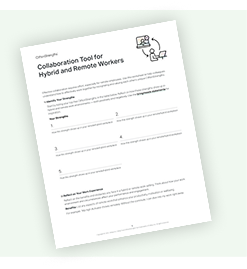
Collaboration Worksheet for Hybrid and Remote Workers
A step-by-step team activity for improving collaboration among distributed teams.
Bring and Need Statements
Explore what each of the 34 CliftonStrengths themes brings to collaboration and what each theme needs from others to thrive.
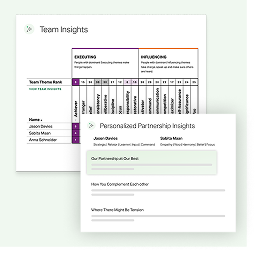
Partnership Insights and Team Grids
Discover insights and practical strategies for building stronger collaboration.
How to Create a Collaborative Culture
Hear how each CliftonStrengths theme shows up in partnerships and teamwork.
CliftonStrengths Insights Newsletter
Get strategies, research and practical advice for using your strengths at work.
What Is Collaboration in the Workplace?
What Is Collaboration in the Workplace?
Collaboration at work is defined as the practice of two or more people combining their knowledge, skills and perspectives to achieve a shared goal. It emphasizes co-creation and shared ownership over simply dividing tasks.
Key characteristics of workplace collaboration include:
-
shared ownership of the goal and the outcome
-
fluid roles that adapt based on the task at hand
-
combined thinking that produces results no one person could achieve alone
-
a focus on creative problem-solving over task completion
Collaboration happens between colleagues on a project, across departments tackling a shared challenge, and between managers and their teams. It can happen in person, remotely or in hybrid environments.
Why Is Collaboration Important in the Workplace?
Why Is Collaboration Important in the Workplace?
Collaboration in the workplace matters because it strengthens performance, builds a more engaged, committed workforce, and improves organizational outcomes. Teams that collaborate well innovate faster, solve problems more effectively and produce better results. Individual employees benefit from deeper connections and more meaningful work.
Collaboration matters at work because it:
-
accelerates innovation by combining diverse perspectives
-
improves problem-solving through divergent thinking
-
increases retention
-
strengthens employees’ sense of purpose as their work contributes to a common goal
The benefits of collaboration in the workplace extend beyond any single project. They compound over time building the trust, relationships and shared knowledge that make teams more effective with every challenge they face together.
Gallup data show that employees with at least one collaborative relationship are:
29% more likely to say they will stay with their company for the next year.
42% more likely to intend to remain with their current employer for their entire career.

How Collaboration Improves Employee Retention
Gallup research shows that employees with at least one strong collaborative relationship are significantly more likely to stay engaged and remain with their organization, both in the near term and over the course of their career.
How to Unlock Powerful Partnerships With CliftonStrengths
Explore why work friends matter for your team and your business.
What Is the Difference Between Teamwork and Collaboration in the Workplace?
What Is the Difference Between Teamwork and Collaboration in the Workplace?
Teamwork is a performance system that turns individual talent into collective results. Collaboration is the practice of two or more people combining their knowledge, skills and perspectives to achieve a shared goal.
Teamwork is about roles, structure and efficiency:
-
Defined roles. Each person knows their responsibilities.
-
Clear hierarchy. Decisions flow through a chain of command.
-
Task completion. Team members focus on completing tasks within a framework.
Collaboration is about collective effort and input to reach the common goal:
-
Shared ownership. Contributions blend seamlessly.
-
Fluid roles. Partners adapt based on the task at hand.
-
Creative problem-solving. Divergent thinking generates solutions.
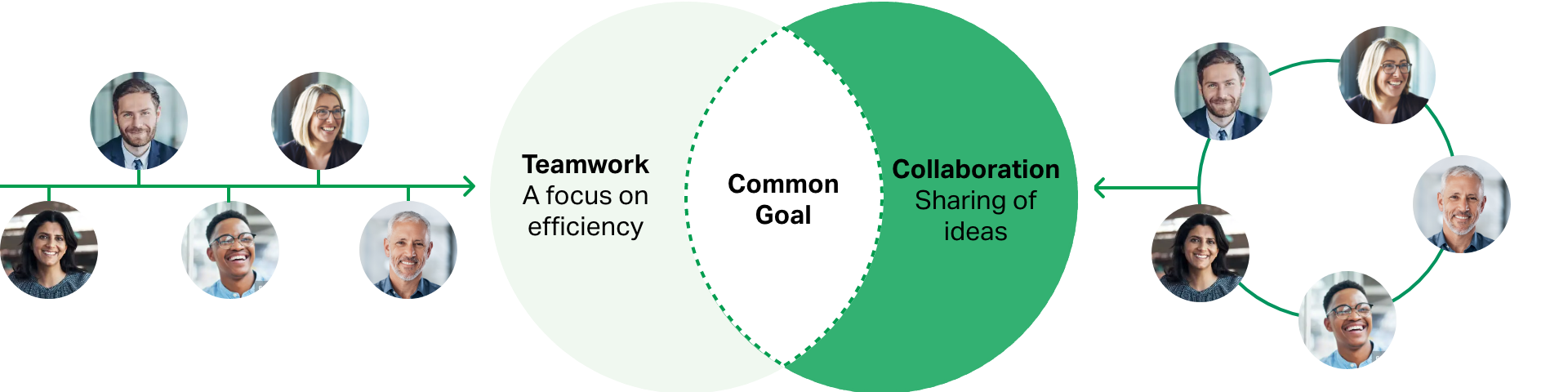
Both teamwork and collaboration in the workplace are essential, and the most effective leaders and teams know which approach their work requires.
Examples of Teamwork vs. Collaboration
Most workplaces need both exceptional teamwork and effective collaboration, often within the same project. Here's what each looks like in practice:
-
Teamwork in action — a surgical team: The surgeon performs the procedure, the anesthesiologist monitors the patient, and the nurses provide vital support. Each team member has clearly defined roles and responsibilities that they carry out precisely to ensure a successful outcome for their patient.
-
Collaboration in action — a product design team: Designers, engineers and researchers brainstorm a new app together. Ideas flow freely, and the best thinking wins regardless of title. No single person owns the solution. The team builds it together.
-
Both at once — a marketing campaign launch: The project manager runs the timeline, ensuring clear teamwork, defining deliverables, assigning owners and setting up structured check-ins. Meanwhile, the creative and strategy team members collaborate on messaging, pushing ideas back and forth until the strongest concept emerges. One project can call for both teamwork and collaboration, with each playing its part as the work unfolds.
What Are Strategies for Successful Collaboration in the Workplace?
What Are Strategies for Successful Collaboration in the Workplace?
Successful collaboration requires deliberate strategies that build trust, focus people on shared goals and help every team member contribute their best. The most effective starting point is understanding the unique strengths each person brings to the work.
Key strategies for successful workplace collaboration:
-
Identify and apply individual strengths.
-
Promote psychological safety.
-
Establish clear goals and expectations.
-
Recognize and reward collaborative efforts.
Identify and Apply Individual Strengths
A vital component of successful collaboration is understanding and applying individual strengths when working together. When people operate in their areas of greatest talent, they are more engaged and productive. Managers who know their team's strengths can help their teams improve communication and collaboration. Here's how:
-
Take the CliftonStrengths assessment. Start improving collaboration in the workplace by identifying individual talents through the CliftonStrengths assessment.
-
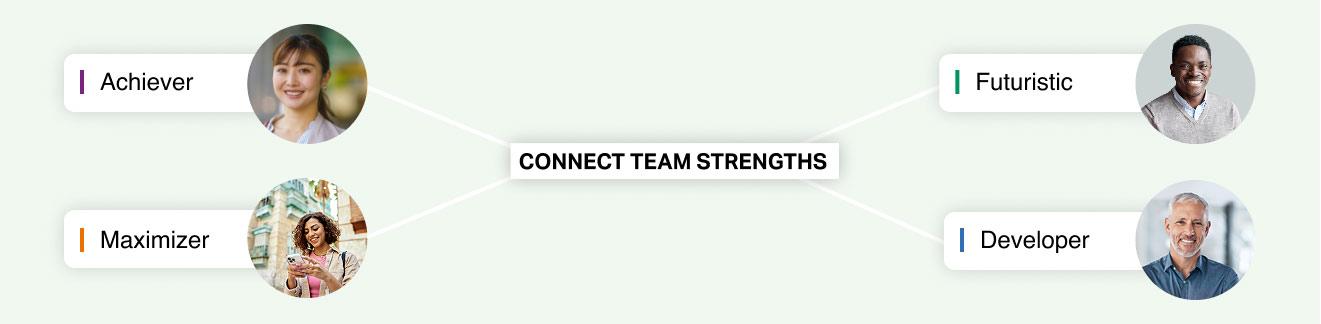
Examine your Team Grid. The CliftonStrengths Team Grid maps each team member’s strengths in a single view, making it easy to see where the team's collective talents are concentrated and where gaps exist. Leaders and teams can use insights from the Team Grid to assign roles that align with natural strengths and identify complementary pairings for specific projects.
-
Consider the team’s dominant strengths domains. The four domains of CliftonStrengths help partners and teams identify how they will work together effectively to accomplish goals:
Executing themes turn plans into actionable results.
Influencing themes inspire action and effective communication.
Relationship Building themes connect and unify diverse team members.
Strategic Thinking themes provide foresight and innovative solutions.
-
Communicate through a lens of strengths. CliftonStrengths gives team members a common language to clearly articulate what they excel at and where they may need support, making collaboration more efficient from the start. Understanding what you bring and what you need from others helps teams work together with greater clarity and less friction.

I Bring: intensity and stamina of effort
I Need: freedom to work at my own pace

I Bring: attention to messages that must be heard
I Need: a sounding board, an audience

I Bring: social depth and transparency
I Need: time and opportunities for one-on-one interactions

I Bring: a learning perspective and excitement for the learning process
I Need: exposure to new information and experience
Promote Psychological Safety
Psychological safety is the foundation of collaboration. It allows individuals to share ideas, take risks and speak up without fear of judgment or negative consequences.
Ways to build psychological safety on your team:
-
Encourage open dialogue. Actively seek input from all team members, especially those who don’t speak often.
-
Address toxic behaviors quickly. Interrupt negative dynamics such as dismissive comments or talking over others before they become patterns.
-
Model vulnerability. Share your own challenges to show that mistakes are learning opportunities, not liabilities.
Establish Clear Goals and Expectations
Clarity is important for collaboration. Teams perform best when every member understands what success looks like and how their individual role contributes to the shared mission.
How to set goals that foster strong collaboration with colleagues:
-
Set clear expectations. Identifying what a collaborative partnership or team needs to achieve provides clear direction and keeps people focused on the right result.
-
Communicate the why. Connecting individual tasks to the larger purpose increases motivation and accountability.
-
Align roles with strengths. When people work in areas that match their natural talents, expectations feel attainable and contributions feel meaningful.
-
Set SMART goals. Objectives should be Specific, Measurable, Achievable, Relevant and Timely.
Recognize and Reward Collaborative Efforts
Celebrating collaboration reinforces its importance and encourages people to keep investing in their working relationships.
Ways to recognize collaborative contributions:
-
Public recognition. Highlight partnership successes during meetings or in company communications.
-
Peer nominations. Encourage colleagues to recognize each other's efforts in meetings or using tools like a “strengths board” where employees post public praise. Peer recognition can be especially meaningful because it comes from the colleagues who see your daily work.
-
Personalized feedback. Connect recognition directly to the individual's contributions.
-
Strengths-based goals. Align individual goals with strengths and identify how each goal contributes to team objectives, so that everyone can see how their unique contribution advances collective success.
What Is Cross-Functional Team Collaboration?
What Is Cross-Functional Team Collaboration?
Cross-functional collaboration occurs when employees from different departments or areas of expertise work together toward a shared goal. Team members bring different strengths, knowledge, skills and working styles to:
-
solve complex problems
-
innovate new products and solutions
-
deliver better results than single teams could achieve alone
Benefits of Collaboration Across Teams
Working across departments delivers advantages that extend beyond a specific project or team:
-
Enhanced innovation. When people with different areas of expertise work on the same problem, they spot opportunities and solutions that narrowly focused teams might miss.
-
Stronger relationships. Cross-functional teams increase awareness of different roles and contributions across the organization, breaking down silos between departments and creating a more informed workforce that collaborates more naturally across functions.
-
Comprehensive decision-making. Involving people across functions reveals blind spots and leads to solutions that are more likely to succeed across the organization.
Strategies for Effective Cross-Functional Team Collaboration
Managers can apply these collaboration strategies to foster collaboration in the workplace and build more effective teams across departments:
-

Establish clear goals and roles. Define objectives and responsibilities so that all team members understand their contributions toward the common goal.
-

Encourage open communication. Promote transparency and regular information sharing to build trust and prevent misunderstandings.
-

Use technology to enhance information sharing. Adopt collaborative tools and platforms for seamless communication and project management across different functions.
-

Provide training and support. Offer resources and training, such as strengths-based development or cross-functional onboarding, to help team members build effective collaboration skills.
-

Recognize and reward effective collaboration. Reinforce a culture that values diverse perspectives and teamwork by calling attention to the successful outcomes and specific contributions of collaborative partnerships.
What Are Common Collaboration Challenges at Work?
What Are Common Collaboration Challenges at Work?
Common barriers to collaboration at work include:
-
mismatched expectations
-
lack of communication
-
imbalance in contributions
-
navigating conflict
A lack of collaboration in the workplace often starts with one of these four challenges going unaddressed. Learning to encourage collaboration in the workplace requires understanding what gets in the way and having a framework for working through it. CliftonStrengths gives groups a shared language, clearer roles and a stronger foundation for addressing these challenges together.
Mismatched Expectations
Collaboration breaks down when team members aren't clear on roles, responsibilities or ways of working. Without that shared understanding, efforts become fragmented and frustration builds.

How to apply strengths to improve mismatched expectations: Share each person’s work style based on their strengths to set realistic roles and responsibilities. Discussing your partner's strengths ensures everyone understands what each person brings and what they need before work begins.
Lack of Communication
Unclear or inconsistent communication leads to misunderstandings, slowed progress, frustration and eroded trust between collaborators.
How to apply strengths to improve a lack of communication: Review and discuss each collaborator’s top strengths. Discussing how each partner naturally thinks, feels, and behaves and how they prefer to give and receive information creates open dialogue that keeps everyone aligned throughout a project.
Imbalance in Contributions
Uneven workloads can contribute to frustration, burnout or disengagement. Left unaddressed, resentment builds and collaborative effort breaks down.
How to apply strengths to improve an imbalance in contributions: Start projects by discussing what each person does best and where they need support. Sharing strengths and challenges upfront helps create a fair, efficient division of tasks and a more balanced, collaborative environment where everyone contributes to a project's success.
Navigating Conflict
Conflict is a natural part of any collaborative relationship, but unresolved tension can damage working relationships and disrupt progress if not managed well.
How to apply strengths to improve navigating conflict: Pause and reexamine each partner’s strengths when conflict arises. Understanding each other's CliftonStrengths makes it easier to appreciate different perspectives, understand various work styles, approach conflict with empathy and refocus conversations on shared goals rather than personal differences.
What Are Strategies for Remote Team Collaboration?
What Are Strategies for Remote Team Collaboration?
Virtual collaboration requires digital platforms and applications that help employees communicate, share information and work together regardless of location. But collaboration tools for remote teams aren't enough. Remote collaboration requires intentional practices that build trust, maintain alignment and keep every team member connected.
Key strategies for remote and hybrid team collaboration:
-
Establish a team collaboration plan.
-
Schedule regular check-ins.
-
Set clear communication guidelines.
-
Use digital collaboration tools effectively.
-
Apply CliftonStrengths to bridge the distance.
According to Gallup’s trends on remote and hybrid work among U.S. full-time, remote-capable employees, about:
5 in 10 work in hybrid environments
1 in 4 work fully remote
Make a Plan for How to Collaborate Remotely
Successful remote collaboration starts with a plan. Recent Gallup research on productivity in hybrid teams shows that nearly half of hybrid workers, 48%, are on a team that has never discussed a formal or informal plan for how to collaborate effectively in a hybrid environment.
Managers who work with their team to establish hybrid policies give the team a meaningful advantage. Gallup insights on hybrid work experiences show that work teams that set their hybrid policy together are the most likely to say the policy is fair and has a positive impact on collaboration, yet only 11% of employees benefit from this team-driven approach.
A remote or hybrid team collaboration plan should define:
-
how your team communicates
-
when people are expected to be available
-
how to hand off work between team members across different locations
Involving your team in building collaboration norms, rather than passing them down from leadership, makes those norms more likely to improve collaboration in the workplace.
Schedule Regular Check-Ins
According to Gallup research on hybrid teams, regularly scheduled team check-in meetings are the most commonly used virtual collaboration practice among teams that have a plan for improving hybrid collaboration. Two-thirds of those teams use check-ins to coordinate work and stay aligned. Check-ins help distributed teams stay focused, spot roadblocks early and ensure every team member stays connected to shared goals.

Regular one-on-one check-ins between managers and employees are equally important. They give managers the opportunity to coach to individual strengths, address challenges and maintain the kind of relationships that strengthen performance.
Set Clear Communication Guidelines
Among hybrid workers whose team has a plan for improving collaboration, half or more identify availability guidelines — knowing when teammates are expected to be online and how to signal periods of unavailability — as a key coordination practice. Without these norms, remote and distributed teams default to ambiguity, which can erode trust, slow progress and hinder collaboration.
Communication guidelines to establish with your team:
-
when to use real-time communication (video calls, live meetings) versus delayed communication (email, recorded updates)
-
expected response times for different types of messages
-
how and where to document decisions so that everyone stays informed
Use Digital Collaboration Tools Effectively
The right collaboration tools for remote teams reduce friction and give everyone equal visibility into shared priorities, decisions and progress. Digital collaboration technology alone won't solve remote team collaboration challenges, but it creates the conditions for people to work together effectively across locations.
Types of tools that support remote and hybrid team collaboration:
-
video conferencing for team meetings, one-on-ones and relationship building
-
messaging and communication tools for quick questions and real-time updates
-
project management platforms for tracking tasks, deadlines and ownership in a central location
-
document collaboration tools for co-creating and sharing work in one place
When evaluating digital collaboration tools, prioritize simplicity and adoption over volume. A few tools your team uses consistently will outperform many tools that get ignored.
Apply CliftonStrengths to Bridge the Distance
Physical distance makes it harder to build the relationships that fuel strong remote team collaboration. CliftonStrengths gives distributed teams a shared language and a deeper understanding of how each person works best, even without the benefit of in-person interaction.
Strengths-based practices for remote and hybrid teams:
-
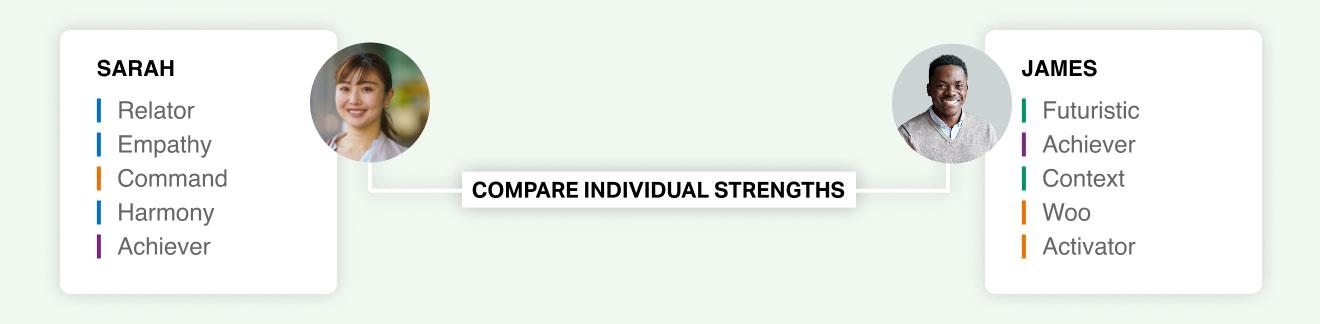
Share strengths profiles. Have team members share their CliftonStrengths results so that colleagues understand how each person thinks, communicates and contributes. Knowing a teammate leads with Analytical® or Woo® helps you tailor collaboration and communication, even across locations and time zones.
-
Connect strengths to team goals. Regularly discuss how strengths across the team connect to team goals and challenges. Focusing on strengths during virtual collaboration sessions or team meetings reinforces each person's value and helps teams work through obstacles by drawing on the right strengths at the right time.
-
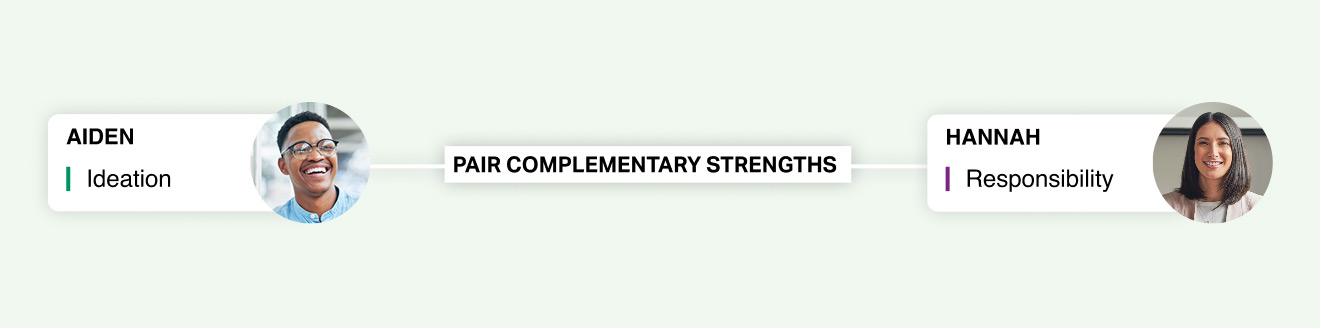
Pair complementary strengths. When assigning projects or tasks, pair team members whose strengths complement each other. A big-picture strategic thinker working with a detail-oriented executor ensures both planning and follow-through are covered, regardless of where each person works.
What Helps Employees Collaborate With Partners?
What Helps Employees Collaborate With Partners?
Powerful workplace partnerships are built on eight key elements that determine whether collaboration thrives or breaks down. Understanding and applying these principles helps employees and teams get the most out of every working relationship.
-
Complementary Strengths
-
A Common Mission
-
Fairness
-
Trust
-
Acceptance
-
Forgiveness
-
Communication
-
Unselfishness
- Complementary Strengths
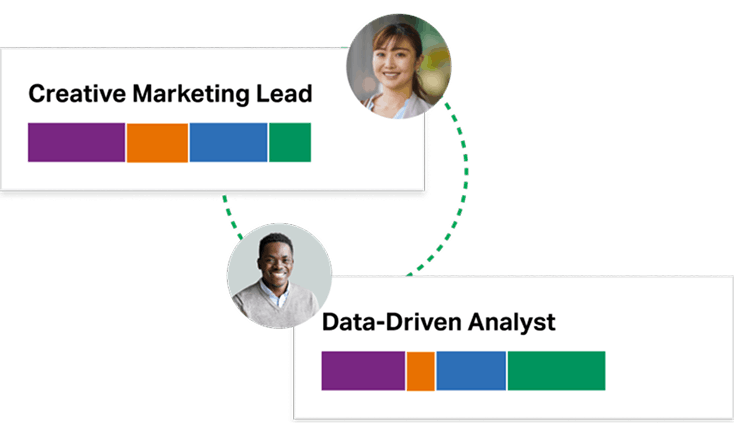
Nobody is great at everything, but powerful partnerships let people combine their unique strengths to achieve more together. Partners with complementary strengths fill gaps in each other's abilities, allowing each person to focus on what they do best.
Best indicators of complementary strengths:
-
We complement each other's strengths.
-
We need each other to get the job done.
-
They do some things much better than I do, and I do some things much better than they do.
Example of employee collaboration based on complementary strengths: A creative marketing lead works with a data-driven analyst to design campaigns. The strategist focuses on bold, engaging ideas, while the analyst ensures those ideas align with market trends and deliver measurable results.
- A Common Mission
A shared purpose holds a partnership together, and without it, even the most talented collaborators can waver. A common mission provides focus and resilience, especially when challenges arise.
Best indicators of a common mission:
-
We share a common goal.
-
We have a common purpose for what we do.
-
We believe in the same mission.
Example of employee collaboration based on a common mission: Two startup founders have different personal goals. While one wants financial independence and the other societal change, their shared purpose of building a sustainable business keeps them focused on the same goal.
- Fairness
Fairness in a partnership has less to do with splitting work equally and more to do with ensuring that both partners feel the other values and rewards their contributions. A lack of fairness leads to resentment and erodes collaboration over time.
Best indicators of fairness:
-
We share the workload fairly between us.
-
We do not have to keep track of who does what or who gets credit.
-
We see each other as equals.
Example of collaboration in the workplace based on fairness: In an architecture firm, a senior architect handles client presentations while a junior partner manages detailed drafting. Though the roles differ in visibility, both agree that their contributions are essential, and their recognition of each other reflects that.
- Trust
Trust is the foundation of any partnership. Without trust, collaboration turns into micromanagement. Trust allows partners to focus on their own responsibilities without monitoring or doubting each other's commitment, reducing friction and enabling faster decisions.
According to Gallup research on trust, in a good collaboration, 58% of partners strongly agree that they trust each other, and another 29% score the statement a 4 (“agree”) on a 5-point scale. In a poor partnership, less than 3% strongly agree they trust each other, while 50% strongly disagree.
Best indicators of trust:
-
We can trust each other.
-
We can count on each other to do what we say we will do.
-
They tell others how good I am, and I tell others how good they are.
Example of employee collaboration based on trust: A senior lawyer trusts a junior associate to conduct thorough research, while the associate relies on the lawyer to argue the case effectively in court. Mutual trust streamlines their workflow and strengthens their commitment to following through.
- Acceptance
Partnerships flourish when individuals embrace each other's differences rather than trying to change or fix their partner. Acceptance builds mutual respect and reduces unnecessary conflict.
Best indicators of acceptance:
-
We focus on each other's strengths, not weaknesses.
-
We accept each other as we are and don't try to change each other.
-
We are understanding when one of us makes mistakes.
Example of a collaborative partnership based on acceptance: Two tech startup founders — one who thrives under pressure, one who prefers careful planning — recognize their differences as advantages. Rather than clashing over these tendencies, they balance each other out.
- Forgiveness
Mistakes and missteps happen in every partnership. The ability to forgive is what allows partnerships to grow stronger and survive rather than collapse under the weight of unresolved conflict.
Gallup research shows that serious violations of trust are rare in the best partnerships. Only 18% of strong partnerships experience a real dispute, compared with 40% in poor ones. When a falling-out does occur, 85% of those in strong partnerships are able to forgive, versus just 14% in poor partnerships.
Best indicators of forgiveness:
-
There have been times when one of us has violated the other's trust.
-
When that happens, we are able to forgive each other.
Example of employee collaboration based on forgiveness: After a project delay causes tension, two managers discuss the issue openly, forgive each other for missteps and reset expectations for their future collaboration.
- Communication
Clear, consistent communication prevents misunderstandings and keeps partnerships on track. Effective communication includes active listening, proactively sharing updates, and frequently and openly discussing needs. The goal is not just talking but ensuring mutual understanding.
Best indicators of effective communication:
-
We rarely misunderstand each other.
-
We are good listeners to each other.
-
We show appreciation for what the other does.
Example of employee collaboration based on communication: Two department heads meet weekly to review progress, recalibrate strategies and tackle challenges together. This regular communication keeps their teams focused and strengthens connections across departments.
- Unselfishness
The best partnerships put shared success ahead of individual recognition. Unselfishness builds trust, deepens connection and creates a sense of achievement that neither partner could feel alone.
Best indicators of unselfishness:
-
We take as much satisfaction in seeing the other succeed as we do from our own success.
-
My partner will risk a lot for me, and I will do the same for them.
-
My partner is like a sibling to me.
Example of employee collaboration based on unselfishness: In a nonprofit, a director and a lead fundraiser work together to secure a major grant. Both acknowledge that their combined efforts made the achievement possible. Neither seeks individual credit for the win.
What Are Collaborative Partnership Examples?
What Are Collaborative Partnership Examples?
Collaborative partnership examples show what it looks like when two people combine their strengths to achieve outcomes that would be difficult to accomplish alone. These partnerships can exist across roles, teams, or departments and often improve problem-solving, innovation and results.
Common examples of collaborative partnerships at work include:
-
teammates combining complementary strengths on a project
-
a manager and employee working together on development goals
-
cross-functional partners coordinating work between departments
-
leaders collaborating to solve complex organizational challenges
The following real-world examples show what it looks like when complementary strengths, trust, shared mission and the other elements of effective collaboration in the workplace come together.

Complementary Strengths: Steve Jobs and Steve Wozniak
Jobs and Wozniak built Apple®;, one of the most iconic companies in history, by leaning into what made them different rather than trying to be the same. Wozniak brought deep technical genius in engineering, while Jobs excelled at visionary thinking and marketing. Neither could have built Apple alone, but together their complementary strengths revolutionized an entire industry.

Common Mission: Edmund Hillary and Tenzing Norgay
When Hillary and Norgay set out to climb Mount Everest, their backgrounds, motivations and personal ambitions differed greatly. Hillary, a New Zealander, was driven by exploration, while Norgay, a Sherpa from Nepal, saw the climb as a way to honor his heritage and advance his community. Despite their differences, a common mission united them: to reach the summit. This shared goal helped them navigate extreme conditions and dangerous terrain, overcoming obstacles that would have defeated less unified partners.

Fairness: Bill Hewlett and Dave Packard
Hewlett and Packard exemplified fairness in their leadership approach. They matched their salaries and shared responsibilities equally, even during difficult times. This built trust between them and modeled fairness across their organization, earning the loyalty of their employees.

Acceptance: LeBron James and Anthony Davis
James and Davis won an NBA championship in 2020 in large part because of their acceptance of each other's contrasting styles. James, known for his vocal leadership and all-around brilliance at the game of basketball, complements Davis, who is quieter but dominates with his defensive and offensive versatility. While James often takes the spotlight as the face of the franchise, he fully embraces Davis as the team's centerpiece on the court. In return, Davis respects James' leadership and allows him to set the team's tone. Their acceptance of each other's roles was instrumental to their championship win.

Forgiveness: Oprah Winfrey and Iyanla Vanzant
Winfrey and Vanzant experienced a serious falling-out in the 1990s over misunderstandings about Vanzant pursuing her own show. Years later, they reconciled publicly, acknowledging their mistakes, rebuilding trust and ultimately collaborating again. Their forgiveness not only restored the relationship but also made it stronger, and their story has inspired others navigating their own partnership rifts.
Leading With Strengths
Learn how influential leaders use their greatest strengths to empower their teams and create meaningful change.
Quick Collaboration Q&A
Quick Collaboration Q&A
What Is Collaboration?
The meaning of collaboration is the practice of two or more people combining their knowledge, skills and perspectives to achieve a shared goal. Collaboration emphasizes shared ownership, fluid roles as partners adapt to each task’s needs and creative problem-solving that draws on divergent thinking to generate solutions.
What Is Collaboration Versus Partnership?
Collaboration occurs within a partnership. Collaboration describes how people work together on a shared goal, while partnership refers to the deeper, ongoing relationship built on trust, complementary strengths, and mutual commitment that makes that collaboration sustainable over time.
How Does Collaboration Differ From Workplace Cooperation?
Cooperation means working alongside others without necessarily combining efforts. Collaboration goes further, requiring people to actively combine their thinking, share responsibility and invest in a joint outcome. Cooperation divides tasks; collaboration multiplies efforts.
What Are Collaboration Skills?
Collaboration skills are the abilities that allow people to work effectively with others toward a common goal. They include communication, active listening, adaptability, and the ability to recognize and make the most of the strengths of those around you. Gallup also emphasizes eight key elements that define powerful, collaborative partnerships: complementary strengths, a common mission, fairness, trust, acceptance, forgiveness, communication and unselfishness.
Better Collaboration Starts With Strengths
Discover how your team’s unique talents can transform the way you work together.