
How Can a Strengths-Based Approach Improve Organizational Success?
A strengths-based approach improves organizational success by aligning employees’ natural talents with strategic priorities, leading to higher engagement, increased profitability and significantly lower turnover. Organizations that incorporate strengths into the workplace see up to 23% higher engagement, 29% higher profit and 72% lower turnover.
How Can a Strengths-Based Approach Help Organizational Performance?
How Can a Strengths-Based Approach Help Organizational Performance?
A strengths-based approach enhances organizational performance by aligning employee talents with business objectives, resulting in higher engagement, increased profit and lower turnover.
When organizations position employees to use their strengths every day, they bring more energy, confidence and clarity to their work. Over time, this strengthens teams, improves leadership effectiveness and leads to measurable improvements in performance and culture.
Gallup research shows a strengths-based approach can result in up to:
29% higher profit
19% higher sales
23% higher employee engagement
72% lower turnover
Gallup findings indicate that organizations that apply a strengths-based approach can achieve measurable performance improvements, including 29% higher profit, 19% higher sales, 23% higher employee engagement and 72% lower turnover.
In practice, a strengths-based approach improves organizational performance by reshaping how leaders manage, how teams collaborate and how work gets done. Organizations that use CliftonStrengths strategically shape leadership development, team effectiveness and performance systems to reflect employees’ natural talents — rather than focusing primarily on fixing weaknesses.
This approach helps leaders place people in roles where they can perform at their best and fosters stronger collaboration across teams. The result is a culture where employees are more engaged, more productive and more likely to stay. Over time, these conditions support sustained business results and long-term organizational success.
How Do Employee Strengths Improve Business Performance?
How Do Employee Strengths Improve Business Performance?
Employee strengths improve business performance by aligning daily work with people’s natural talents. This alignment increases productivity and profitability while reducing turnover.
When employees consistently use their strengths, they work more efficiently and collaborate more effectively. Together, these behaviors lead to stronger performance at the individual, team and organizational levels.
What applying employee strengths at work can do for your organization:
- Increase profit by up to 29% by improving productivity and quality of work.
- Increase sales by up to 19% as strengths-based teams convert opportunities more effectively.
- Reduce turnover by up to 72%, lowering recruitment and training costs.
- Preserve institutional knowledge and strengthen team continuity.
In strengths-based organizations, performance improves because leaders intentionally align roles, workflows and development with what employees do best. Rather than asking people to spend most of their time fixing weaknesses, managers help employees use their strengths in core responsibilities, problem-solving and collaboration.
This approach improves focus and efficiency, helps prevent burnout, and supports teams in performing at higher levels over time. As a result, strengths-based development becomes a practical way to improve business performance, rather than a standalone engagement initiative.
How Can Incorporating Strengths in a Workplace Boost Team Performance?
How Can Incorporating Strengths in a Workplace Boost Team Performance?
Incorporating strengths in the workplace boosts team performance by helping teams recognize, combine and use each member's natural talents. This approach increases productivity, strengthens collaboration and reduces turnover.
When teams understand how individual strengths complement each other, they coordinate more effectively and share work more strategically, which reduces friction overall.
When incorporating strengths into how teams work, organizations can:
- Position team members where they are naturally most effective, maximizing capability and output.
- Increase productivity by up to 18% by reducing friction and inefficiency in daily work.
- Improve collaboration by helping teams recognize and appreciate the value of diverse talents.
- Strengthen engagement and accountability, leading to more consistent performance.
- Reduce turnover by up to 72%, stabilizing teams and sustaining momentum.
Incorporating strengths in the workplace transforms team performance by shifting the focus from role-based expectations to talent-based contributions. Rather than expecting everyone to excel at the same tasks, teams intentionally align work with individuals’ natural patterns of thinking, problem-solving and behavior.
This insight enables a more strategic distribution of responsibilities that improves coordination, increases trust and allows leaders to delegate with confidence. Over time, these dynamics reduce friction, strengthen collaboration and enable teams to sustain higher levels of performance.
How Does Using Strengths in an Organization Support a Culture of Engagement and Wellbeing?
How Does Using Strengths in an Organization Support a Culture of Engagement and Wellbeing?
Using strengths in an organization fosters a culture of engagement and wellbeing. Employees are more engaged and experience a higher quality of life when their daily work aligns with their natural talents.
When people regularly use their strengths, work feels more meaningful and energizing rather than draining. Over time, this creates a workplace culture where engagement and wellbeing reinforce each other.
23% higher employee engagement
3x more likely to report an excellent quality of life
10% higher levels of citizenship and volunteerism
Using strengths in an organization creates a culture where people are valued for what they naturally do best, not just for meeting role expectations. When employees spend more time working in areas of strength, they experience greater confidence, purpose and psychological safety — all of which are foundational to sustained engagement and wellbeing. In fact, organizations that use strengths have seen 23% higher employee engagement and employees who are three times more likely to report an excellent quality of life.
A strengths-based culture extends beyond individual performance. Employees who feel engaged and supported are more likely to contribute positively to their teams, their organizations and their communities. Organizations that use strengths report 10% higher citizenship and volunteerism. By incorporating strengths into leadership practices, development systems, and everyday work, organizations create environments where engagement and wellbeing are not competing priorities — they are mutually reinforcing outcomes.
What Is a Strengths-Based Culture? How Does It Drive Organizational Success?
What Is a Strengths-Based Culture? How Does it Support Organizational Success?
A strengths-based culture is a workplace that consistently develops and applies employee strengths across all aspects of work. It supports organizational success by improving engagement, productivity and collaboration at scale.
Rather than relying on one-time initiatives, a strengths-based culture shows up in everyday systems and leadership practices. Strengths shape how work is assigned, how people grow and how the organization supports employees over time.
A strengths-based culture shows up in many ways:
- Leaders use strengths in daily systems such as performance reviews, team meetings and development conversations.
- Managers optimize talent by focusing on what’s right with people, rather than spending most of their time fixing what’s wrong.
- Engagement fuels productivity and strengthens collaboration, creating momentum over time.
- Organizations use strengths throughout the employee life cycle, from onboarding through succession planning.
- Teams maintain high performance by using strengths in day-to-day operations, rather than relying on standalone workshops.
A strengths-based culture works because it aligns organizational systems with how people naturally perform at their best. When leaders align roles, expectations and development with strengths, employees gain clarity, confidence and a stronger sense of fulfillment, which directly influences how effectively work gets done.
Over time, this approach improves both the employee experience and organizational results. Higher engagement leads to stronger productivity, better collaboration and more consistent performance. Because strengths are part of daily operations rather than a separate program, organizations build a durable foundation for long-term organizational success and competitive advantage.
What Business Initiatives Can Strengths-Based Development Accelerate?
What Business Initiatives Can Strengths-Based Development Accelerate?
Strengths-based development accelerates important business initiatives by grounding change, leadership and performance efforts in employees’ natural talents. This approach helps organizations move initiatives forward more quickly and sustain results over time.
When organizations plan initiatives that reflect how people naturally think, feel and perform, employees engage sooner, show less resistance and apply change more consistently.
Strengths-based development can accelerate key initiatives such as:
Change management: Employees are more likely to support change when it aligns with their natural talents.
Leadership development and succession planning: Organizations identify and develop leaders based on their innate capabilities.
Mergers and acquisitions: Organizations bring cultures together by recognizing and valuing the diverse strengths of their employees.
Performance management: Conversations shift from fixing gaps to maximizing contributions.
Hybrid team leadership: Distributed teams collaborate more effectively across different working styles and locations.
Onboarding and career development: New hires contribute sooner when organizations position people where they'll excel.
Strengths-based development reinforces business initiatives by using natural talents as the foundation for change, rather than relying on generic programs. CliftonStrengths transforms abstract organizational initiatives into people-powered results by connecting them directly to what employees naturally do best, helping change feel authentic rather than mandated.
By building on the natural talents already present in the organization, companies improve business performance and create conditions where change happens sooner, lasts longer and produces measurable results.
What Tools Help Organizations Apply Strengths in Business?
What Tools Help Organizations Apply Strengths in Business?
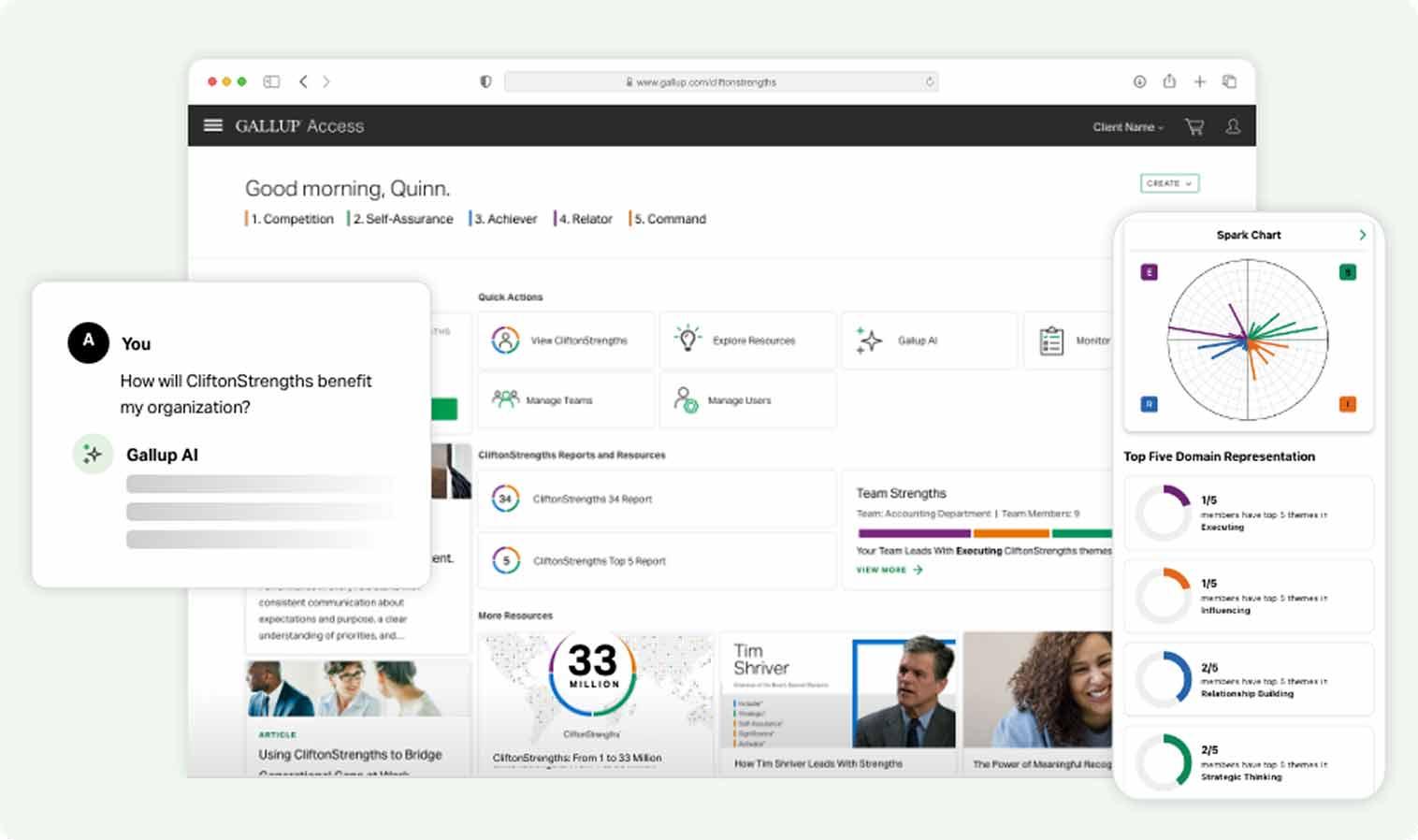
Gallup Access is the premier tool that helps organizations apply strengths in business by delivering personalized CliftonStrengths insights, team analytics, and actionable guidance in one integrated platform.
Gallup Access helps organizations apply strengths through:
- Individual assessments: Employees discover their top five CliftonStrengths and learn how to use them.
- Team analytics: Leaders see collective strengths patterns, gaps and complementary capabilities.
- Manager resources: Coaching prompts, conversation guides and development strategies that support daily management practices.
- Progress tracking: Organizations can measure how people use their strengths and the impact on engagement and performance.
- Scalable implementation: Organizations can start small with pilot teams and expand across the organization using a consistent approach.
Gallup Access provides an integrated platform for applying strengths in business at scale. It delivers personalized CliftonStrengths insights for individuals, team analytics that reveal collective patterns, and actionable guidance for leaders. This approach helps organizations apply strengths in day-to-day work and achieve measurable improvements in performance.
Which Companies Are Using Strengths to Improve Business Performance?
Which Companies Are Using Strengths to Improve Business Performance?
90% of Fortune 500 companies have implemented CliftonStrengths
More than 90% of Fortune 500 companies have used CliftonStrengths to improve organizational performance through strengths-based development.
Across industries, regions and organizational models, these companies use strengths to solve real business challenges from engagement to leadership effectiveness to culture transformation.
Explore how organizations like yours use strengths to:
-
Improve business and team performance.
-
Strengthen organizational culture and leadership effectiveness.
-
Achieve measurable, research-backed outcomes.

Organizations worldwide use CliftonStrengths to turn talent into a competitive advantage. From global enterprises to growing organizations, leaders apply strengths-based development to improve performance, strengthen culture and help people do their best work.
Read these success stories to learn how organizations across industries use strengths to address real business challenges, accelerate team performance, and achieve measurable results and to understand how a strengths-based approach could work in your organization.

Southwest Airlines: Culture Takes Flight and Soars
What started as a grassroots effort expanded to near-universal strengths adoption at Southwest Airlines.

Strengths and Diversity at Estée Lauder Companies
To achieve their vision, Estée Lauder Companies committed to a rapid rollout that made strengths part of the foundation of their culture.

Stryker: Using Talent to Succeed
With around 300 active strengths coaches, Stryker places careful focus on hiring the right people with the best talent.

Developing Talent to Succeed at Ameritas
Many companies strive to improve the lives of their customers and employees. At Ameritas, this vision is more than a hopeful pursuit — it's real.
How Do I Get Started With Strengths-Based Development at My Organization?
How Do I Get Started With Strengths-Based Development at My Organization?
Organizations begin their strengths-based development journey by aligning leadership, starting with a pilot, and intentionally incorporating strengths into existing systems and daily work.
Successful strengths-based development is not a one-time initiative. It follows a phased approach that starts small, builds leadership capability and expands through current organizational practices.
To get started:
- Align leadership early by securing executive sponsorship and identifying internal strengths champions.
- Start with a pilot team to test the approach, gather feedback and refine your strategy.
- Equip managers as strengths coaches so development conversations stay consistent and practical.
- Incorporate strengths into existing systems such as performance reviews, hiring and team meetings.
- Scale intentionally by expanding strengths-based practices across teams and functions.
Getting started with strengths-based development doesn’t require reinventing your organization. It requires focus and intentionality. Organizations that succeed start by aligning leaders on why strengths matter, then apply the approach in real work settings where teams and managers can see immediate value.
As strengths become an integral part of everyday practices, from performance management to team development, they shape how work gets done rather than existing as an additional program. This phased approach helps organizations build momentum, demonstrate progress and establish a sustainable strengths-based culture that supports long-term organizational performance.
Building a Strengths-Based Culture Starts Here
Building a Strengths-Based Culture Starts Here
Your organization is unique. Your strengths-based strategy should be too.
Gallup works with organizations to design strengths-based development approaches that align with their goals, culture and people. Our experts help you apply CliftonStrengths in ways that drive performance, strengthen engagement and support long-term success.