
![Careers PP > Top Card > 2026-03 [UPDATE]](https://imagekit.gallup.com/fusion/tr:n-emd_tmpl_dlp_bg_lg/CSFCMSEN/598665ed-5896-4177-8ccf-cdb5aeb6a80e.jpg)
Career Development: How to Grow Your Career Using Your Strengths
Your career is a continuous journey of aligning who you are with what you do. Discover how to identify the right roles, create a strengths-based development plan and lead productive conversations with your manager to turn your potential into high performance.
What Is Career Development, and Why Is It Important?
What Is Career Development, and Why Is It Important?
Career development is the ongoing process of aligning your unique talents and strengths with your work to achieve higher performance and personal fulfillment. It is not a one-time event like a promotion; it is a continuous career development process of choosing roles and projects that allow you to apply what you do best. This is vital because people who use their strengths are 6x more likely to be engaged in their jobs and 3x more likely to report an excellent quality of life.
- Self-discovery. Identify your natural CliftonStrengths to understand your greatest potential for growth.
- Intentional growth. Prioritize your career and professional development through ongoing coaching and feedback.
- A mindset shift. Move from a “paycheck” mentality to a meaningful career path where you can do what you do best every day.

- My Paycheck
- My Satisfaction
- My Boss
- My Annual Review
- My Weaknesses
- My Job

- My Purpose
- My Development
- My Coach
- My Ongoing Conversations
- My Strengths
- My Life
For many, the traditional approach to career and professional development focuses on identifying gaps and fixing weaknesses to fit a specific job description or hierarchy. Gallup research shows that this approach contributes to disengagement, but when people get to do what they do best every day at work, the organizations they work for see a boost in employee engagement, retention and profit.
Development Is a Process, Not a Promotion
A common misconception is that development means promotion. However, a promotion is a single event, while development is a lifelong process. True career development involves understanding your unique talents and finding roles that allow you to apply those talents daily. When you focus on your CliftonStrengths, you aren't just adding new abilities; you are building a sustainable career path that leads to higher productivity and wellbeing.

The Importance of Strengths-Based Growth
Some approaches emphasize generic professional upskilling, but Gallup research shows that growth is more effective when it builds on your natural talents. This approach benefits both individuals and organizations. When you take ownership of your career development process, you stop waiting for a manager to advance you and start creating opportunities to contribute where you are most naturally talented. When you focus on your strengths, you transform your professional development from a checklist to a clear path for long-term excellence.
How Do I Know if I Need a Career Change?
How Do I Know if I Need a Career Change?
If you feel stuck in your career, it may be a sign that your current role no longer aligns with your strengths, interests or goals. Before deciding how to switch careers, evaluate your employee engagement, your energy at work, your talents and your vision for your career. You may not need a new career but simply new career growth opportunities within your current role. Making this distinction helps you move from feeling stalled to taking intentional steps toward a more fulfilling career path.
- Examining your engagement. Determine if your current role meets your needs as an employee.
- Conducting an energy audit. Identify which tasks leave you energized and which leave you depleted.
- Aligning talent to role. Assess whether your role allows you to do what you do best every day.
- Envisioning your future. Consider whether you can achieve your long-term career goals in your current environment.
Feeling stuck in your career rarely reflects a lack of effort; it often signals misaligned expectations. Gallup research shows that one of the primary reasons people leave their jobs is a lack of advancement, development or career opportunities. When your daily responsibilities don't fit well with your natural talents, work can begin to feel draining instead of developmental.
What Makes an Engaging Career
An engaging career meets your needs as an employee, leading to greater engagement and better performance at work.
Gallup measures four levels of employee needs, from basic clarity to personal growth, using the Gallup Q12® employee engagement survey. When organizations meet these needs in sequence, they create a workplace where individuals and teams can thrive.
Each level builds on the last and provides a clear structure for motivation and development.
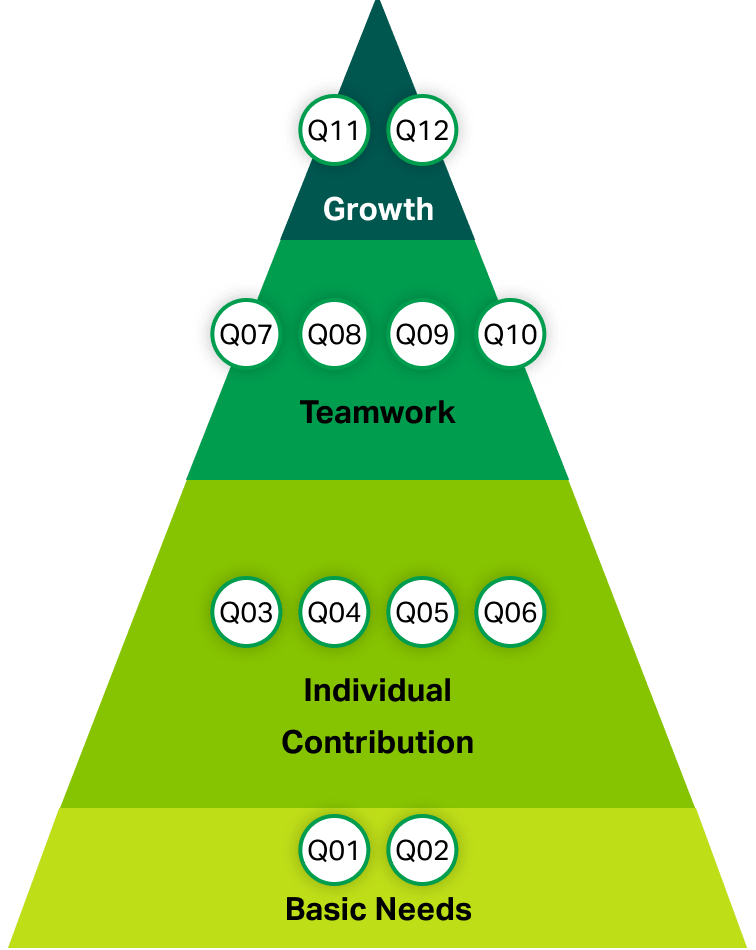
- This last year, I have had opportunities at work to learn and grow.
- In the last six months, someone at work has talked to me about my progress.
- I have a best friend at work.
- My associates or fellow employees are committed to doing quality work.
- The mission or purpose of my company makes me feel my job is important.
- At work, my opinions seem to count.
- There is someone at work who encourages my development.
- My supervisor, or someone at work, seems to care about me as a person.
- In the last seven days, I have received recognition or praise for doing good work.
- At work, I have the opportunity to do what I do best every day.
- I have the materials and equipment I need to do my work right.
- I know what is expected of me at work.
The Gallup Q12 items are Gallup proprietary information and are protected by law. You may not administer a survey with the Q12 items or reproduce them without written consent from Gallup. Copyright © 1993-1998 Gallup, Inc. All rights reserved.
In an engaging role, you have the opportunity to do what you do best every day, receive feedback on your progress, and see opportunities to learn and grow, among the other important elements of an engaging career shown in the graphic above.
CliftonStrengths helps you determine what "best" looks like for you by revealing your natural patterns of thinking, feeling and behaving. When you better understand those patterns, you can build a career path that uses your strengths every day while you continue to grow.
Perform an Energy Audit
Burnout is one of the most pressing issues facing the global workforce. Gallup’s research trends on employee wellbeing indicate that about three in 10 U.S. employees say they “very often” or “always” feel burned out at work. The World Health Organization defines burnout as “a syndrome conceptualized as resulting from chronic workplace stress that has not been successfully managed,” characterized by energy depletion, mental distance from one's job and reduced professional efficacy.
If you consistently work outside your natural talents, you may begin to feel stalled. Employees who are a natural fit for a role tend to work more efficiently and sustain high performance for longer periods. They also have more positive daily work experiences and handle stress more effectively when under time pressure than employees who are not a natural fit for the job.
To conduct your energy audit, track your energy levels across different tasks and projects. If certain activities consistently drain you, move toward roles and responsibilities that build energy instead of draining it. Energy depletion at work doesn’t necessarily mean you are in the wrong career — you may simply be focusing on the wrong activities.

Evaluate Your Talent Alignment
Ask yourself: What do people consistently rely on me for?
If your answer doesn't align with your current job responsibilities, you may have a talent misalignment. Before exploring how to switch careers, consider whether "job crafting" — realigning your projects and job description with your top five strengths — can provide the professional reset you need. When your talents align with your role, you are more likely to be productive and engaged.
Define Your Future Vision
Assess your long-term career goals against your current work environment. Does your workplace provide a high-development culture where someone encourages your growth, or does it value a traditional “command-and-control” style of management that gives you little autonomy to focus on your strengths? If your career path feels blocked, you may need a different environment to reach your goals. Understanding your strengths gives you the confidence to pursue a role that does more than provide a paycheck. It helps you seek work that allows your unique talents to thrive.
How Do I Know What Career Is Right for Me?
How Do I Know What Career Is Right for Me?
To answer the question "How do I know what career is right for me?" start by looking inward at your natural talents rather than relying on a generic career aptitude test. While a career path quiz might suggest job titles, true career satisfaction comes from finding a role that allows you to apply your unique CliftonStrengths. The right career is one where the daily demands align with how you naturally think, feel and behave.
- Talent awareness. Understand your CliftonStrengths and how the assessment works to help you maximize your potential.
- Role research. Look beyond job titles to find tasks that align with your natural career path.
- Environment fit. Identify workplace cultures that value a strengths-based approach to development.
Many people start their search with a career aptitude test and hope it will produce the perfect job title. However, Gallup research suggests that how you do the work often matters more than the title itself. To find a career that lasts, focus on the intersection of your interests and your innate talents.
Build Talent Awareness Beyond the Career Path Quiz
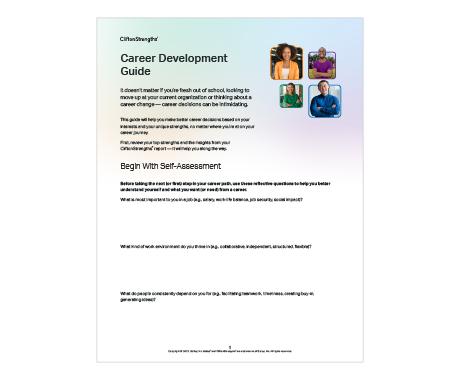
While a career path quiz can be a fun starting point, it rarely explains why you succeed in certain roles. Instead of searching for a generic title, use the CliftonStrengths Career Development Guide to conduct a self-assessment. By reflecting on your strengths, what you want for your career, how you work best and other aspects of your ideal job, you’ll gain insight into how to determine if a job is the right fit for you.
Use Role Research to Map Your Career Path
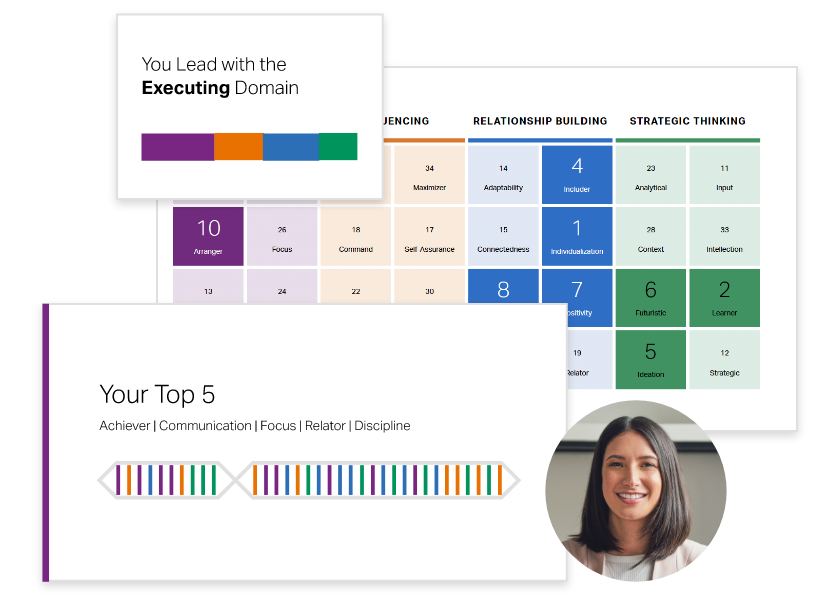
Each person expresses a different balance of the four CliftonStrengths domains: Executing, Influencing, Relationship Building and Strategic Thinking. As you research roles, evaluate how your strengths align with the daily tasks in a job description. For example, if most of your strengths lie in Strategic Thinking, you will likely feel more comfortable in roles that involve deep analysis and future planning. If you lead with Relationship Building, you may prefer roles that require collaboration.
Understanding these domains helps you filter career growth opportunities to find where you can achieve excellence. Use the following questions to reflect on how you like to work to accomplish goals:

How do you like to get your work done? What, specifically, do you do to ensure your work is executed efficiently and effectively? More broadly, do you even prefer a specific way of doing work, or do you go with the flow?

Which strengths do you use to get others to see things from your perspective? What strength do you naturally turn to when influencing others?

What helps you to engage with others, build friendships, make connections and grow your network? Does relating deeply to a select few come naturally, or do you prefer to make connections with anyone/everyone? Maybe both?

How do you generate ideas, problem-solve and make decisions? What strengths help you do that?
Evaluate Environment Fit and Development Culture
The last step in identifying which career is right for you is choosing an environment that prioritizes development and allows your strengths to flourish. Gallup research shows that managers account for at least 70% of the variance in team-level engagement. Employees are most successful in an environment where bosses act as coaches and someone encourages their development.
When evaluating how to switch careers, look for organizations that prioritize ongoing strengths-based coaching conversations rather than relying solely on annual reviews. During the interview process, you can evaluate the culture by asking:
-
"How do managers here provide feedback?" Listen for mentions of frequent, ongoing check-ins rather than just an annual review.
-
"How does the company help employees discover and use their strengths?" Listen for an emphasis on individual talents over generic job descriptions.
-
"What resources are available for professional development?" Listen for coaching and learning opportunities, not just ways to "climb the ladder."

The right environment treats your growth as a continuous process rather than a one-time event. Choosing a workplace that values a strengths-based approach increases the likelihood that your career path will remain energized and sustainable.
How Do I Create a Career Development Plan?
How Do I Create a Career Development Plan?
Use the CliftonStrengths Career Development Guide to conduct a self-assessment, understand how you work best, determine if a job is right for you and clarify your career goals. A successful career development plan aligns your natural talents with your professional objectives. Instead of focusing on fixing weaknesses, your plan should prioritize the intentional use of your CliftonStrengths to achieve long-term career goals. This approach ensures your professional development plan is a practical guide for ongoing engagement and strong performance.
- A focus on your strengths. Use the CliftonStrengths assessment to pinpoint your top talents.
- Strengths-based goals. Define career goals that allow you to do what you do best every day.
- Ongoing conversations. Replace annual reviews with frequent, meaningful career discussions.
Most career development plans fail because they are designed to improve weaknesses. This typical approach often leads to slow progress and frustration. According to Gallup research, employees who receive strengths-based development are more productive and less likely to leave their organizations.
Identify Strengths Over Weaknesses
The foundation of your professional development plan should be your top five CliftonStrengths. Rather than concentrating on what you lack, identify the natural patterns of thinking, feeling and behaving that have already led to your greatest wins. When you build a plan based on what is naturally right with you, you develop more quickly and perform more consistently than you would by fixing your flaws.
Set Strengths-Based Career Goals
When you define your long-term career goals, consider how your specific strengths can solve team problems or contribute to meaningful results. For example, if you lead with Achiever®, you might set a goal to lead a high-output project. If you lead with Developer®, you may focus on mentoring new team members. Aligning your goals with your talents ensures that your career path feels like a natural progression rather than a forced climb.
"The right expectations begin from the inside out. When you are familiar with your strengths, you can use them to fulfill your expectations. So you must be sure that as you shape your expectations, you consider what your strengths are." — Don Clifton
Refer to Your Plan in Ongoing Conversations
Your career development plan should not sit in a drawer until your formal performance review. Instead, use it as a talking point during frequent check-ins with your manager. Great managers coach by identifying successes and motivating you to go beyond what you think you can do. When you bring your plan into regular coaching conversations, you keep your growth active and your performance moving forward.
Subscribe to the CliftonStrengths Insights newsletter for strategies to succeed using your strengths.
What Should I Discuss With My Manager in a Career Development Conversation?
What Should I Discuss With My Manager in a Career Development Conversation?
In a career development conversation with your manager, focus on three areas: your recent successes, your potential based on your natural talents and the specific career growth opportunities you want to pursue. Preparing for this conversation requires a shift in mindset from seeking permission from a boss to seeking partnership with a coach. Instead of waiting for a formal performance review, initiate frequent discussions based on how your CliftonStrengths can contribute to results.
- A focus on successes. Use your CliftonStrengths report to identify how your strengths contributed to the team’s recent success.
- Dialogue. Replace one-way, infrequent updates with two-way, frequent discussions about your potential.
- Action steps. Define clear, strengths-based objectives to complete before your next development conversation.
Taking ownership of your career and professional development means prioritizing frequent, focused and future-oriented conversations with your manager. When you arrive with a clear understanding of your strengths, accomplishments and opportunities, you make it easier for your manager to coach you effectively and support your career growth.
Lead With Your Successes and Strengths
Start your development conversation by describing recent work where you felt most effective. Use the language of your top five CliftonStrengths to explain why you thrived. For instance, if you lead with Strategic®, share how you navigated a complex project. This helps your manager recognize patterns in your performance and identify career growth opportunities that fit your natural way of thinking and behaving.
Invite Ongoing Dialogue With Your Manager
Career development is continuous and happens through different types of conversations with your manager. These conversations typically include:





When you actively participate in these discussions and they happen consistently — not just once a year during an annual performance review — they create clarity, strengthen collaboration and support long-term growth.
Define Clear, Strengths-Based Action Steps
The most effective career development conversation ends with a well-defined path forward. Instead of setting a vague goal like "improve communication," define a strengths-based objective such as "Use my Communication® strength to lead the monthly client briefing." This makes your development tangible and measurable, ensuring your career path includes distinct opportunities for you to contribute to your team’s and organization’s success.
| Generic Opportunity | Strengths-Based Action Step | Why It Works |
|---|---|---|
| "I need to work on my public speaking and communication." | "I will use my Communication strength to lead the monthly client briefing to improve project transparency." | It builds on a natural talent rather than correcting a weakness. |
| "I should try to be more organized and better at planning." | "I will apply my Strategic talent to create a new project road map that helps the team anticipate roadblocks." | It uses an existing thinking pattern to solve an operational problem. |
| "I need to network more and meet people in other departments." | "I will use my Relator® strength to schedule one-on-one coffee chats with three key partners this quarter to deepen collaboration." | It prioritizes strategic, results-driven relationship building over generic networking. |
| "I want to be a better leader and take on more responsibility." | "I will use my Developer strength to mentor our two new interns and help them onboard and reach productivity faster." | It defines leadership through growing others. |
How Can I Make My Performance Review More Productive?
How Can I Make My Performance Review More Productive?
To make your performance review more productive, hold a formal progress conversation at least twice a year and focus on future potential rather than just evaluating past performance. Shifting from a corrective mindset to a developmental one ensures that your performance development will advance you toward excellent outcomes.
- Defining success by outcomes. Focus on the results you produce rather than a generic checklist of behaviors.
- Reframing weaknesses. Identify how your strengths can remove barriers to excellent performance.
- Investing in future growth. Discern the experiences and development needed to help you apply your talents at the next level.
Gallup research suggests that traditional reviews often fail because they focus on past mistakes that cannot be changed. By focusing on your strengths, results and opportunities, you and your manager can turn your formal performance evaluation into a road map for future success.
Identify Your Formula for Excellence
One of the most valuable parts of performance development is identifying the specific strengths and partnerships that contributed to your successes. During your review, go beyond describing what you did. Explain how your talents shaped the outcome and who complemented your efforts. This helps you reproduce similar career growth opportunities in the future.
Manage Weaknesses With Self-Awareness
Gallup defines a weakness as "anything that gets in the way of your success." Understanding your weaknesses is vital for having productive performance reviews, as well as other career development conversations like job interviews or planning meetings.
Knowing your strengths and weaknesses helps you say, "Because I'm really good at X, I may struggle with Y. But I use X and Z to compensate." It's normal to be highly effective at some things and less-than-great at other things. When evaluating situations where your role requires talents outside your top five strengths, discuss changing a process, perspective, or partner to help you minimize difficulties and maximize your ability to perform effectively using your strengths.
Focus on Future Potential
At your formal review, transition quickly from "what happened" to "what’s next." Discuss with your manager the skills you want to learn, opportunities to gain new work experience, support that you need and how you can use your strengths to achieve your goals. By focusing on the future, you turn a traditional review into an empowering development conversation for long-term career growth.

Quick Career Development Q&A
Quick Career Development Q&A
How Do I Set Effective Career Goals?
Set effective career goals by making them specific, realistic and aligned with your strengths. Focus on what you want to improve, learn or experience next, not just the job title you hope to earn. Break larger goals into smaller milestones to track progress and adjust as your career path evolves.
How Do I Explore My Career Options?
To explore your career options, start by identifying the type of work that energizes you and the environments where you perform best. Research roles that align with your CliftonStrengths, talk to people in those roles and look for opportunities to test your interests through career growth opportunities such as stretch assignments or new responsibilities before making a major change.
How Can I Grow in My Career?
You can grow in your career by building on your strengths, seeking consistent feedback and pursuing experiences that stretch your abilities. Growth does not always mean a promotion — it can mean developing deeper expertise, expanding your responsibilities or increasing your influence within your current role. Prioritizing professional development that aligns with your natural talents ensures your growth is sustainable.
How Do I Improve My Career Development Quickly?
To improve your career development quickly, focus on one or two intentional actions. Clarify your goals, ask your manager for specific feedback and apply your strengths often in your daily work. Small, focused steps often create more momentum than large, dramatic changes that lack direction.
Discover Your CliftonStrengths®
Discover Your CliftonStrengths
Whether you're improving in your current role, considering a career change or just entering the workforce, CliftonStrengths helps you understand how you naturally think, feel, and behave. When you understand your strengths, you make more confident decisions about your career direction and growth.
Start building your career on what you do best.