![CS Effective Leadership PP > Top Card > 2026-04 [UPDATE]](https://imagekit.gallup.com/fusion/tr:n-emd_tmpl_dlp_bg_lg/CSFCMSEN/f568a885-41be-4345-be56-ed0616ea686d.jpg)
Effective Leadership: What Makes a Good Leader
Great leadership is built on knowing yourself, developing others and leading from your greatest strengths. Explore Gallup's research and insights on effective leadership and discover how to become a better leader, starting with what you already do well.
What Is Effective Leadership?
What Is Effective Leadership?
Effective leadership aligns people and guides them successfully toward a shared goal by inspiring action, developing others and leading from your own unique strengths.
Effective leadership involves:
-
defining clear outcomes and communicating them to your team
-
uniting people around a common purpose
-
leading from strengths by knowing and applying your natural talents
-
building engagement by taking responsibility for team culture
-
developing others rather than just directing their tasks
-
building trust so people feel empowered and willing to follow
What a Leader Is
A leader is anyone, regardless of title or industry, who is responsible for guiding others toward an outcome. Whether you're leading a corporation, a classroom or a volunteer team, leadership is defined by influence: the ability to move people toward something meaningful.

What Makes Leadership Effective
Leadership involves inspiring, aligning and activating those who follow. Leading effectively begins with knowing what you do naturally well, applying it with intention and helping your teams do the same.
Great leaders:
-
focus on individual and team strengths to enhance performance and development
-
know how team members’ strengths complement each other and use that knowledge to create powerful partnerships that achieve results
-
acknowledge weaknesses but rely on their strengths to reach higher performance for themselves and their teams
Effective leadership methods vary by leader, so what makes for effective leadership is less about adopting a particular style and more about knowing your strengths and deliberately using them to lead.
Leadership effectiveness also requires leaders to define responsibilities and outcomes for themselves and their teams. Because unclear expectations erode trust, successful leaders ensure every person understands what success looks like and how to achieve it. They also take responsibility for their followers’ engagement and team culture because how leaders show up every day shapes how people experience their work.
Examples of Effective Leadership
Listen to some of the world’s most influential leaders on practical ways to increase leadership effectiveness, strengthen relationships and improve team outcomes.
Why Does Effective Leadership Matter?
Why Does Effective Leadership Matter?
Effective leadership is the single greatest factor in how an organization performs. Gallup research shows that managers account for 70% of the variance in team engagement, which highlights the importance of leadership in creating a stable, high-performing culture. Because leaders influence everything from employee wellbeing to profitability, understanding why leadership is important is essential for business success.
The outcomes of effective leadership are visible in three areas:
-
Employee engagement. Among employees who strongly agree that their leaders made them "feel enthusiastic about the future," 69% are engaged, compared with 1% of those who disagree.
-
Business outcomes. High-engagement teams led by effective leaders see 23% higher profitability and significantly lower turnover than low-engagement teams.
-
The lives of followers. There is a direct connection between how people rate their lives and the presence of positive leadership attributes.
What Followers Need From Leaders
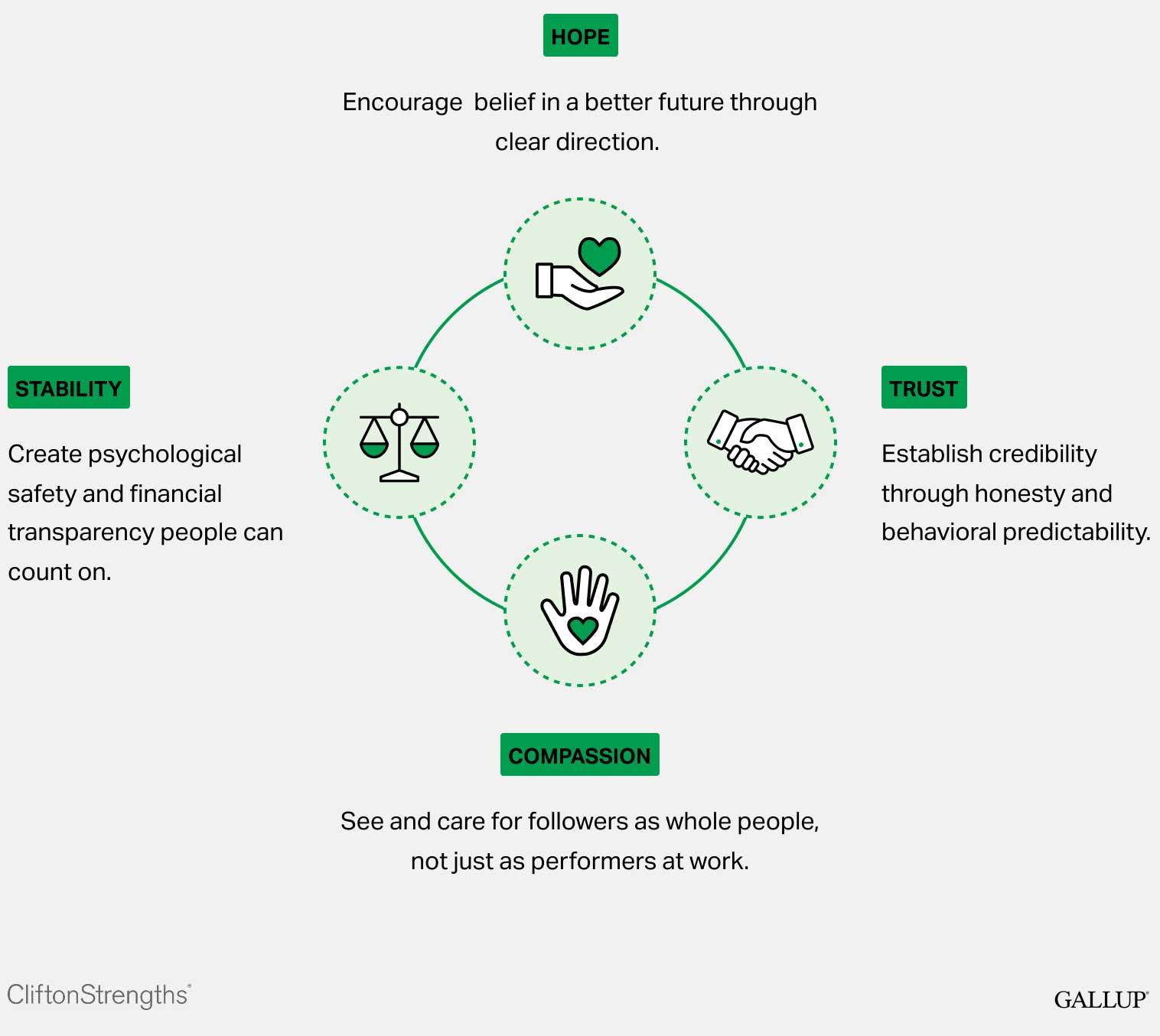
Gallup's Global Leadership Report: What Followers Want, based on surveys across 52 countries, reveals that followers around the world consistently prioritize four things from their leaders: hope, trust, compassion and stability.
-

Hope is the dominant need. In Gallup’s research, 56% of mentions of positive leadership traits relate to hope. When leaders meet followers' need for hope, thriving increases and suffering decreases.
-

Trust is foundational for effective leadership. Honest, clear communication and consistent behavior build trust. When followers trust their leaders, 1 in 2 are engaged; when they do not, only 1 in 12 are engaged.
-

Compassion means seeing people as whole individuals and looking beyond their output. Followers whose leaders demonstrate genuine care are more likely to advocate for their organization and support their colleagues.
-

Stability keeps people present and connected. When employees feel their job and organization are secure, they can focus and perform. Followers are 9x more likely to be engaged when they believe their company has a secure financial future.
The 4 Needs of Followers
The Business Case for Compassion
Caring leadership produces measurable business results. Gallup research on compassion finds that employees who feel their supervisor genuinely cares about them as a person are:
-
more productive in their daily roles
-
more profitable for their employers
-
more likely to stay with the organization long-term
-
better at creating engaged and loyal customer experiences
The return on caring is real. Leaders who are curious about what motivates and concerns their followers build a culture of performance that shows up directly on the bottom line.
What Are the Qualities of a Good Leader?
What Are the Qualities of a Good Leader?
Good leaders are authentic, self-aware, committed to growth and development, genuinely curious about the people they lead, and consistent in how they lead. Different leaders express these qualities in different ways, depending on their natural talents.
Qualities of a great leader include:
-
authenticity based on self-awareness, meaning you understand your natural strengths, your leadership style and how you affect others, then lead from that understanding rather than imitate someone else
-
a commitment to growth by investing in your own development and the development of those you lead
-
genuine curiosity about your people, what they need and what they do best
-
consistency in showing up reliably for your people and practicing the leadership behaviors that contribute to performance, development, and success

Authenticity Over Imitation
What makes a good leader? Effective leaders focus on being authentic. They lead from who they are rather than copying others. Being genuine relies on self-awareness: understanding your natural strengths, how they show up in your leadership and how they affect the people around you.
Leaders who know themselves make better decisions, engage their teams and support performance over time. Instead of trying to develop talents they don't naturally have, they build on what they do well and surround themselves with people whose strengths complement their own.
Growth, Curiosity and Consistency
The signs of a good leader show up in how they invest in their own and others' development, how well they know and care about their team members, and how reliably they follow through.
-
Growth: Through intentional practice, meaningful experiences and a willingness to keep learning, leaders invest in their own growth and create opportunities for others to develop.
-
Curiosity: Great leaders want to understand their people and what they need, what motivates them and what helps them thrive.
-
Consistency: Showing up, practicing the right behaviors and following through on commitments builds trust between leaders and their teams over time.
How Do Great Leaders Build Effective Teams?
How Do Great Leaders Build Effective Teams?
Great leaders build effective teams by positioning people to do what they do best and empowering them to work well together. Successful teams have leaders who align individuals' roles with their natural strengths, provide the resources and partnerships people need to perform, develop their team members, and set clear expectations so everyone knows where they're going and how they contribute.
Building an effective team requires leaders to:
-
know each team member's natural strengths and their own
-
match people to tasks and projects that fit their talents
-
identify complementary partnerships across the team
-
develop people continuously, not only when performance slips
-
set clear expectations and communicate them often

Learn and Apply Your Team's Strengths
Before a leader can build an effective team, they need to understand their team’s talents and dynamics. Gallup's CliftonStrengths® assessment gives leaders a clear picture of how each team member, including themselves, naturally thinks, feels, and behaves, and how those natural tendencies show up in their work.
Team talent composition matters. When people with complementary strengths collaborate, they make better decisions and achieve stronger results. Each person contributes in a different way, bringing out the best in the other, and strong partnerships help teams move faster and perform at a higher level.
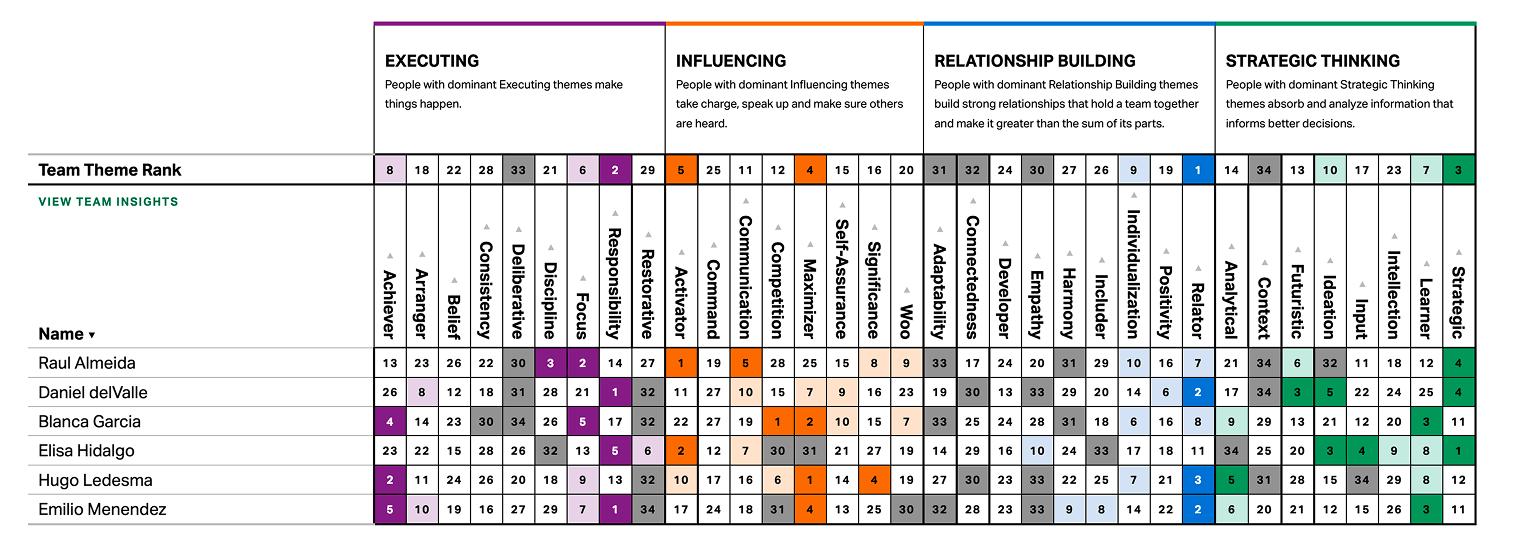
How to Lead People Using the CliftonStrengths Team Grid
The CliftonStrengths Team Grid is a practical tool that gives leaders a visual summary of their team's collective strengths across four domains: Executing, Influencing, Relationship Building and Strategic Thinking. It shows where the team's strengths are concentrated and where gaps exist.
With the Team Grid, leaders can:
-
match team members to projects based on where they can perform best
-
identify natural partnerships and collaboration opportunities
-
recognize domain gaps and plan how to address them
-
guide focused conversations about how the team works together
When a leader and team understand the team’s strengths makeup, collaboration improves and progress comes faster. The Team Grid is a practical tool that helps teams work smarter and accomplish more than they could alone.
Develop People Continuously
The best leaders don't wait for a performance review or an error in someone’s work to invest in their people. Gallup's employee engagement research shows that development is among the most powerful factors in engagement and that highly engaged teams see significantly lower turnover and stronger performance.
Leaders create a culture of development by making it a priority and equipping their managers to do the same. That means coaching team members through challenging assignments, helping people understand how their strengths apply to new situations, and having regular feedback and development conversations.
Set Clear Expectations and Build Trust
Trust develops when leaders set clear expectations, communicate often and follow through. Gallup research shows that when leaders lack clarity about their own roles and outcomes, it can cause their team members to lose trust in them.
Effective leaders discuss expectations often with individuals and the full team. They communicate where the team is going, what each person is responsible for, and how individual contributions connect to the larger goal so that every person can show up focused, confident, and ready to do their best work.
How Do I Become a Better Leader?
How Do I Become a Better Leader?
You become a great leader at work by understanding your natural talents, identifying how you lead and applying that knowledge to guide your team to high performance. Improve as a leader by building self-awareness using these three steps:
-
Identify your dominant strengths domain.
-
Identify your typical leadership style.
-
Examine how you lead across the domains.
Step 1. Identify Your Dominant Strengths Domain.
To understand how you naturally lead, start by identifying your dominant CliftonStrengths domain. Gallup studied more than 20,000 senior leaders and over 1 million work teams and found that every leader is dominant in one of four domains based on the 34 CliftonStrengths themes:
-
Executing themes make things happen and deliver results.
-
Influencing themes move others toward goals and make sure voices are heard.
-
Relationship Building themes encourage cohesion, trust and lasting connections.
-
Strategic Thinking themes absorb information, analyze situations and make sound decisions.
Step 2. Identify Your Typical Leadership Style.
You have strengths in all four domains, but one dominant domain where your natural talents are strongest and most energizing. That domain defines your typical leadership style:
-
Process-Oriented Leader
-
Impact-Oriented Leader
-
People-Oriented Leader
-
Thought-Oriented Leader
Four Domains and Related Leadership Styles
| Domain | Leadership Style | Natural Behavior |
|---|---|---|
| Executing | Process-Oriented Leader | Makes things happen and delivers results |
| Influencing | Impact-Oriented Leader | Moves others toward goals and ensures voices are heard |
| Relationship Building | People-Oriented Leader | Builds cohesion, trust and lasting connections |
| Strategic Thinking | Thought-Oriented Leader | Absorbs information, analyzes situations and makes sound decisions |
Step 3. Examine How You Lead Across the Domains.
Many leadership models ask you to identify or choose one style: Are you task-oriented or relationship-focused? Analytical or commanding? This approach limits how you see your leadership.
Gallup's approach focuses on how you lead across the domains based on your strengths. Every leader makes things happen, influences others, builds relationships and thinks strategically. With knowledge of your leadership style and strengths, you can develop your strongest leadership behaviors and create strategies for leading well in weaker areas.
For example, a Process-Oriented Leader doesn’t have the same natural strengths as a People-Oriented Leader, but both leaders can still build strong relationships by developing the Relationship-Building themes that are strongest for them. A Thought-Oriented Leader may not lead with the same natural influence as an Impact-Oriented Leader, but they can still inspire people to achieve their goals by focusing on their strongest Influencing themes.
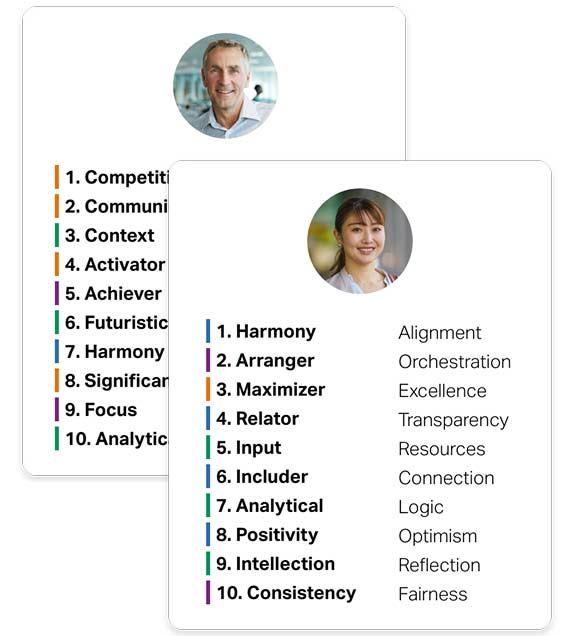
Even leaders who share the same style achieve results differently based on their unique combination of talents. If one Impact-Oriented Leader’s top themes include Communication® and Significance®, and another’s include Command® and Competition®, they’ll take entirely different approaches to leading their team.
Traditional methods of leadership discovery assign one leadership identity to you.
| I am task-oriented and like to get things done. | I can motivate others and can often be commanding. |
| I am analytical in my approach to leadership. | I focus on relationships and can understand where my followers are coming from. |
The four domains of leadership examine how you lead in different ways.
| How do you make things happen? | How do you influence others? |
| How do you absorb, think about, and analyze information and situations? | How do you build and nurture strong relationships? |
Understanding your dominant domain, leadership style and how you naturally apply your strengths each day is what makes strengths-based leadership so powerful. Instead of prescribing a single set of talents and methods that every leader must match, CliftonStrengths gives each leader a framework for becoming the best version of themselves and bringing out the best in those they lead.
Become a Strengths-Based Leader
Identify your leadership style, develop your leadership strengths and manage your weaker areas.
What Are Effective Leadership Skills?
What Are Effective Leadership Skills?
Gallup has discovered a set of research-backed core leadership skills that define how to be an effective leader. These behaviors emerged from three decades of Gallup research across 559 roles and 18 industries.
The 7 essential leadership skills are:
What Effective Leadership Looks Like in Practice
Effective leaders apply important leadership skills consistently and in recognizable ways to boost engagement and performance. Here is what the effective leadership practices look like in action:
-
Build relationships.
Effective leaders build connections because people won't follow someone they don't trust. They recognize the value of others, get to know their team members as individuals and build authentic, lasting relationships.
-
Develop people.
Development should be ongoing. Organizations that make a strategic investment in employee development are twice as likely to retain their employees and report 11% greater profitability, according to Gallup research on high-development cultures.
-
Lead change.
The key word is "lead." Effective leaders guide their teams while keeping the mission in focus. They involve their teams in the change process so everyone understands the direction and takes ownership of the outcome together.
-
Inspire others.
Inspiration is essential. Leaders connect daily work to a larger sense of purpose so that their teams see why their work matters. That sense of meaning fuels motivation and commitment to shared goals.
-
Think critically.
Effective leaders evaluate risks, organize their thoughts and develop clear plans instead of reacting in the moment. Their disciplined thinking leads to better decisions and more consistent results.
-
Communicate clearly.
Clear communication builds understanding, improves decision-making and strengthens trust. When employees strongly agree that their leaders communicate effectively, they are 73% less likely to feel burned out at work.
-
Create accountability.
Accountability is leadership’s greatest weakness. Gallup research shows that fewer than half of leaders (46%) rate themselves as outstanding at holding teams accountable, and managers rate their leaders even lower. Effective leaders make accountability a daily practice by setting clear expectations, consistently following through and applying fair standards across teams.
The Gap Between Leadership Self-Perception and Reality
For six of the seven expectations, managers rate their leaders at least 20 percentage points below how leaders rate themselves. This is a significant leadership blind spot that effective leadership development can address.
How Managers Rate Their Leaders vs. How Leaders Rate Themselves
% Exceptional/Outstanding
| Leadership Expectation | Managers' Ratings of Direct Leader | Leaders' Ratings of Themselves | Percentage-Point Difference |
|---|---|---|---|
| Create accountability | 30 | 46 | +16 |
| Build relationships | 33 | 54 | +21 |
| Inspire others | 32 | 57 | +25 |
| Communicate clearly | 33 | 58 | +25 |
| Lead change | 34 | 60 | +26 |
| Develop people | 32 | 60 | +28 |
| Think critically | 37 | 66 | +29 |
Aug. 5-19, 2025. Learn more about leadership ratings.
How Leadership Skills Connect to Your Leadership Responsibilities
Effective leadership behaviors help leaders meet four key leadership responsibilities: purpose, people, decisions and performance.
Leadership Responsibilities and Corresponding Behaviors
| Leadership Responsibility | Overview of Responsibility | Core Leadership Skill |
|---|---|---|
| Purpose | Leaders articulate a clear mission that defines what the organization stands for and who it exists to serve. |
Inspire others Communicate clearly |
| People | In larger organizations, leaders build alignment, trust, and cohesion across multiple leadership levels and communicate that foundation to every team. Gallup research shows that followers need their leaders to meet four core needs: hope, trust, stability and compassion. |
Build relationships Develop people |
| Decisions | Leaders navigate difficult choices by understanding their own strengths, recognizing their limitations, and seeking diverse perspectives to move the organization forward. |
Think critically Lead change |
| Performance | Leaders define what exceptional performance looks like, partner with managers to plan for results, and hold individuals and teams accountable for delivering on commitments and creating customer value. |
Create accountability |
Consistency Matters
Practicing the seven behaviors occasionally isn't enough. Followers notice when leaders show up reliably, follow through on commitments and apply the same standards day after day. That consistency is what makes the seven expectations productive rather than aspirational.
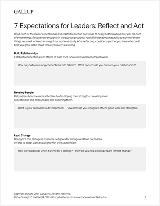
Seven Expectations for Leaders: Reflect and Act
How Do I Create a Leadership Development Plan?
How Do I Create a Leadership Development Plan?
A strong leadership development plan starts with knowing your natural strengths, building on your past experiences, and focusing on the experiences and skills you still want to develop. The most effective leadership development is individualized, ongoing and based on how you naturally lead.
To create a personal leadership development plan:
-
Discover your natural talents and how they show up in your leadership.
-
Reflect on the key experiences that have shaped you and what they taught you.
-
Identify the experiences, skills and growth you want to pursue next.
Step 1. Discover Your Strengths
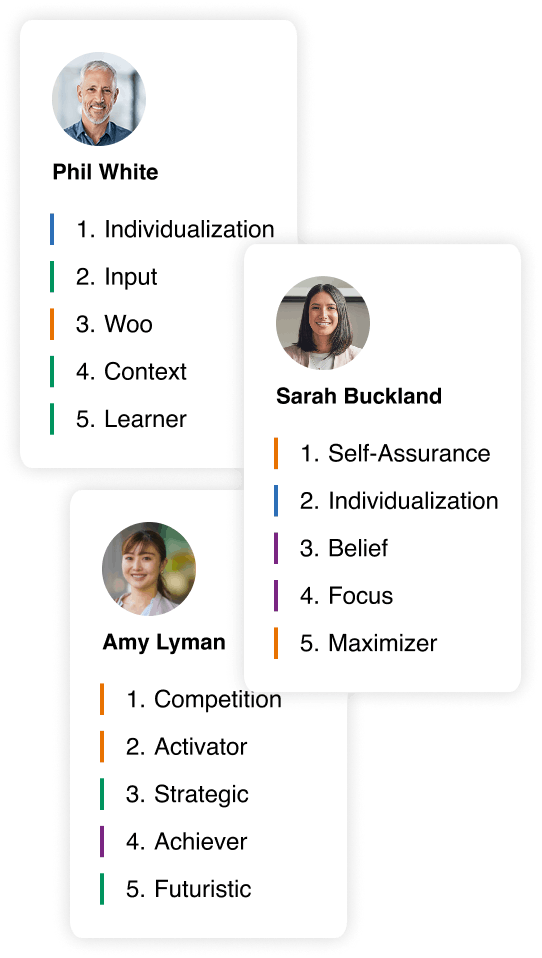
When you take the CliftonStrengths assessment, you receive a personalized report that identifies your natural talents and how they show up in your work. The CliftonStrengths for Leaders report goes deeper, offering insights and guidance on how to apply your unique strengths in a leadership role.
No two leaders have the same strengths in the same order. That's why your leadership development must begin with learning what makes you unique as a leader. From that foundation, you can build an effective action plan.
Step 2. Reflect on What Has Shaped You
Key experiences are among the most important factors in a leader’s success. These are the moments in a leader's life that result in learning, growth and increased skills for leading effectively. Before deciding where to go next, it helps to understand where you've been.
List the experiences that have had the greatest impact on your development as a leader. Then map them to Gallup's seven expectations and reflect on patterns in your experience:
-
Which expectations have you had the most opportunity to practice?
-
Which have you rarely been tested on?
-
Which behaviors feel uncomfortable?
-
Which behaviors feel natural in your day-to-day leadership?
Use these insights, along with your CliftonStrengths results and your dominant domain, to guide your direction in Step 3: identifying the experiences you want to pursue, the skills you want to build and the leader you want to become.
Step 3. Identify the Experiences You Want to Have
Once you understand your strengths and how your past experiences have shaped you, you can set clear leadership development goals and make intentional choices about what comes next.
Key experiences that develop leaders tend to share common threads: embracing new situations, working through uncertainty and staying engaged when challenges arise.
Use the examples below as a starting point to identify the development experiences you want to pursue.
Examples of key experiences for developing leaders:
-
working on assignments and projects outside one’s area of expertise
-
improving a struggling team, product or business
-
leading a cross-functional team on a high-priority project
-
experiencing failure and learning from it

Discover How to Improve Your Leadership Skills
Quick Leadership Q&A
Quick Leadership Q&A
Here are answers to some of the common questions about effective leadership.
What Is the Difference Between a Leader and a Manager?
The main difference is scope. Leaders set strategic direction, shape organizational culture and lead the people who lead others. Managers carry out that direction and work closely with their teams each day. As organizations change, the distinction is less rigid. Many managers now take on leadership responsibilities. Gallup finds that 70% of the variance in a team's engagement is influenced by the manager, which means today's managers also need leadership development.
What Are a Leader's Four Core Responsibilities?
Leaders are responsible for purpose, people, decisions and performance.
-
Purpose: Define a clear mission that explains what the organization stands for and who it serves.
-
People: Build alignment, trust and cohesion across teams while meeting followers' core needs.
-
Decisions: Navigate complex choices with self-awareness, diverse perspectives and clear thinking.
-
Performance: Establish what exceptional performance looks like and hold people accountable for achieving it.
What Are Some Examples of Effective Leadership?
Here are a few examples of effective leadership in practice:
-
A manager pairs two team members with complementary strengths, leading to faster, better work.
-
A leader communicates a clear vision during change, helping their team feel connected and confident rather than uncertain.
-
An executive holds weekly check-ins focused on coaching and recognition instead of status updates.
-
A leader addresses disengagement directly and quickly before it affects the team.
What Is Leadership Effectiveness?
Leadership effectiveness is how well a leader delivers results while supporting their people. It includes sustaining engagement, building trust and developing others. Employees experience leadership effectiveness through whether they feel trusted, inspired, heard and held to clear expectations. Effective leaders meet their responsibilities related to purpose, people, decisions and performance in ways that strengthen the organization over time.
Start Leading With Your Strengths
Start Leading With Your Strengths
Whether you're new to leadership or looking to sharpen your skills, your strengths are your greatest advantage.
Get personalized leadership insights and advice based on your CliftonStrengths results.
