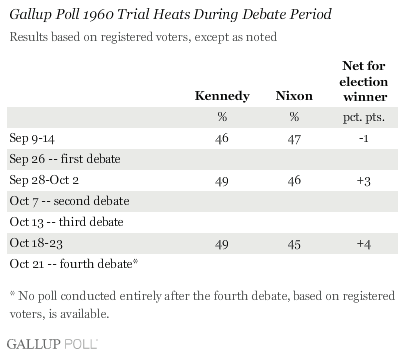
PRINCETON, NJ -- Gallup election polling trends since the advent of televised presidential debates a nearly a half-century ago reveal few instances in which the debates may have had a substantive impact on election outcomes. The two exceptions are 1960 and 2000, both very close elections in which even small changes could have determined who won. In two others -- 1976 and 2004 -- public preferences moved quite a bit around the debates, but the debates did not appear to alter the likely outcome.
Details
The presidential debates had little to no impact on voter preferences during the debate periods in 1984, 1988, and 1996.
The 1980 and 1992 debates may have influenced voter support for the third-party candidates running in those elections; however, they do not appear to have altered the structure of the races for the two major-party candidates.
-
In 1980, third-party candidate John Anderson fell from 15% support prior to his only debate (which was with Ronald Reagan) in late September to only 8% support by mid-October. However, given the long span between polls during this period, and the downward trend in Anderson's support prior to the debates, it is unclear whether his debate with Reagan was a factor.
-
In 1992, Ross Perot's generally well-reviewed debate performances (close to half of Americans thought he won the first debate, and the plurality thought he won the third debate) were no doubt part of the reason he catapulted from a 10% level of support prior to the first debate to 17% support after the last debate.
The 1976 and 2004 debates seem to have made the races more competitive, but they did not change the fundamentals of the races; the candidate leading before the debates eventually won the elections.
By contrast, the debates of 1960 and 2000 seem to have been associated with meaningful shifts in the horse races for those elections, whereby the ultimate winner moved from a deficit position to front-runner.
(In 1964, 1968, and 1972, incumbent president Lyndon Johnson and Republican nominee (and later President) Richard Nixon refused to debate their opponents, so no presidential debates were held in those years.)
1960
Perhaps the most fabled televised presidential debate was the very first: the Sept. 26, 1960, debate between Nixon and John F. Kennedy, in which a thin, pale, and stiff-looking Nixon sweated under the hot lights of the television studio, while Kennedy proved himself to be a highly telegenic master of the new medium.
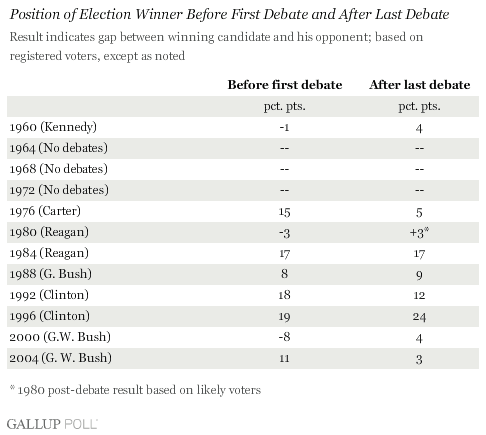
Gallup trends show that Kennedy and Nixon were about tied among registered voters in August and September polls leading up to that debate. Immediately after it, Kennedy was ahead by 3 percentage points, and ahead by 4 points by the time the fourth debate was held in late October. Given Kennedy's ultimate margin of victory in the popular vote of only two-tenths of a percentage point, it is clear the debates didn't produce a major shift in the structure of the election, but this debate-period boost in his support could very well have accounted for the outcome.
2000
In 2000, Al Gore led George W. Bush by 8 percentage points among registered voters right before the first debate (held Oct. 3). Although a Gallup debate-reaction survey that night found debate watchers closely divided in their views of who won (48% said Gore and 41% Bush), the post-debate media spin may have been more favorable to Bush. Gallup polling in the first three days after that debate showed the race tied at 43%.
Gore recovered somewhat before the second debate on Oct. 11 (leading by 5 points in a pre-debate poll) but Bush was again leading right after it, by 2 points. Gallup's debate-reaction survey on Oct. 11 showed 49% of debate watchers saying Bush won the debate, compared with only 36% picking Gore.
There was another shift toward Bush around the third debate (held Oct. 17), from a tie at 44% right before it, to a 4-point lead for Bush, 46% to 42%, immediately after it. Gallup's debate-reaction survey on this night showed the candidates again about tied in perceptions of who won: 46% for Gore and 44% for Bush. Debate watchers mostly credited Gore with expressing himself more clearly (57% for Gore vs. 33% for Bush) while Bush was seen as the more likable candidate, 60% to 31%.
Thus, across the entire 2000 debate period, the race shifted from an 8-point lead for Gore to a 4-point lead for Bush. Other campaign factors may have come into play to cause this, but Gallup analysts at the time assigned at least some of the shift to the debates themselves. Gore had been consistently ahead in the race (among registered voters) for most of September and October prior to the first debate, whereas Bush generally remained in the lead in most Gallup polling after the third and final debate. (The race tightened up in the last few days before Election Day, with Gore moving into a 1- to 2-point lead among registered voters.) Gore won the popular vote, but he might also have won the Electoral College vote had his 8-point pre-debate-period lead not slipped away in the last few weeks of the campaign.
Lesser Debate Impacts
-
In 1976, the debates may have made the race between Jimmy Carter and Gerald Ford more competitive, but they did not change the fact that Carter was ahead of Ford in Gallup polling throughout the debate period (and, of course, Carter won the election). Carter held a substantial lead over Ford among registered voters prior to the first presidential debate. Gallup polling found more Americans saying Ford than Carter won the debate, 38% to 25%, and perhaps as a result, Carter's lead shrank to only 2 points just prior to the second debate.
After Ford's statement about the lack of Soviet domination of Eastern Europe -- widely perceived as a gaffe -- Carter's lead expanded slightly to 6 points and remained at about that level after the third and final debate. The closer nature of the final outcome (a 2-point margin of victory for Carter) was most likely because of the difference between the preferences of all registered voters and those of actual voters.
-
In 2004, Bush went from holding an 11-point lead over John Kerry among registered voters just prior to the first debate on Sept. 30 to a 2-point lead right after it -- a 9-point loss for Bush. (A post-debate Gallup Poll found Kerry the perceived winner by a wide margin, 53% to 37%.) The race remained close thereafter: it was tied at 48% after the second debate, and Bush was up by 3 points after the third debate. Bush won the election by a 3-point margin, but it might have been larger had he performed better in the debates.
(It is of note that Gallup's 2004 debate-reaction polls showed Americans believing that Kerry won each debate; nevertheless, he still lost the election.)
The 1980 Carter-Reagan Debate
In 1980, Carter consented to only one debate with Reagan, held on Oct. 29, less than a week before Election Day. In an Oct. 24-26 Gallup Poll, Carter led Reagan by 3 percentage points, 45% to 42%, among national registered voters. A post-debate registered voter trial-heat figure is not available in Gallup's published records, but in Gallup's final pre-election poll of "likely voters," conducted Oct. 30 to Nov. 2, Reagan led Carter by 3 points, 46% to 43%. Without comparable pre- and post-debate registered voter figures on presidential preferences, it is unclear what impact the 1980 debate may have had on the election. However, given that Reagan won the election by nearly 10 percentage points, it is not likely to have been a determining factor.
Bottom Line
In two election years, the presidential debates may have had a meaningful impact on the structure of the presidential races; in most others, they probably have not. The debates were less likely to be catalyst events in years when one candidate was a strong front-runner, including 1984, 1988, and 1996. However, in highly competitive election years, any movement in voter preferences can be race altering, and the debates seem to have the potential to produce such movement. The probable examples of this are 1960 and 2000.
Given this, and the close nature of the race in recent Gallup Poll Daily tracking, the 2008 debates could be an important factor in shifting voter preferences decisively toward one candidate or the other. With so much economic uncertainty and political activity going on, however, it may be impossible to disentangle the effect of the debates from the effect of other news events on voter preferences at this critical time.
The complexity of real-world events confounding an analysis of the impact of the presidential debates is actually a problem that applies to a review of all of the elections; it's not a perfect science, and the conclusions drawn here could be debated.