A Gallup poll from June of this year* shows that trust in government is decaying following its post-Sept. 11 surge, but remains above where it was prior to the terrorist attacks. When Gallup asked Americans how much of the time they could trust the government in Washington, D.C., to do what is right, 45% of Americans said "just about always" or "most of the time," while half (51%) said only "some of the time." The percentage saying "just about always" or "most of the time" is down sharply from last October, at which time 60% gave this response. Still, the current figure is the second highest recorded by Gallup since 1992.
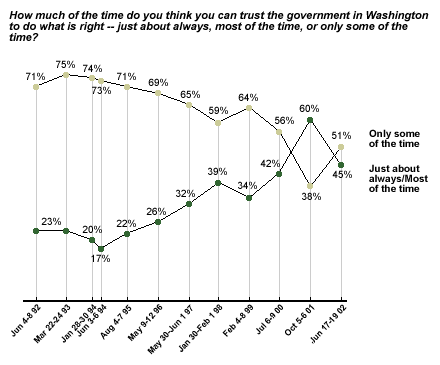
The response to this question when it was asked following Sept. 11 stands as evidence of a public surge in governmental trust during a time of crisis. This rally effect also manifested itself with well-documented increases in George W. Bush's approval ratings and Congress' approval ratings. Nevertheless, trust in government is still lower today than it was in the 1950s and '60s. According to University of Michigan's National Election Studies data, even the initial post-Sept. 11 reading on trust is lower than the levels observed as recently as 1968, when 61% of Americans trusted the government to do what was right always or most of the time.
International and Domestic Issues
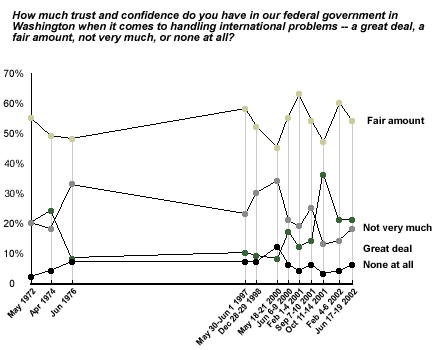
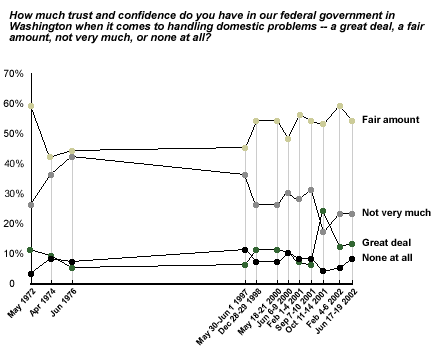
Public trust in the government's handling of both domestic and international affairs has also returned to more typical levels after surging in response to the terrorist attacks. Considering the international nature of the governmental reaction to the attacks, (i.e., the war on terrorism), it is not surprising that the rally was bigger for international issues than for domestic affairs.
Twenty-one percent of Americans currently say they have a "great deal" of trust in the way the government handles international problems. Another 54% say they have a "fair amount" of trust, while 18% say "not very much" and 6% indicate they have no trust at all. Public trust in this area remains relatively unchanged from February 2002, but trust is down significantly from last October. At that time, more than a third of the public (36%) said they had a "great deal" of trust in the way the government handled international problems. The 21% expressing a great deal of confidence in the government's handling of international problems is still higher than every reading Gallup has obtained since 1974, including the 14% measured immediately prior to the terrorist attacks.
Trust in the government's handling of domestic issues is also beginning to return to more normal pre-Sept. 11 levels. The June survey shows 13% of Americans say they have a "great deal" of trust in this regard and 54% have a "fair amount." Conversely, 23% say they do not have very much trust in the government's handling of domestic issues and 8% have none at all. In the fall of 2001, nearly a quarter of the public (24%) said they had a "great deal" of trust, while 53% had a "fair amount." Again, the 13% expressing a great deal of confidence in the government is higher than any pre-Sept. 11 measurement, and is more than double what Gallup observed in a Sept. 7-10 poll.
Key Points
Public trust in government, both on international and domestic issues, has clearly waned since Sept. 11, but is still stronger than before the terrorist attacks. The upcoming mid-term election campaigns will give Americans an opportunity to hear elected officials address a broad range of domestic and international issues -- the results will help determine whether the Sept. 11 rally effect will linger well into the next year, or largely fade away.
*Results are based on telephone interviews with 1,005 national adults, aged 18 and older, conducted June 17-19, 2002. For results based on the total sample of national adults, one can say with 95% confidence that the maximum margin of sampling error is ±3%.