Charter schools -- public schools of choice that are exempt from certain state or local rules and regulations that govern traditional public schools -- have proliferated in the United States since the first ones opened in 1992. It appears the American public may be warming to the idea of these alternative public schools.
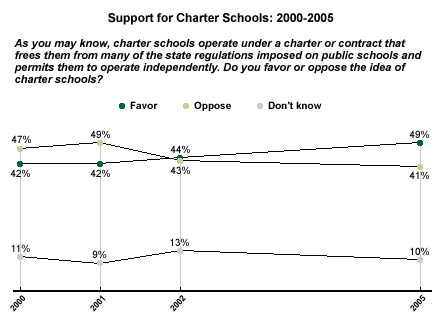
Today, about half of all Americans (49%) favor the concept of charter schools, according to the most recent Phi Delta Kappa/Gallup Poll of the Public's Attitudes Toward the Public Schools*. Over the last several years, slightly fewer Americans have favored the idea, with support ranging from 42% to 44% from 2000 to 2002.
Two Schools of Thought
The first charter school law was passed in Minnesota in 1991 as one of an ongoing series of ideas to improve U.S. public schools. Once a charter school is established within a school district, parents are free to choose it instead of a mainstream public school for their child. Generally, if there is not enough space available at a charter school for everyone who wants to attend, a public lottery takes place to establish the student body.
Proponents of the concept say that absent the constraints of some state rules and regulations, charter schools are free to develop creative approaches to teaching, the most successful of which can be duplicated in traditional schools. Opponents say charter schools not only drain public tax dollars away from the traditional schools, but they take the most academically gifted students with them, stripping mainstream public schools of the most actively involved parents in the process.
"We haven't had that experience," says Jennifer Langer, executive director of the New Jersey Charter Public Schools Association. "Nothing indicates that kids in our state are coming in at a higher academic level -- in fact they are coming in at a lower level …We educate a lot of immigrant children with language barriers, special education children, and those with behavioral problems who need more discipline than they receive in the regular schools."
Devil in the Details
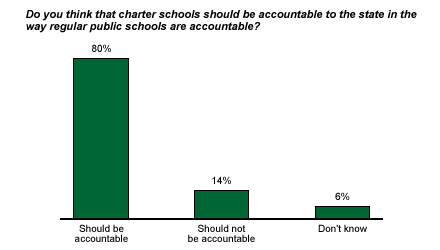
Although more Americans favor the idea than ever before, they do believe charter schools should be just as accountable to the state as public schools. In the poll, 80% of Americans hold this view, a figure that hasn't changed appreciably since 2000.
Since charter school accountability varies widely from state to state, it can be a difficult issue for people to fully grasp. "In New Jersey, for instance," says Langer, "there is no flexibility on accountability. Our charter schools are bound by the same core curriculum, standardized testing, and teacher certification as the regular public schools."
Funding Issues
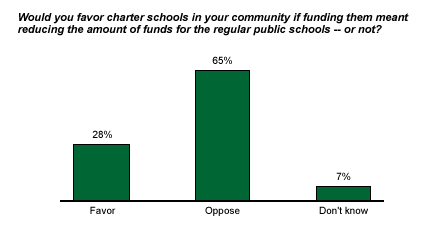
Sentiment toward the funding of charter schools has remained steady since 2002, when the PDK survey first asked Americans about it. Sixty-five percent say they would oppose charter schools in their local communities if they took money away from the regular public schools.
"When they [Americans] find out that their taxpayer dollars are being spent on these schools which, in many instances, have much less oversight over the financial dealings and maybe have fewer quality standards in place (like requirements about teacher certification, etc.) and that they aren't held to the same standards as mainstream public schools -- they are wary. And they should be," says Denise Cardinal, a spokeswoman for the National Education Association. "Charter schools are public schools; they use public dollars and there needs to be security measures in place to protect the students, parents, and taxpayers from the possibility of misuse when it comes to charter schools."
Bottom Line
Nearly 3,400 charter schools operate in 40 states, serving roughly 1 million students, according to Colleen Sutton, director of communications at the National Alliance for Public Charter Schools in Washington, D.C. Sutton says that represents 2% of the total K-12 school population in the United States. As the growth trend continues and more children become charter school students, it will allow for a better assessment of their efficacy compared with traditional public schools. To date, it is unclear whether charter schools are better described as creative educational laboratories as their proponents suggest or as an unnecessary drain of talent and taxpayer dollars away from traditional public schools as their opponents assert.
*This article contains findings from the 37th Annual Phi Delta Kappa/Gallup Poll of the Public's Attitudes Toward the Public Schools, released on Aug. 23 in Washington, D.C.
The findings of the survey are based on telephone interviews with a random sample of 1,000 U.S. adults, aged 18 and older, conducted from June 9 to June 26, 2005. For results based on this sample, one can say with 95% confidence that the maximum error attributable to sampling and other random effects is ±3 percentage points.