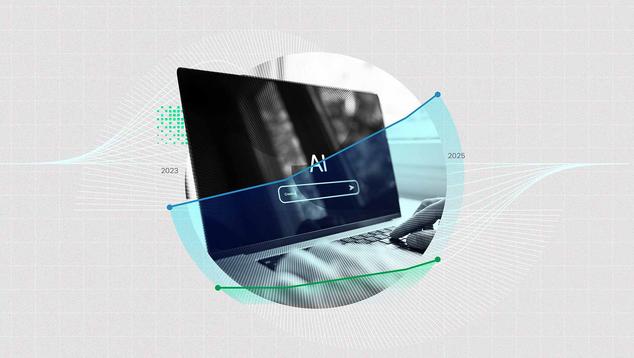
U.S. employees already using artificial intelligence (AI) in the workplace used it slightly more often in the fourth quarter of 2025 than in the prior quarter, continuing a gradual increase since 2023. The proportion of employees using AI daily has risen from 10% to 12%. Frequent use, defined as using AI at work at least a few times a week, has also inched up three percentage points to 26%.
These increases are on par with the expansion of frequent workplace AI use reported throughout 2025. Meanwhile, the percentage of total users, those who use AI at work at least a few times a year, was flat in Q4 after sharp increases earlier in the trend. Nearly half of U.S. workers (49%) report that they “never” use AI in their role.
Organizational AI adoption has not changed meaningfully from the previous quarter. In Q4, 38% of employees said their organization has integrated AI technology to improve productivity, efficiency and quality. Forty-one percent said their organization has not implemented AI tools, and 21% said they don’t know. These results closely mirror Q3 figures.
AI Use Varies by Industry and Role Type
AI use in the workplace is most prevalent in knowledge-based industries and least common in production and service-based sectors. Employees in technology, finance and higher education report the highest levels of AI use, especially compared with U.S. employees in retail, manufacturing and healthcare.

Line charts show trends in workplace AI use by industry among U.S. employees, from 2023 to 2025. Across all industries, total AI use increases over time, with notable variation in adoption levels. Technology shows the highest use, with total AI use at 77%, including 57% frequent users and 31% daily users. College or university and finance also report high adoption, with total AI use at 63% and 64%, respectively. Professional services reaches 62% total AI use, including 36% frequent and 16% daily users. K-12 education shows rising use to 56% total AI use. Community or social services, government or public policy, healthcare and manufacturing show more moderate adoption, with total AI use ranging from about 41% to 43%. Retail reports the lowest adoption, with total AI use at 33%, including 19% frequent users and 10% daily users.
Gains in AI use were uneven across industries in Q4. The total AI user base increased most in finance and professional services, moving up six and five points, respectively. These increases widened existing gaps between higher-growth industries and those with lower AI use. In retail, total AI use did not increase in Q4 from Q3, while manufacturing saw a three-point increase.
In industries such as technology where AI use has been most prevalent, growth in total users shows signs of leveling, with gains found primarily among those already using AI. Total AI use in technology increased by just one percentage point in Q4, from 76% to 77%, while frequent use rose from 50% to 57%.
Across industries, AI use is concentrated in roles that employees describe as remote-capable, meaning the job could reasonably be completed remotely regardless of where the employee actually works. These roles are typically desk- and office-based positions.
Since Q2 2023, total AI use among employees in remote-capable roles has increased from 28% to 66%, while frequent use has risen from 13% to 40%. Growth has been slower in roles that are not remote-capable: AI use in these positions has increased from 15% to 32%, with frequent use rising from 8% to 17%.

Line charts compare AI use among U.S. employees in remote-capable and non-remote-capable roles from 2023 to 2025. Employees in remote-capable roles show substantially higher AI adoption throughout the period. By 2025, total AI use among remote-capable employees reached 66%, including 40% who use AI frequently and 19% who use it daily. Employees in non-remote-capable roles reported much lower use. In the most recent data, total AI use among these employees is 32%, with 17% using AI frequently and 7% using it daily.
Leaders Continue to Use AI More Than Other Employees
Employees in leadership positions are more likely than managers and individual contributors to use AI at work. In Q4, 69% of leaders said they use AI at least a few times a year, compared with 55% of managers and 40% of individual contributors. Part of this difference likely reflects role type, as leaders are more likely to hold office-based and remote-capable roles where AI tools are more easily applied.

Line graph. Percentages of Americans who think the coronavirus situation in the U.S. is getting a lot or a little better, staying the same, or getting a lot or a little worse, from April 2020 to February 2022. In the latest poll, 63% of U.S. adults said it is getting better, up from 20% in January. Twelve percent said it is getting worse, down from 58% in January and 25% say said it is staying the same, relatively unchanged.
Leaders also report more frequent AI use than other employees, a gap that has widened over time. Since Q2 2023, frequent AI use among leaders has risen from 17% to 44%. Over the same period, frequent use among managers has doubled from 15% to 30%, while frequent use among individual contributors has increased from 9% to 23%. Frequent use has risen among all three types of workers since Q3, contributing to the overall climb in Q4.
Implications
Modest gains in frequent AI use were seen in Q4 2025, on par with the growth seen in Q3, but the percentage of employees who say they use AI overall remained flat. Use remains most prevalent in knowledge-based industries and remote-capable roles. These differences in AI adoption may help to explain why overall adoption appears to be slowing, even as AI use continues to deepen within certain segments of the workforce.
Leaders, in particular, report substantially higher and more frequent AI use than other employees, and that separation has grown over time. Gallup research shows that lack of utility is the most common barrier to individual AI use, suggesting that clear AI use cases may be more apparent for leaders than employees in other roles. For organizations integrating AI technology, this underscores the importance of grounding decisions about AI adoption in a clear understanding of how AI may be applied to different roles and functions, not just among those closest to decision-making.
Gallup’s newest indicator tracks workplace AI adoption over time, including usage frequency, employee comfort, manager support, organizational integration and strategic communication. Explore all of our indicators for global data on what matters most in the workplace and to societies at large.
Lead AI adoption with intention and clarity.
- Explore strategies for promoting AI adoption in ways that support productivity, quality and long-term performance.
- Learn why managers play a critical role in supporting AI adoption and influencing how AI is used in day-to-day operations.
Learn more about how the Gallup Panel works. View complete question responses and trends (PDF download).