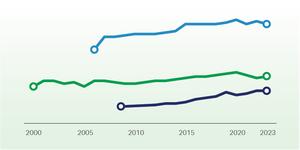
The percentage of U.S. employees who are actively engaged at work averaged 31% in 2025, unchanged from 2024, according to Gallup’s employee engagement survey. This follows several years of decline from a high of 36% in 2020, which came after a decade of steady growth.
Each percentage-point change in active engagement at work represents approximately 1.6 million full- or part-time employees in the U.S. The declines since 2020 equate to about 8 million fewer engaged employees over five years, with 3.2 million fewer engaged workers compared to 2023 alone.
Biggest Workplace Engagement Declines Among Youngest Workers
Between 2020 and 2025, younger U.S. workers experienced the largest drops in engagement. The percentage of Generation Z and younger millennials who are engaged at work dropped by eight points, while older millennials (born 1980 to 1988) dropped by nine points. Generation X declined in engagement by six points, and baby boomers saw no change in engagement since 2020.
In what ways is engagement suffering for younger members of the U.S. workforce? The data show that Generation Z and young millennials are reporting the biggest drops in feeling cared about, having opportunities to learn and being developed at work.
Generation Z and younger millennial employees were 13 points less likely in 2025 (41%) than in 2020 (54%) to strongly agree with the statement “My supervisor, or someone at work, seems to care about me as a person.” Agreement with the statement “This last year, I have had opportunities at work to learn and grow” also fell 11 points, to 37% from 48% in 2020.
The largest declines in older millennials’ engagement follow a similar pattern, with feeling cared about down 12 points since 2020 and having opportunities at work to learn and grow down 11 points.
Decline in Employee Engagement Comes Down to Basic Needs: Communication, Respect
Clarity about what is expected at work and feeling cared about as a person show the largest declines among Employee Engagement Index items since 2020 for all U.S. employees (nine and eight points, respectively). To better understand this decline, Gallup conducted qualitative analysis on responses to open-ended survey questions, asking employees to elaborate on their experiences related to these items.
The analysis revealed that 35% of respondents said better communication would most help them gain clarity about what is expected at work. Smaller percentages mentioned direction from leadership (7%), additional development (6%), or recognition and culture (5%) as ways to help them gain greater clarity of expectations.
The qualitative data showed that U.S. workers are seeking more communication about both the direction of their company and their own individual development. For example, one employee said that one thing that would clarify expectations is “greater transparency from management regarding firm strategy, goals and decision-making.” Other respondents focused more locally: “Communication from management and conversation on where my career and the department are going” and “more regular, consistent communication from my manager.”
To feel more cared about at work, 34% said supportive relationships, communication and respect would help, while 23% mentioned pay, benefits and security. Another 11% cited work environment and balance, while 4% said growth and future opportunities would help them feel more cared about.
The qualitative data revealed that employees mostly want to feel cared about at work. For some, that means fair compensation: “Paying me my worth. I shouldn’t be struggling to make ends meet.” For others, it means being taken seriously when concerns are raised. As one employee explained, “If I felt listened to. If we have a complaint, the response is always, ‘remember why you’re here' or ‘have more grace’ or ‘practice gratitude,’ which is not solving the problem and making us feel bad for even bringing something up that we need worked on.”
Employees at All Levels Unclear on Exceptional Performance
Gallup data show that leaders (defined as senior leaders or leaders who manage other managers) are 10 points more likely than people managers, project managers and individual contributors to report that they know what exceptional performance looks like for their role.
That said, overall clarity on what constitutes exceptional performance is low. Less than a third of leaders strongly agree that they have a clear definition of excellence, while about one in five among all other employees say the same.
Strong agreement that there is a clear definition of exceptional performance is highly correlated with being engaged at work. Managers and individual contributors who have this clarity are nearly four times as likely as those without it to be engaged. Leaders are nearly three times as likely to be engaged if they have clear expectations for exceptional performance.
What Leaders Can Do in 2026
Employee engagement has declined after a decade of steady improvement leading up to the COVID-19 pandemic. The data suggest that many of the gains organizations made in clarifying role expectations, developing people and improving the day-to-day experience at work have stalled — and, in some cases, have begun to reverse. Younger workers appear particularly vulnerable in this environment, as they are more likely to be early in their career and more dependent on clear expectations, feedback and development.
The erosion of role clarity is especially concerning. When expectations are unclear, engagement suffers, particularly among employees who are still learning how to succeed in their role. During periods of ongoing change and uncertainty, clarity becomes more important, not less. Organizations with employee engagement initiatives that restore overall clarity in performance objectives within roles will be better positioned to improve and sustain engagement over time.
Focus on the factors that matter most to improving employee engagement in your workplace.
- Gallup is always measuring employee engagement. See the latest global engagement data by exploring our employee engagement indicator.
- Act on what drives engagement with Gallup’s research-backed improvement guide.
- Strengthen performance and retention with Gallup’s proven employee engagement framework and solutions.