Evolution means different things to different people. Some see Charles Darwin's theory as indisputable scientific fact. Other people claim evolution is just an unproven hypothesis, and believe the biblical story of creation -- in which God created humans in their current form -- is indisputable. There are, of course, countless nuanced opinions that fall somewhere in between.
Many battles have been waged over whether and how evolution or creationism (or both) should be taught in the nation's schools. The most recent Gallup Youth Survey* asked U.S. teenagers what they think about man's origins and found predictably mixed feelings.
How Did We Get Here?
Gallup asked teens (aged 13 to 17) to choose from three different statements on the origin of human beings: 1) humans developed over millions of years, but God guided the process; 2) humans developed over millions of years, but God had no part in the process; or 3) God created humans pretty much in their present form within the last 10,000 years or so. A plurality of teens (43%) choose the "middle-ground" option, believing God guided human evolution over millions of years. More than a third of teens (38%) choose the "creationist" option -- that God created humans pretty much as they are now. Only 18% of teens choose the "evolutionist" view -- that humans evolved over millions of years with no help from God.
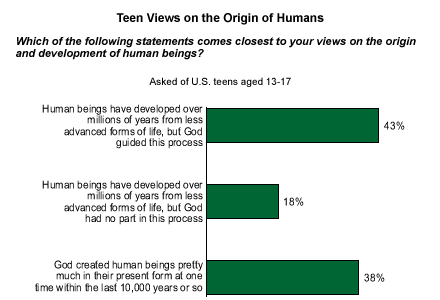
Gallup asked this same question of U.S. adults in a November 2004 poll**. The results are similar, although slightly more adults (45%) believe God created human beings in their present form within the last 10,000 years or so. Thirty-eight percent of adults say humans evolved over millions of years with God's guidance, and only 13% believe human beings evolved without God's help.
Why are teens slightly more likely than adults to choose an evolutionist theory of human origin? One possible explanation is evolution did not begin to gain prominence in school curricula until the 1960s -- therefore many older adults may never have learned about Darwin's theory. Further, many of today's teenagers have recently studied evolution in school (or are currently studying it), so the subject may be fresh in their minds.
Darwin's Theory: Fact or Fiction?
Gallup also posed a more direct question about evolution to teens, asking them if they believe Darwin's theory of evolution is: 1) a scientific theory that is well supported by evidence, 2) just one of many theories and has not been well supported by evidence, or 3) they don't know enough to say. Thirty-seven percent think evolution is a theory well supported by evidence, 30% say it is not well supported by evidence, and 33% don't know enough to say.
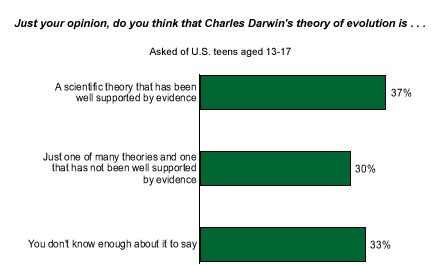
While teens show a slight tilt in favor of Darwin's theory, adults are divided -- 35% say Darwin's theory is well supported by evidence and 35% think it is not. Twenty-nine percent aren't sure.
Bottom Line
In 1925, Tennessee high school biology teacher John Scopes was put on trial for teaching evolution, which was illegal in the state at that time. Education has changed considerably since the famous "Scopes Monkey Trial," but the debate about teaching evolution hasn't ended. Legal battles continued throughout the 20th century, and the Kansas state school board is still debating whether "alternatives" or "challenges" to evolution theory should be included in school curricula. A 10-day hearing on the subject will take place this spring.
Data from Gallup Youth Surveys and adult surveys alike reinforce the notion that evolution is far from a foregone conclusion among large numbers of Americans.
*These results are based on telephone interviews with a randomly selected national sample of 1,028 teenagers in the Gallup Poll Panel of households, aged 13 to 17, conducted Jan. 17 to Feb. 6, 2005. For results based on this sample, one can say with 95% confidence that the maximum error attributable to sampling and other random effects is ±3 percentage points. In addition to sampling error, question wording and practical difficulties in conducting surveys can introduce error or bias into the findings of public opinion polls.
**Results are based on telephone interviews with 1,016 national adults, aged 18 and older, conducted Nov. 7-10, 2004. For results based on the total sample of national adults, one can say with 95% confidence that the maximum margin of sampling error is ±3 percentage points.