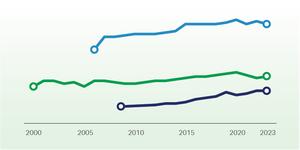
LONDON — Optimism about the local job market among employees in Europe stayed at record highs in 2025, even though engagement in their own jobs remained among the lowest of any region in the world.
In 2025, 57% of European workers said it was a good time to find a job in their local area, stable compared with the previous year and higher than at any point in the long-term trend. These data are based on three-year rolling averages.
The first year with globally comparable data, 2011, marked the low point for European workforce optimism: Just 17% of employees said it was a good time to find a job locally in the aftermath of the global financial crash and the onset of the Eurozone crisis.
The proportion then increased in an almost linear fashion for much of the following decade, before the COVID-19 pandemic temporarily stalled the trend. By 2023, it had crossed the 50% level for the first time, and it has held at 57% since 2024.
Largest Gain in Job Market Optimism of Any Region
In 2011, European employees were more pessimistic about their local job prospects than those in any other global region. Unemployment across the European Union rose from 7.2% in 2008 to a peak of 11.4% in 2013 as the crisis deepened.
Since then, the 40-percentage-point increase in optimism among European employees is the largest of any region in the world. Post-Soviet Eurasia (+33 points) and East Asia (+22 points) saw significant but smaller gains, and now stand at levels comparable to Europe’s.
Employees in most regions are more optimistic about local job conditions than they were in 2011, though the United States and Canada are an exception. There, the current figure of 47% is roughly on par with 2011 levels, representing one of the few regions where job market sentiment is no higher today than it was in the first year of measurement after the financial crash.
At the country level since 2011, the 10 largest increases in job market optimism globally are all from Europe. Each of these countries had a small minority of employees in 2011 who said it was a good time to find a job. Now, at least three in five say the same. The countries span the continent: the Netherlands, Ireland, Greece, Slovenia, Denmark, Cyprus, Croatia, Bosnia and Herzegovina, Lithuania and the Czech Republic.
Employee Engagement in Europe Continues to Lag
Despite consistent gains in job market optimism over the past decade and a half, European employees' day-to-day experiences at work are not improving. In 2025, just 12% of employees across Europe were engaged in their jobs — a figure that has been broadly stable since 2012 and is significantly below the global average of 20%. No other region records lower employee engagement, a proxy for cultural ambition.
Low engagement is linked to lower employee productivity, higher absenteeism and greater staff turnover. The share of actively disengaged European employees — those who are psychologically detached from their employer — stood at 15% in 2025. That is down from an average of 21% between 2011 and 2014, but still higher than 2025’s 12% of engaged employees. Europe is one of only two regions, alongside the Middle East and North Africa (MENA), where more employees are actively disengaged than engaged.
Even so, Europe does not have the highest rate of active disengagement of any region. MENA leads at 25%, followed by South Asia (20%), Sub-Saharan Africa (18%), the United States and Canada (17%), and East Asia (16%).
On the basis of actively disengaged employees, European managers aren't significantly worse at people management than their peers elsewhere, but they haven't cracked the leadership code on engaging employees as much as their counterparts in other regions. Even within Europe, there are specific companies where six out of 10 employees are engaged, according to Gallup data. These best-practice companies actively prioritize training, coaching and investing in people, a set of employee engagement strategies that many other managers across Europe could follow.
Bottom Line
Across Europe, workers are increasingly confident that they could get a new job but are not finding meaning or motivation in the one they have. Low workplace engagement has negative consequences for productivity and growth, both of which have been sluggish in Europe in recent years. Europe’s economy faces many challenges in the years ahead from workforce trends such as overseas competition, artificial intelligence and an aging workforce. Tackling these challenges will mean fixing the continent’s broken workplaces.
Additional Steps
- Download the State of the Global Workplace report to explore employee engagement best practices and better understand the global engagement trends impacting your workforce.